Astronomy Explainer Video Maker
Turn complex astronomy concepts into stunning explainer videos without editing. Agent Opus is an astronomy explainer video maker that transforms your script, outline, or blog post into a finished video complete with AI motion graphics, dynamic visuals of planets and galaxies, voiceover, and social-ready formatting. Describe black holes, exoplanets, or stellar evolution in plain text and get a publish-ready astronomy video in minutes. No timeline, no stock footage hunting, no manual compositing. Just prompt to video.

Explore what's possible with Agent Opus

Reasons why creators love Agent Opus' Astronomy Explainer Video Maker
Consistent Visual Quality
Maintain professional-grade visuals across every explainer so your channel looks polished from first video to hundredth.
Publish While It's Relevant
Cover breaking space discoveries and celestial events before the news cycle moves on without you.
Authority Without the Camera
Build credibility as an astronomy educator even if you're camera-shy or lack on-screen presentation experience.
No Equipment, No Problem
Skip expensive telescopes and studio setups while still delivering cinematic space content that captivates viewers.
Scale Your Teaching Impact
Create an entire astronomy curriculum or series without burning out on production timelines and costs.
Complex Concepts Made Clear
Turn abstract astronomical phenomena into visual stories your audience actually understands and remembers.
How to use Agent Opus’ Astronomy Explainer Video Maker
 1
1Describe your video
Paste your promo brief, script, outline, or blog URL into Agent Opus.
 2
2Add assets and sources
Upload brand assets like logos and product images, or let the AI source stock visuals automatically.
 3
3Choose voice and avatar
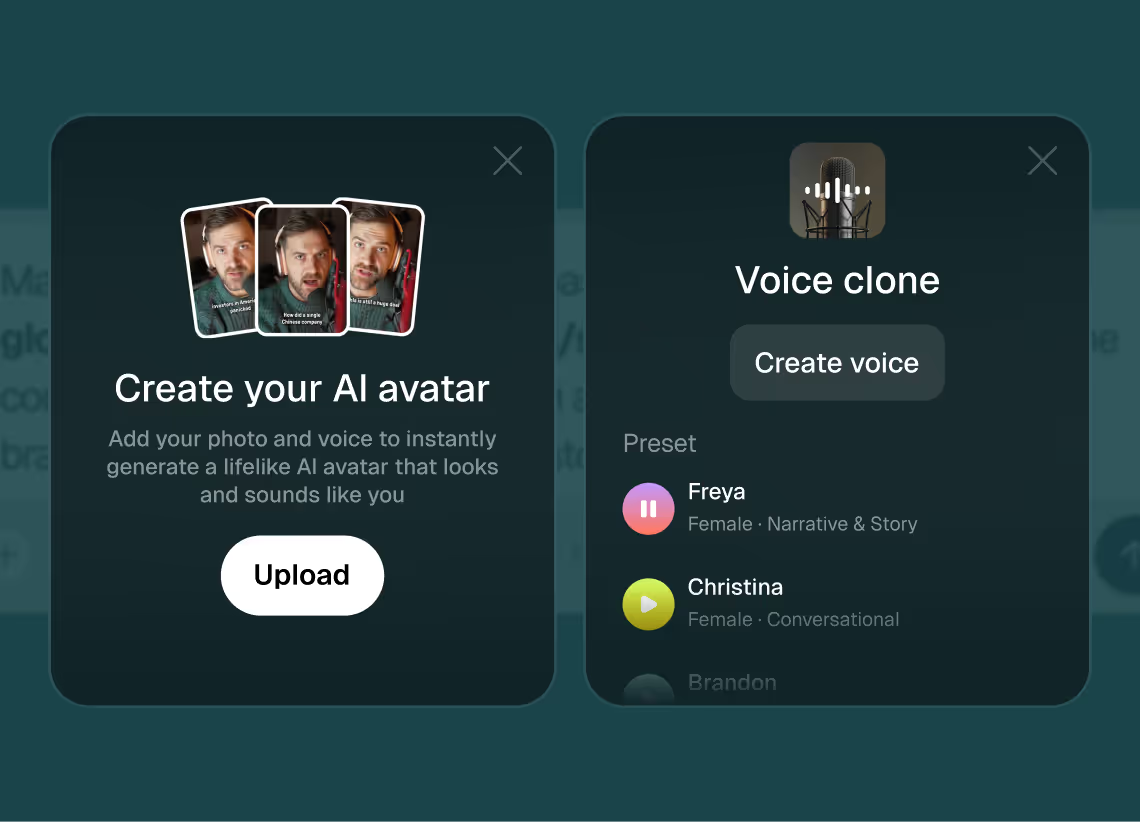
Choose voice (clone yours or pick an AI voice) and avatar style (user or AI).
 4
4Generate and publish-ready
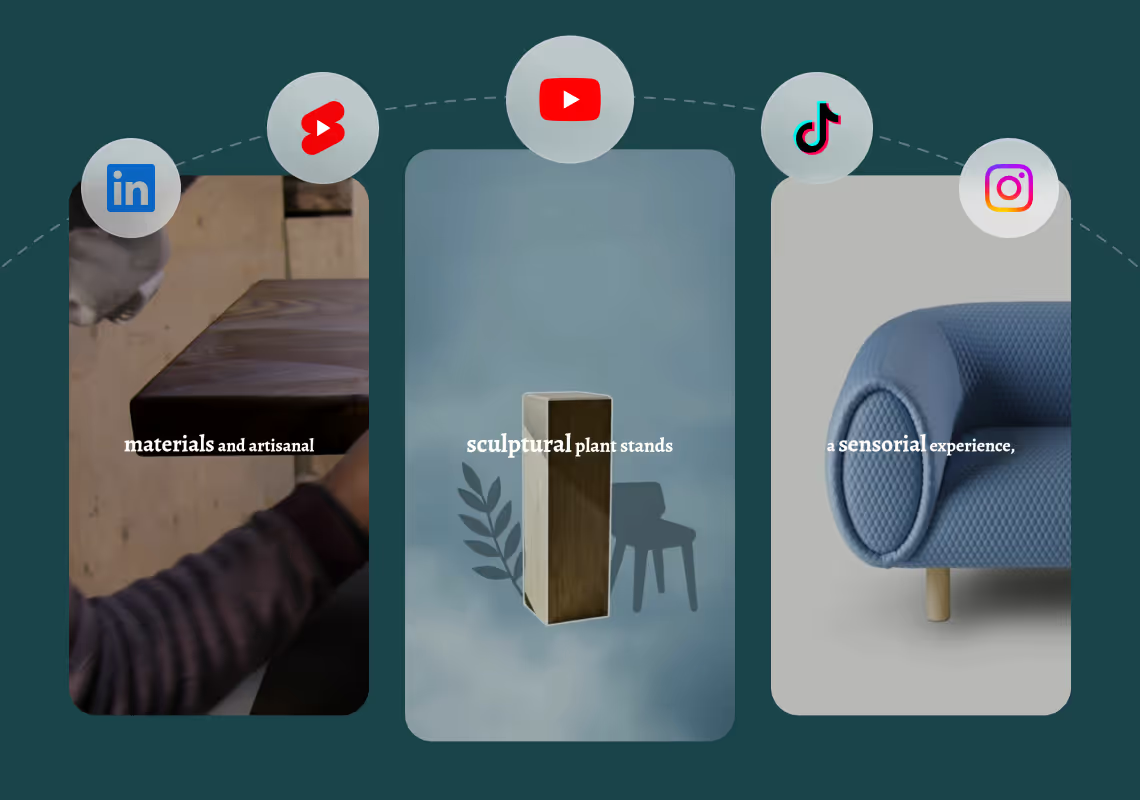
Click generate and download your finished promo video in seconds, ready to publish across all platforms.


8 powerful features of Agent Opus' Astronomy Explainer Video Maker
Educational Astronomy Content
Create classroom-ready explainer videos covering constellations, eclipses, and cosmic events.
Space Science Storytelling
Build narrative-driven astronomy videos that captivate audiences and simplify cosmic concepts.
Cosmic Visuals Generated
Generate stunning space imagery, planets, and galaxies from simple text descriptions.
Astrophysics Made Simple
Convert complex theories into digestible video explainers with clear narration and graphics.
Text to Astronomy Video
Turn written explanations of celestial phenomena into engaging visual videos instantly.
Animated Star Maps
Transform star charts and astronomical data into dynamic, animated video sequences.
Solar System Walkthroughs
Generate guided video tours of planets, moons, and asteroids with accurate visuals.
Narrated Space Concepts
Add AI voiceover to explain black holes, orbits, and stellar evolution clearly.
Testimonials
This looks like a game-changer for us. We're building narrative-driven, visually layered content — and the ability to maintain character and motion consistency across episodes would be huge. If Agent Opus can sync branded motion graphics, tone, and avatar style seamlessly, it could easily become part of our production stack for short-form explainers and long-form investigative visuals.
srtaduck
I reviewed version a and I was very impressed with this version, it did very well in almost all aspects that users need, you would only have to make very small changes and maybe replace one of 2 of the pictures, but even saying that it could be used as is and still receive decent views or even chances at going viral depending on the story or the content the user chooses.
Jeremy
all in all LOVE THIS agent. I'm curious to see how I can push it (within reason) Just need to learn to get the consistency right with my prompts
Rebecca
Frequently Asked Questions
How does an astronomy explainer video maker handle technical scripts versus simple prompts?
Agent Opus as an astronomy explainer video maker adapts to both detailed technical scripts and high-level prompts with equal fluency. If you provide a full script with specific terminology like redshift calculations, Hertzsprung-Russell diagrams, or Chandrasekhar limits, the system parses each concept and sources visuals that match the precision of your language. It identifies key terms, finds relevant imagery of spectra, star charts, or simulation data, and times motion graphics to align with your narrative beats. For example, a script explaining Type Ia supernovae will trigger visuals of white dwarf binaries, accretion disks, and light curve graphs, all sequenced to match your voiceover pacing. Conversely, if you submit a simple prompt like 'Explain why Mars is red in under 60 seconds,' Agent Opus generates a concise script, selects surface imagery showing iron oxide dust, and adds motion graphics highlighting mineral composition. The astronomy explainer video maker uses natural language processing to detect whether you want a deep dive or a quick overview, then adjusts scene complexity, visual density, and pacing accordingly. Technical scripts benefit from longer scene durations and detailed diagrams, while short prompts yield punchy visuals and faster cuts optimized for social platforms. You can also mix formats by providing an outline with bullet points and Agent Opus will expand each point into a narrated scene with supporting visuals. This flexibility means the same tool serves PhD-level astrophysics lectures and 30-second TikTok hooks about black holes without requiring you to switch workflows or learn different interfaces.
What are best practices for prompts when using an astronomy explainer video maker?
Effective prompts for an astronomy explainer video maker balance specificity with creative freedom. Start by naming the exact phenomenon or concept you want to explain, such as 'gravitational lensing by galaxy clusters' or 'the lifecycle of a red giant star.' Agent Opus uses these anchor terms to source accurate imagery and diagrams, so precise language yields better visual matches. Next, indicate your target audience and desired tone. A prompt like 'Explain pulsars to high school students in a fun, energetic style' will generate different visuals and pacing than 'Describe pulsar timing arrays for graduate researchers in a technical tone.' The astronomy explainer video maker adjusts vocabulary, scene complexity, and motion graphic intensity based on these cues. If you have a specific structure in mind, outline it in the prompt: 'Start with a wide shot of the Milky Way, zoom into the galactic center, explain Sagittarius A-star, then show simulated orbits of nearby stars.' This guides scene sequencing without requiring manual timeline work. For blog-to-video workflows, paste the article URL and add a note like 'Focus on the discovery implications, skip the historical background' to prioritize certain sections. Always specify a rough duration if you have platform constraints, for example '90 seconds for Instagram Reels' or '5 minutes for YouTube.' Agent Opus will compress or expand content to fit. Include any must-have visuals in your prompt, such as 'Use real Hubble images of the Crab Nebula' or 'Show animated diagrams of orbital resonance,' and the system will prioritize those assets during sourcing. Avoid vague prompts like 'Make a space video' because the astronomy explainer video maker performs best when it knows the specific concept, audience, and format you need. The more context you provide upfront, the less iteration required after generation.
Can an astronomy explainer video maker keep on-brand voices, logos, and visual styles across multiple videos?
Yes, Agent Opus as an astronomy explainer video maker supports brand consistency through voice cloning, asset libraries, and style templates. Voice cloning is the most powerful branding tool: upload a short sample of your narration and the system replicates your vocal tone, pacing, and inflection across every astronomy video you generate. This means your entire YouTube series on exoplanet detection or your TikTok channel explaining cosmic phenomena will sound like the same trusted host, even though each video is generated from a new script. For visual branding, you can upload your channel logo, lower-third graphics, or custom intro/outro sequences, and Agent Opus will composite them into every generated video at consistent positions and timings. If you run a planetarium's social media account, your logo appears in the corner of every Mars exploration video or black hole explainer without manual placement. The astronomy explainer video maker also learns from your asset preferences over time. If you consistently use certain color palettes for nebulae or prefer specific diagram styles for orbital mechanics, the system prioritizes similar visuals in future generations. You can create style templates that define motion graphic intensity, scene transition speeds, and visual density, then apply those templates to new scripts with one click. For example, a 'classroom-friendly' template might use slower pacing and more labeled diagrams, while a 'social-viral' template emphasizes fast cuts and bold animations. This ensures that whether you are explaining the cosmic microwave background or the formation of the Moon, every video feels cohesive with your existing content library. Brand consistency extends to aspect ratios and platform formatting as well. If you always publish square videos for Instagram and vertical for TikTok, Agent Opus remembers those preferences and auto-formats new astronomy explainer videos accordingly, maintaining visual identity across every channel you manage.
What are the limitations or edge cases of an astronomy explainer video maker for highly specialized topics?
An astronomy explainer video maker like Agent Opus excels at mainstream and intermediate astronomy topics but faces constraints with cutting-edge research, proprietary data, and highly niche sub-disciplines. For example, if you want to explain a preprint paper published last week on novel exoplanet atmospheres detected by JWST, the system may not yet have access to the specific spectroscopy graphs or simulation outputs referenced in that paper. In such cases, you can upload your own diagrams or data visualizations as custom assets, and Agent Opus will integrate them into the generated video alongside auto-sourced imagery. Similarly, topics requiring real-time data like current solar flare activity or asteroid tracking depend on the freshness of the stock and web image libraries the system queries. If no recent imagery exists, the astronomy explainer video maker will substitute archival visuals or simulations, which you can flag for manual replacement if absolute currency is critical. Another edge case involves highly mathematical derivations. While Agent Opus can visualize equations and animate graphs, it does not perform symbolic math or generate novel proofs. If your script walks through the derivation of the Schwarzschild radius step-by-step, you will need to provide the equation images or LaTeX renders as assets, and the system will sequence them with voiceover and motion graphics. For extremely niche topics like specific pulsar timing residuals or obscure historical observations, the auto-sourced imagery may be generic rather than precisely matched. In these scenarios, the astronomy explainer video maker functions best as a rapid assembly tool: it handles scene pacing, voiceover, and motion graphics automatically, while you supply the one or two specialized visuals that define your unique angle. Finally, if your content requires peer-reviewed accuracy for academic publication, treat Agent Opus as a draft generator. The system prioritizes speed and visual appeal, so you should verify that sourced imagery and narration align with current scientific consensus before publishing to professional audiences. For educational content, science communication, and social media, these limitations rarely surface because the astronomy explainer video maker draws from vast libraries of verified space imagery and handles the most common explanatory scenarios with high fidelity.