Climate Change Explainer Video Maker
Turn climate science into compelling video content instantly. Agent Opus is a climate change explainer video maker that transforms prompts, scripts, outlines, or blog URLs into finished, publish-ready videos. No timeline, no editing, no stock footage hunting. Describe your climate topic, add your data or research links, and Agent Opus assembles scenes, sources visuals, generates AI motion graphics, adds voiceover, and delivers social-ready output. Perfect for educators, nonprofits, science communicators, and brands building awareness around sustainability and environmental impact.

Explore what's possible with Agent Opus

Reasons why creators love Agent Opus' Climate Change Explainer Video Maker
Budget-Friendly Impact
Skip expensive production crews and still deliver high-quality explainers that drive awareness and action on climate issues.
Credibility Without a Studio
Present complex climate data with polished visuals and professional narration that builds trust, no filming required.
Consistent Messaging at Scale
Produce multiple explainers with unified branding and tone, so your climate message stays coherent across every campaign.
Accessible to Every Audience
Reach global communities with multilingual narration and captions that make climate science understandable for everyone.
Science Made Shareable
Turn dense research and statistics into clear, engaging stories that audiences actually watch and share across platforms.
Launch-Ready in Hours
Go from script to published video the same day, so you can respond to breaking climate news while it's still trending.
How to use Agent Opus’ Climate Change Explainer Video Maker
 1
1Describe your video
Paste your promo brief, script, outline, or blog URL into Agent Opus.
 2
2Add assets and sources
Upload brand assets like logos and product images, or let the AI source stock visuals automatically.
 3
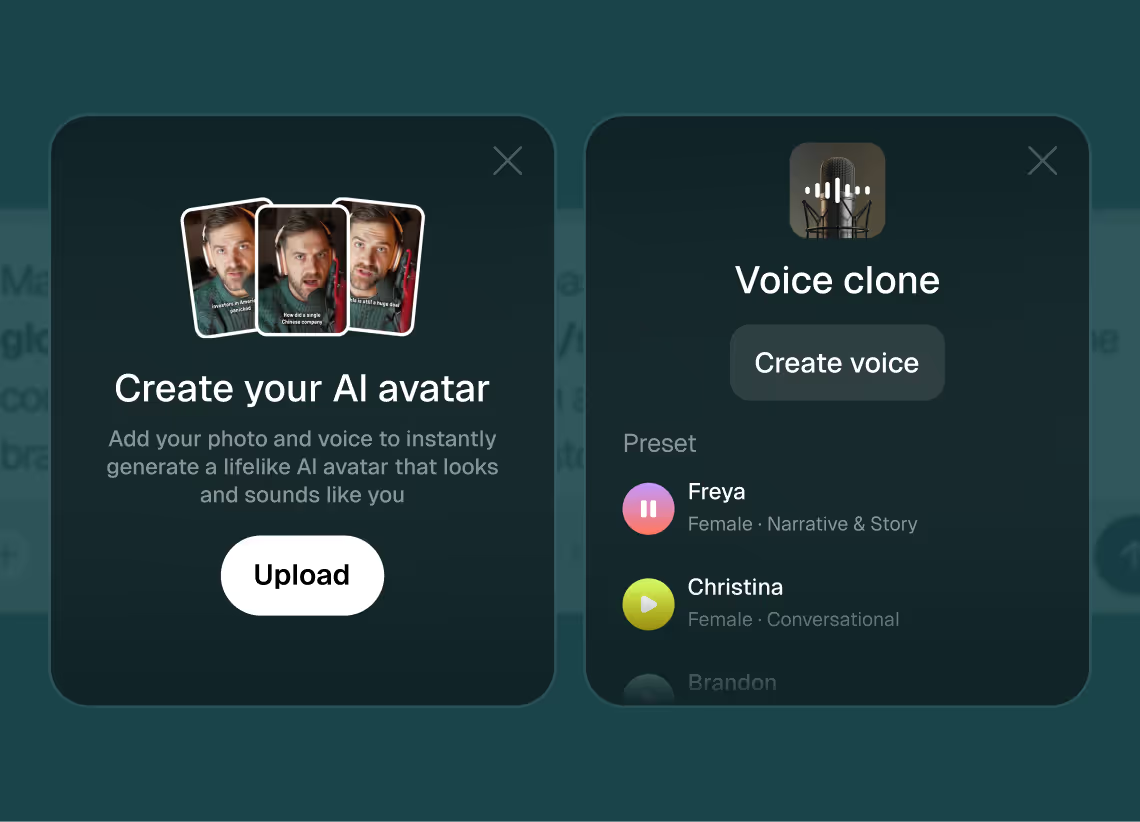
3Choose voice and avatar
Choose voice (clone yours or pick an AI voice) and avatar style (user or AI).
 4
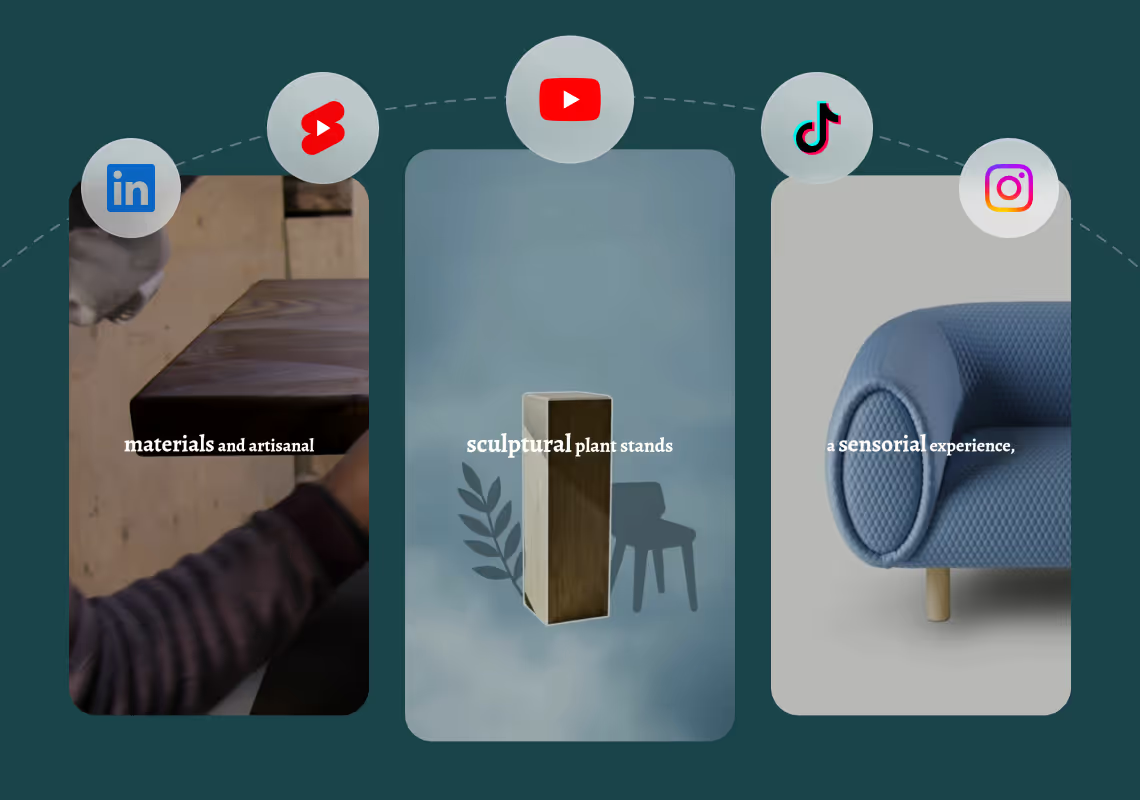
4Generate and publish-ready
Click generate and download your finished promo video in seconds, ready to publish across all platforms.


8 powerful features of Agent Opus' Climate Change Explainer Video Maker
Scientific Accuracy Visuals
Produce videos with fact-based imagery showing rising seas, carbon cycles, and ecosystem impacts.
Infographic to Video
Convert static climate infographics into dynamic video explainers with motion graphics and voiceover.
Prompt-Based Scene Building
Describe climate scenarios in text and watch Agent Opus generate matching animated explainer sequences.
Educational Voiceover AI
Generate clear, authoritative narration that explains complex climate concepts in accessible language.
Instant Educational Content
Generate shareable climate explainer videos in minutes without filming or manual animation work.
Data Visualization Generation
Transform temperature graphs, emission stats, and climate data into animated video charts automatically.
Script to Climate Video
Turn climate research or talking points into polished explainer videos with AI narration and visuals.
Multi-Topic Climate Series
Create consistent explainer videos covering different climate topics with unified branding and pacing.
Testimonials
This looks like a game-changer for us. We're building narrative-driven, visually layered content — and the ability to maintain character and motion consistency across episodes would be huge. If Agent Opus can sync branded motion graphics, tone, and avatar style seamlessly, it could easily become part of our production stack for short-form explainers and long-form investigative visuals.
srtaduck
I reviewed version a and I was very impressed with this version, it did very well in almost all aspects that users need, you would only have to make very small changes and maybe replace one of 2 of the pictures, but even saying that it could be used as is and still receive decent views or even chances at going viral depending on the story or the content the user chooses.
Jeremy
all in all LOVE THIS agent. I'm curious to see how I can push it (within reason) Just need to learn to get the consistency right with my prompts
Rebecca
Frequently Asked Questions
How does a climate change explainer video maker handle complex scientific data and visuals?
Agent Opus is built to transform dense climate science into clear, visual storytelling. When you input a prompt, script, or article URL about climate change, the system parses the content for key concepts like temperature anomalies, carbon emissions, sea level rise, or policy frameworks. It then auto-sources relevant visuals from royalty-free libraries and the web, including satellite imagery, NOAA charts, IPCC graphics, and stock footage of renewable energy, deforestation, or extreme weather events. The AI motion graphics engine animates these assets, creating dynamic transitions between data points, zooming into regional impacts, or overlaying timelines on maps. For example, if your script discusses global temperature trends since 1880, Agent Opus can pull historical temperature datasets, render them as animated line graphs, and composite them over rotating globe visuals. If you're explaining carbon capture technology, it sources diagrams of direct air capture systems and animates the process flow. You can also upload your own research charts, brand infographics, or campaign assets, and Agent Opus integrates them seamlessly into the scene sequence. The voiceover layer, whether cloned from your voice or generated via AI, is timed to match visual beats, so when the narrator says 'emissions peaked in 2019,' the graph highlights that year. This end-to-end automation means you don't need After Effects skills, a stock footage budget, or hours of manual syncing. You focus on the message; the climate change explainer video maker handles the production, delivering a publish-ready video that educates and engages across social platforms and classrooms.
What are best practices for writing prompts or scripts for climate change explainer videos?
Effective prompts for a climate change explainer video maker balance clarity, structure, and visual cues. Start with a one-sentence thesis: 'Explain how Arctic ice loss accelerates global warming through albedo feedback' or 'Show the economic case for transitioning to renewable energy by 2040.' Agent Opus uses this framing to select visuals and pace the narrative. Next, break your content into logical sections. For a five-minute explainer, you might outline: intro hook, problem statement, mechanism or data, solutions or case studies, and call to action. Within each section, include specific data points or examples. Instead of 'temperatures are rising,' write 'global average temperature has increased 1.2 degrees Celsius since pre-industrial times, with the fastest warming in the Arctic.' Agent Opus will source Arctic temperature maps and animate the 1.2-degree rise. If you're working from a blog post or research article, paste the URL directly. The system extracts headings, key stats, and cited studies, then structures scenes around them. For maximum impact, flag visual opportunities in your script: 'show time-lapse of glacier retreat,' 'overlay CO2 concentration graph,' 'cut to wind farm footage.' Agent Opus interprets these cues and sources matching assets. Avoid jargon without context; if you use terms like 'radiative forcing' or 'tipping points,' add a brief plain-language explanation so the voiceover remains accessible. Specify tone: 'urgent but hopeful,' 'data-driven and neutral,' or 'activist and direct.' This guides voice selection and pacing. Finally, if you have brand guidelines, mention them: 'use our logo in the lower third,' 'feature our solar panel product shots in the solutions section.' The climate change explainer video maker integrates these assets automatically. By combining clear structure, specific data, visual cues, and tone direction, you give Agent Opus everything it needs to generate a compelling, accurate, and publish-ready climate video in one pass.
Can a climate change explainer video maker maintain scientific accuracy and source credibility?
Yes, and Agent Opus is designed with credibility in mind. When you input a script or article URL, the system preserves the factual content you provide. It does not invent data or alter statistics; it visualizes what you write. If your script cites 'IPCC AR6 projects 1.5°C warming by 2030 under current policies,' Agent Opus sources visuals that illustrate warming trends and policy scenarios, but it does not fabricate numbers. The auto-sourced imagery comes from vetted royalty-free libraries, government databases like NASA and NOAA, and reputable stock providers. You can also upload your own peer-reviewed charts, institutional logos, or campaign graphics to ensure brand and source alignment. For maximum accuracy, start with a well-researched script or link to a credible article. If you're adapting a scientific paper, paste the abstract or key findings, and Agent Opus will structure scenes around those points. The voiceover, whether AI-generated or cloned from your voice, reads your script verbatim, so tone and terminology remain under your control. If you want to cite sources on-screen, include them in your script: 'According to NASA, 2023 was the warmest year on record.' Agent Opus can overlay text citations or lower-third graphics during that segment. For educational or nonprofit use, this transparency is critical. The motion graphics layer adds visual clarity without distorting data; for example, animating a bar chart of emissions by country highlights trends but does not manipulate the underlying numbers. If you're concerned about a specific visual, you can flag it in your prompt: 'use only satellite imagery from NOAA for Arctic ice extent.' Agent Opus prioritizes those sources. The result is a climate change explainer video maker that amplifies your research and messaging with professional visuals, while keeping you in control of the science. You own the narrative; the tool handles the production.
How does this tool help nonprofits and educators scale climate communication without a video team?
Nonprofits and educators often have deep subject-matter expertise but limited video production resources. A climate change explainer video maker like Agent Opus removes the technical and financial barriers to visual storytelling. Instead of hiring a videographer, motion designer, and editor, you describe your topic or paste an article, and the system generates a finished video. For a nonprofit running a campaign on ocean acidification, you might input a two-page brief with key stats, a call to action, and links to your donation page. Agent Opus assembles scenes showing coral bleaching, pH level graphs, and marine life impacts, adds voiceover, integrates your logo, and outputs a 90-second Instagram Reel and a three-minute YouTube video. You can generate multiple versions for different platforms or audiences in one session. Educators benefit similarly. A high school teacher preparing a unit on renewable energy can paste a lesson outline or textbook excerpt, and Agent Opus creates a video that visualizes wind turbine mechanics, solar panel efficiency curves, and grid integration challenges. The AI motion graphics make abstract concepts concrete, and the voiceover can match the teacher's own voice via cloning, maintaining classroom continuity. Because there's no manual editing, you can iterate quickly. If a new IPCC report drops, you update your script with the latest findings and regenerate the video in minutes, not weeks. This speed is essential for timely climate communication, where windows of public attention are narrow. The cost savings are significant too. Traditional explainer videos can run thousands of dollars per minute; Agent Opus operates on a subscription or per-video model that's accessible to small budgets. You also avoid ongoing stock footage fees, since the tool auto-sources visuals. For organizations producing regular content, like monthly climate updates or campaign series, the climate change explainer video maker becomes a force multiplier. One communications staffer can produce what used to require a full production team, freeing budget and time for fieldwork, research, and advocacy. The output quality is high enough for broadcast, social media, and donor presentations, ensuring your message reaches and resonates with diverse audiences.