Physics Explainer Video Maker
Transform complex physics concepts into clear, engaging explainer videos in minutes. Agent Opus is a physics explainer video maker that generates complete videos from your text, script, or outline. Describe the concept you want to explain, from Newton's laws to quantum mechanics, and get a publish-ready video with AI motion graphics, diagrams, voiceover, and dynamic visuals. No editing, no timeline, no manual assembly. Just prompt to polished physics video.

Explore what's possible with Agent Opus

Reasons why creators love Agent Opus' Physics Explainer Video Maker
Publish Faster Than Ever
Go from physics concept to polished explainer video in minutes, not weeks of storyboarding and rendering.
No Animation Skills Required
Create professional physics explainers without learning complex animation software or hiring expensive motion designers.
Complex Ideas Made Clear
Turn abstract physics concepts into visual stories that students and audiences actually understand and remember.
Consistent Educational Quality
Maintain the same clear, professional teaching style across every physics topic you cover for your channel or classroom.
Students Stay Engaged Longer
Hold attention through challenging physics topics with dynamic visuals that make learning feel less like work.
Scale Your Teaching Impact
Produce entire physics curriculum series without burning out or sacrificing your evenings to video production.
How to use Agent Opus’ Physics Explainer Video Maker
 1
1Describe your video
Paste your promo brief, script, outline, or blog URL into Agent Opus.
 2
2Add assets and sources
Upload brand assets like logos and product images, or let the AI source stock visuals automatically.
 3
3Choose voice and avatar
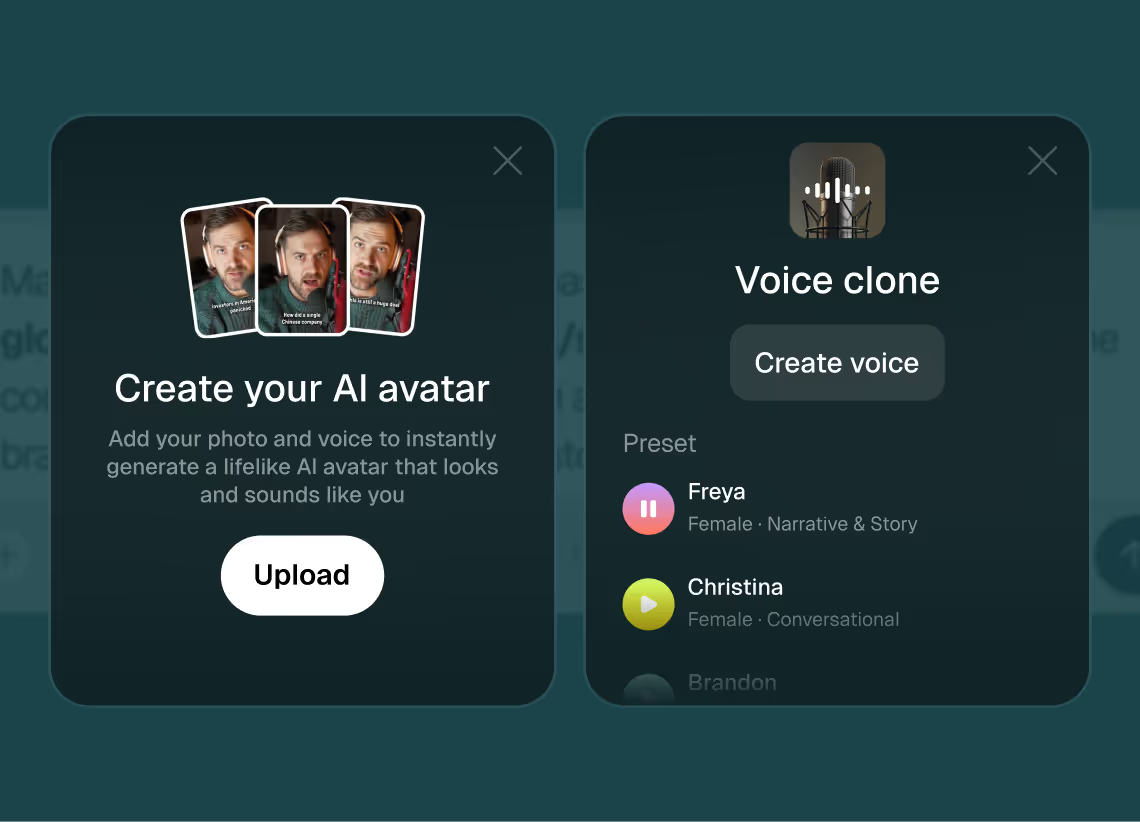
Choose voice (clone yours or pick an AI voice) and avatar style (user or AI).
 4
4Generate and publish-ready
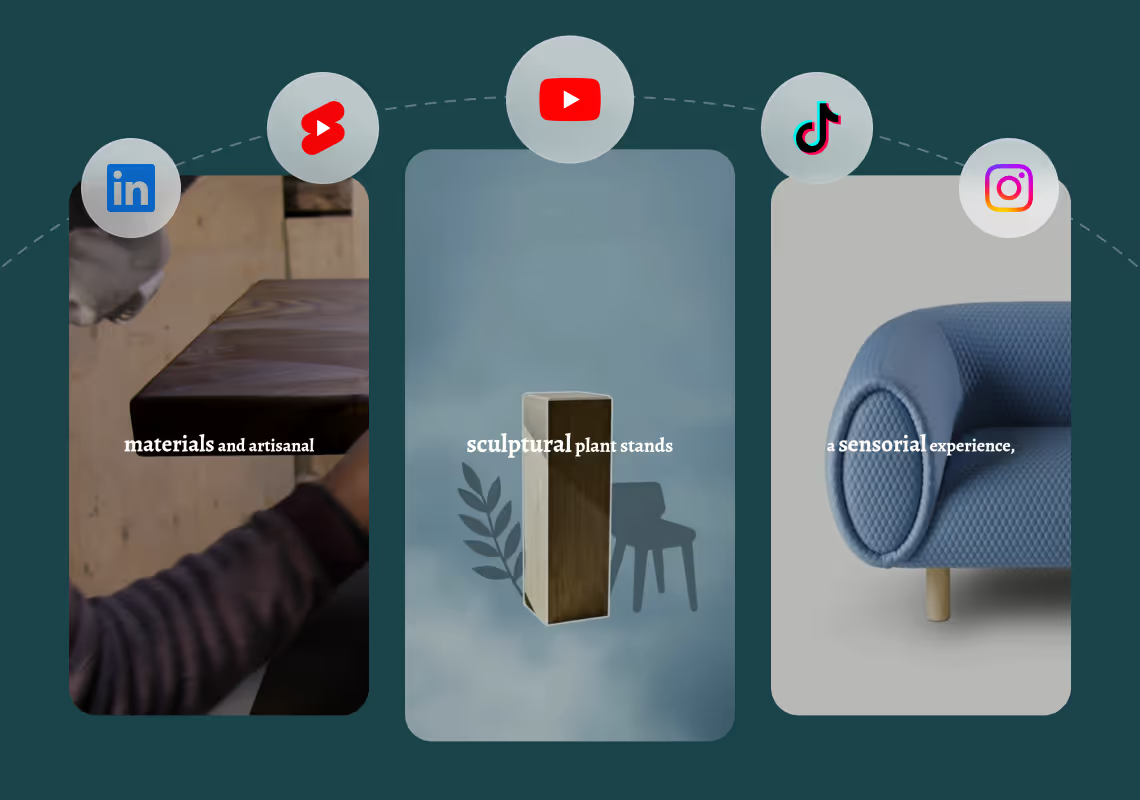
Click generate and download your finished promo video in seconds, ready to publish across all platforms.


8 powerful features of Agent Opus' Physics Explainer Video Maker
Formula Visualization
Generate videos that illustrate equations and principles with dynamic graphics and step-by-step breakdowns.
Diagram to Motion
Upload static physics diagrams and transform them into animated sequences with labels and transitions.
Lab Simulation Scenes
Produce videos showing experiments and phenomena with realistic motion graphics and annotated results.
Concept to Animation
Turn physics prompts into animated explainer videos with diagrams, motion, and narration in minutes.
Classroom-Ready Output
Generate polished explainer videos optimized for lectures, tutorials, and educational content distribution.
Multi-Concept Sequences
Build longer videos covering multiple physics topics in one cohesive, narrated learning experience.
Topic Prompt Generation
Describe any physics concept and receive a complete explainer video with visuals, audio, and pacing.
Narrated Demonstrations
Create physics explainers with AI voiceovers that guide viewers through complex topics clearly and confidently.
Testimonials
This looks like a game-changer for us. We're building narrative-driven, visually layered content — and the ability to maintain character and motion consistency across episodes would be huge. If Agent Opus can sync branded motion graphics, tone, and avatar style seamlessly, it could easily become part of our production stack for short-form explainers and long-form investigative visuals.
srtaduck
I reviewed version a and I was very impressed with this version, it did very well in almost all aspects that users need, you would only have to make very small changes and maybe replace one of 2 of the pictures, but even saying that it could be used as is and still receive decent views or even chances at going viral depending on the story or the content the user chooses.
Jeremy
all in all LOVE THIS agent. I'm curious to see how I can push it (within reason) Just need to learn to get the consistency right with my prompts
Rebecca
Frequently Asked Questions
How does a physics explainer video maker handle complex equations and diagrams?
Agent Opus approaches physics visualization through intelligent scene generation and motion graphics automation. When you submit a physics concept, the system analyzes the explanation structure and identifies key visual moments like formula derivations, force diagrams, wave patterns, particle interactions, or experimental setups. The AI motion graphics engine then generates animated representations of these concepts, creating visual elements that illustrate abstract principles. For example, if you're explaining Newton's second law, Agent Opus can generate animated force vectors, mass representations, and acceleration visualizations that sync with your narration. The system sources relevant educational imagery from web and stock libraries, including lab equipment, real-world physics demonstrations, and scientific photography. It assembles these elements with dynamic pacing that matches explanation complexity, slowing down for difficult concepts and maintaining engagement during foundational material. The result is a complete physics explainer video where equations appear on screen as they're discussed, diagrams animate to show relationships, and visual metaphors clarify abstract ideas. This automation means you focus on crafting clear explanations while the physics explainer video maker handles all visualization, timing, and assembly work.
What are best practices for prompts when using a physics explainer video maker?
Effective prompts for physics explainer videos balance conceptual clarity with visual guidance. Start by stating the physics principle or phenomenon you want to explain, then outline the explanation structure. For instance, instead of just 'explain momentum,' write 'explain conservation of momentum using collision examples, starting with definition, showing elastic vs inelastic collisions, and ending with real-world applications.' This gives Agent Opus a narrative arc to visualize. Include specific visual cues you want emphasized. Mention if you need force diagrams, energy graphs, particle animations, or lab demonstration footage. The more specific your visual requests, the better the motion graphics engine can generate relevant animations. Specify your audience level. A high school physics explainer needs different pacing and visual complexity than a graduate-level quantum mechanics video. Agent Opus adjusts diagram sophistication and explanation depth accordingly. If you have a full script, paste it directly. The system will parse the explanation flow and generate visuals that sync with each concept introduction. For blog or article URLs, ensure the source material has clear section breaks and concept progression. The physics explainer video maker performs best when the input text has logical structure. Consider including real-world examples or applications. These give the system opportunities to source compelling footage like rocket launches, bridge engineering, or particle accelerator imagery that makes abstract physics tangible. Finally, indicate your preferred tone, whether formal academic, enthusiastic educator, or casual science communicator, so voiceover and pacing match your teaching style.
Can a physics explainer video maker maintain consistent visual style across a video series?
Agent Opus supports visual consistency essential for educational content creators building physics video libraries. When you generate your first physics explainer video, the system captures your brand elements including logos, color schemes, typography choices, and motion graphics style. These preferences persist across subsequent videos, ensuring your entire physics series maintains a cohesive look. This is critical for educators creating curriculum content or science communicators building channel identity. The consistency extends to motion graphics treatment. If your first video uses a particular style for force vectors, energy diagrams, or particle animations, Agent Opus applies similar visual language to related concepts in future videos. This helps students recognize familiar visual patterns across topics, reinforcing learning through consistent representation. Voice consistency is equally important. If you use voice cloning for your first physics explainer, that same voice carries through your entire series. Students and viewers develop familiarity with your narration style, making complex physics concepts feel more approachable through consistent delivery. For avatar-based explanations, you can maintain the same AI or user avatar across videos, creating a recognizable instructor presence. The physics explainer video maker also remembers pacing preferences. If you prefer slower explanation speeds for complex topics or faster pacing for review content, these timing patterns apply to similar material in future videos. This automation eliminates the need to manually specify style preferences for each new physics concept, letting you focus on explanation quality while the system handles visual and audio consistency across your growing educational video library.
What physics topics work best with an AI physics explainer video maker?
Agent Opus excels across the full physics spectrum, from classical mechanics to modern physics, with particular strength in topics that benefit from visual demonstration. Classical mechanics concepts like kinematics, dynamics, energy, and momentum are ideal because they involve visible motion, forces, and interactions that motion graphics can illustrate clearly. The system generates animated trajectories, force diagrams, energy transformations, and collision sequences that make these principles tangible. Thermodynamics and heat transfer also work exceptionally well. Agent Opus can visualize molecular motion, heat flow, phase changes, and thermodynamic cycles with particle animations and energy diagrams that clarify abstract thermal concepts. Wave phenomena including sound, light, and electromagnetic waves benefit from the motion graphics engine's ability to animate wave propagation, interference patterns, diffraction, and polarization. These dynamic visualizations make wave behavior far clearer than static diagrams. Electricity and magnetism topics like circuits, fields, and electromagnetic induction are strong candidates. The physics explainer video maker generates circuit animations, field line visualizations, and charge flow representations that demystify electrical concepts. Modern physics including relativity, quantum mechanics, and particle physics work well despite their abstract nature. Agent Opus sources relevant imagery from particle accelerators, space observations, and quantum experiments while generating conceptual animations for phenomena like time dilation, wave-particle duality, and quantum tunneling. The system handles both conceptual overviews and mathematical derivations, making it suitable for introductory explanations and advanced problem-solving videos. Topics requiring extensive mathematical proof work best when you provide clear step-by-step scripts, allowing the motion graphics to highlight each algebraic or calculus step. Experimental physics and lab demonstrations benefit from the system's ability to source real laboratory footage and equipment imagery, connecting theoretical concepts to practical measurement and observation.