Science Explainer Video Maker
Agent Opus is a complete science explainer video maker that transforms complex concepts into engaging visual stories. Describe your topic, paste a script, or share an article URL, and Agent Opus generates a publish-ready science video with AI motion graphics, dynamic visuals, professional voiceover, and optional avatar presentation. No timeline, no manual editing, no stock footage hunting. Just one prompt and a finished science explainer video ready for YouTube, TikTok, LinkedIn, or your classroom. Perfect for educators, science communicators, and content creators who need to make difficult ideas accessible and shareable.

Explore what's possible with Agent Opus

Reasons why creators love Agent Opus' Science Explainer Video Maker
Publish While It's Relevant
Go from breakthrough to published explainer in hours, not weeks, so your content stays timely and impactful.
Scale Your Expertise Effortlessly
Create entire video series covering multiple topics without burning out or sacrificing quality and accuracy.
No Studio, No Problem
Skip filming logistics and production crews while still delivering polished, professional science content every time.
Consistent Voice, Zero Recording
Sound like yourself in every explainer without booking studio time or battling background noise and retakes.
Complex Ideas, Crystal Clear
Turn dense research and abstract concepts into visuals your audience actually understands and remembers.
Credibility Meets Watchability
Maintain scientific rigor while keeping viewers hooked with dynamic visuals that make learning feel effortless.
How to use Agent Opus’ Science Explainer Video Maker
 1
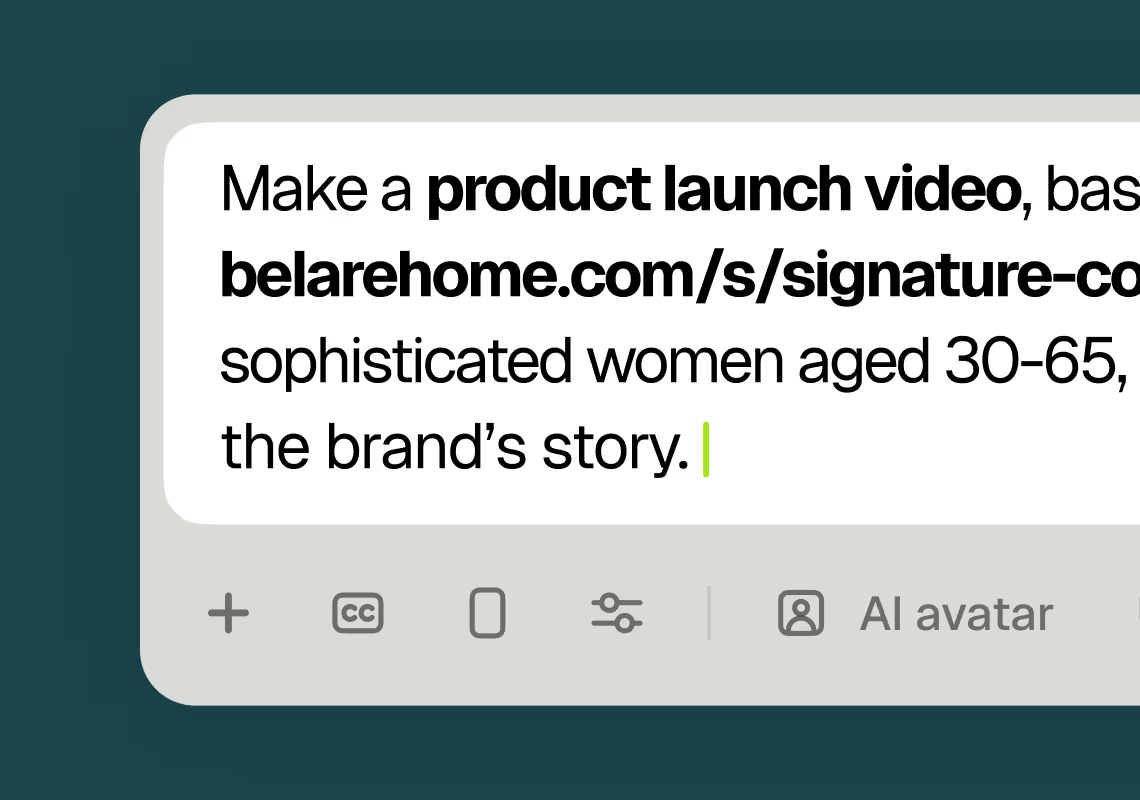
1Describe your video
Paste your promo brief, script, outline, or blog URL into Agent Opus.
 2
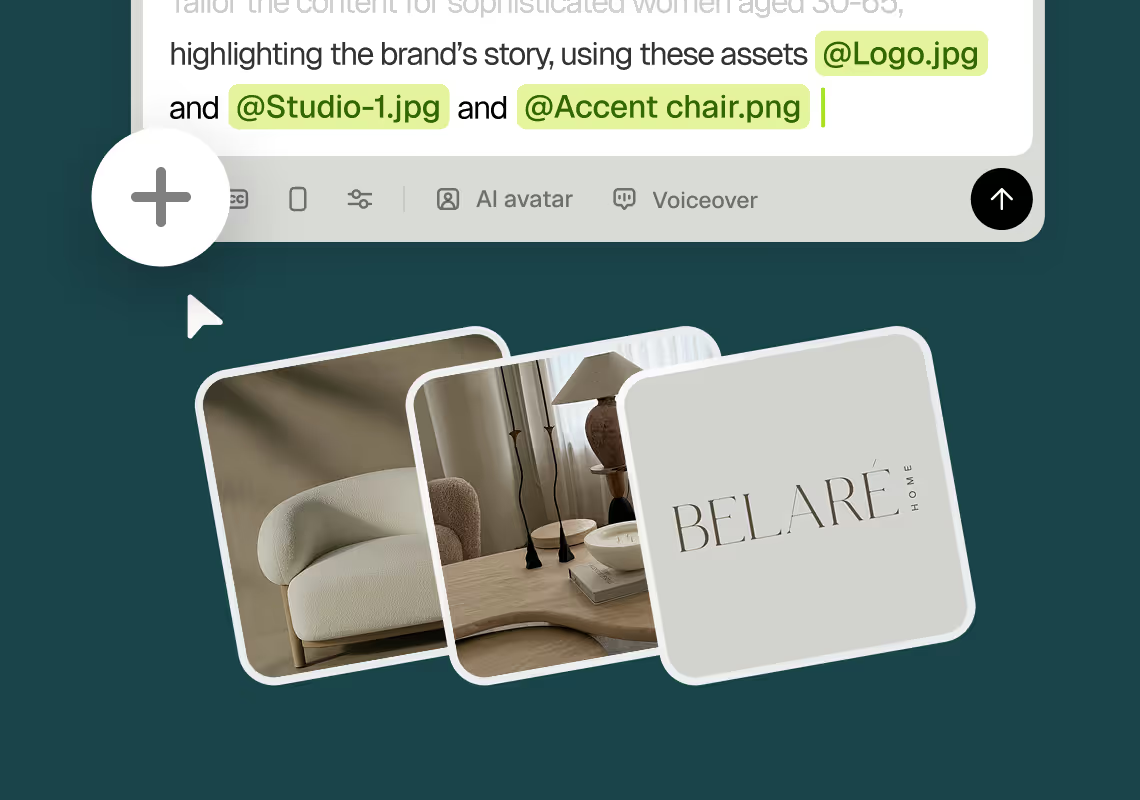
2Add assets and sources
Upload brand assets like logos and product images, or let the AI source stock visuals automatically.
 3
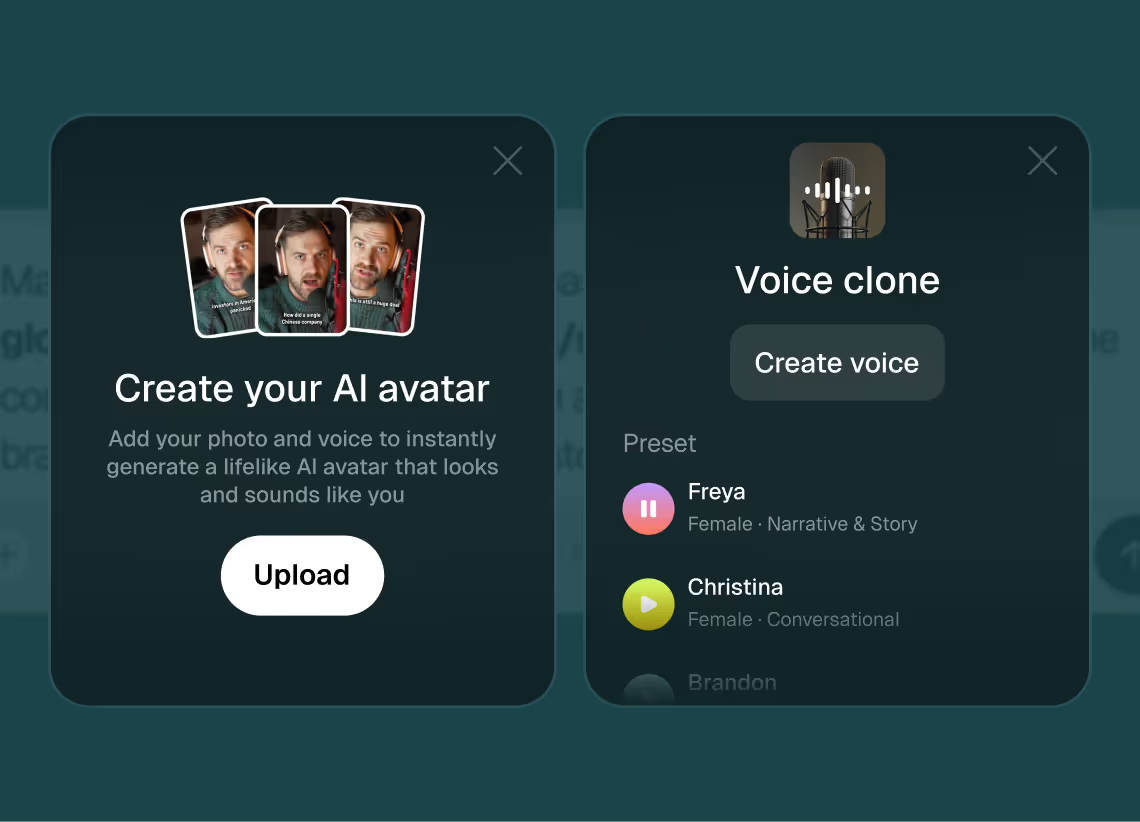
3Choose voice and avatar
Choose voice (clone yours or pick an AI voice) and avatar style (user or AI).
 4
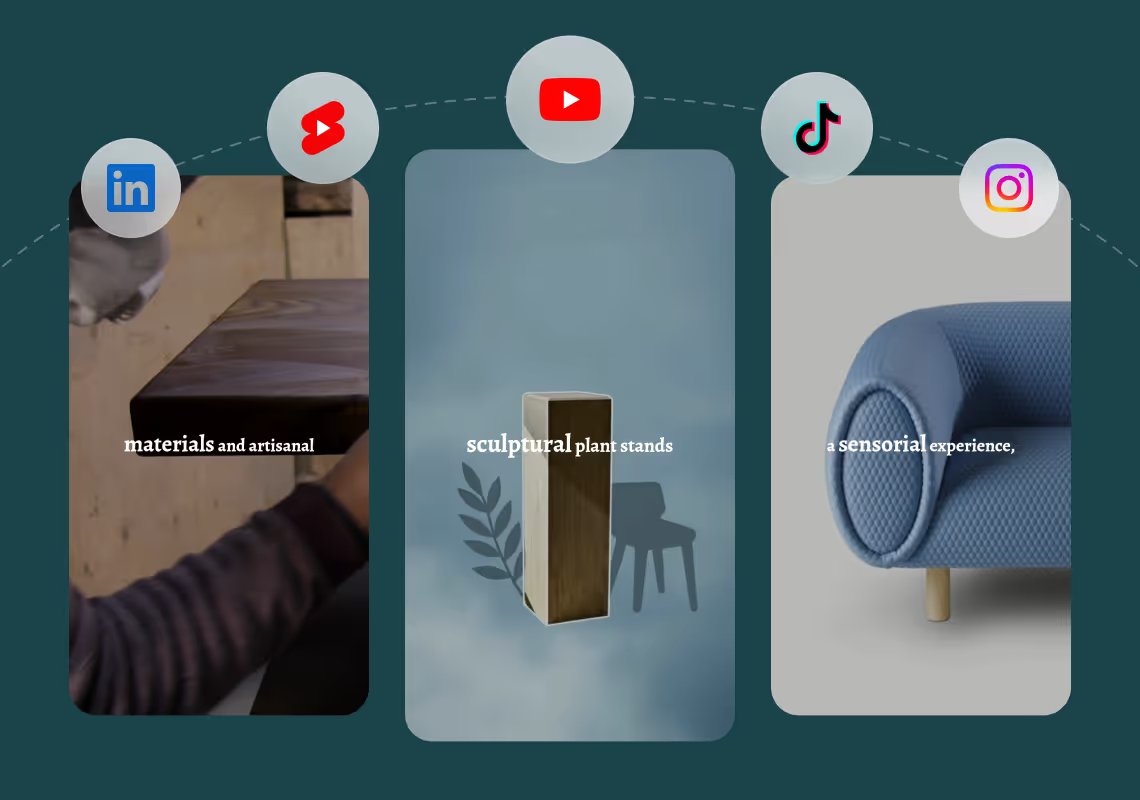
4Generate and publish-ready
Click generate and download your finished promo video in seconds, ready to publish across all platforms.


8 powerful features of Agent Opus' Science Explainer Video Maker
Step-by-Step Breakdowns
Structure videos to walk viewers through processes, experiments, or hypotheses methodically.
Text to Science Video
Turn research notes or scripts into polished explainer videos with accurate visuals and narration.
Academic Tone Control
Adjust pacing and language style to match classroom, conference, or public outreach audiences.
Concept Visualization
Generate diagrams, animations, and graphics that illustrate complex scientific principles clearly.
Educational Narration
Add AI voiceover that explains theories, experiments, and discoveries in an engaging tone.
Formula and Data Display
Automatically render equations, charts, and data points as animated on-screen elements.
Citation and Source Overlay
Display references, study links, or author credits on-screen to support credibility.
Lab and Field Scenes
Create realistic laboratory or field environments to contextualize your scientific explanations.
Testimonials
This looks like a game-changer for us. We're building narrative-driven, visually layered content — and the ability to maintain character and motion consistency across episodes would be huge. If Agent Opus can sync branded motion graphics, tone, and avatar style seamlessly, it could easily become part of our production stack for short-form explainers and long-form investigative visuals.
srtaduck
I reviewed version a and I was very impressed with this version, it did very well in almost all aspects that users need, you would only have to make very small changes and maybe replace one of 2 of the pictures, but even saying that it could be used as is and still receive decent views or even chances at going viral depending on the story or the content the user chooses.
Jeremy
all in all LOVE THIS agent. I'm curious to see how I can push it (within reason) Just need to learn to get the consistency right with my prompts
Rebecca
Frequently Asked Questions
How does a science explainer video maker handle technical accuracy and visual clarity?
Agent Opus is designed to transform scientific content into visually coherent explainer videos by intelligently parsing your input for key concepts, processes, and relationships. When you provide a prompt like 'Explain how mRNA vaccines work' or paste a research abstract, the system identifies the core narrative arc, breaks it into logical scenes, and sources or generates visuals that illustrate each step. For example, if your script describes cellular mechanisms, Agent Opus will assemble diagrams of cells, ribosomes, and spike proteins, then animate transitions between stages to show cause and effect. The AI motion graphics engine applies dynamic effects like zooms, highlights, and callouts to emphasize critical points, making abstract ideas like gene expression or thermodynamics tangible. You retain full control over accuracy by supplying a detailed script or outline. Agent Opus does not invent facts; it visualizes the science you provide. If you need to show a specific molecular structure or data chart, you can reference it in your prompt or upload a custom image, and the system will integrate it into the final video. The result is a science explainer video that balances technical precision with visual engagement, suitable for educational YouTube channels, online courses, conference presentations, or social media science communication. Because the output is publish-ready, you avoid the weeks of manual animation and editing that traditional science video production demands.
What are best practices for writing prompts in a science explainer video maker?
Effective prompts for a science explainer video maker start with a clear learning objective and a defined audience. Begin by stating the concept you want to explain and the level of detail required. For instance, 'Create a 60-second video explaining photosynthesis for high school students' gives Agent Opus a scope, a time constraint, and an audience context. If you are working from a script, structure it with an introduction that poses a question or problem, a body that walks through the mechanism or process step by step, and a conclusion that reinforces the key takeaway. Use concrete language and avoid jargon unless you define it within the script. For example, instead of saying 'eukaryotic transcription factors bind to promoter regions,' you might say 'special proteins latch onto DNA to start copying a gene.' This clarity helps the AI select visuals that match your narrative. When you want specific visuals, call them out: 'Show a diagram of the water cycle with evaporation, condensation, and precipitation labeled' or 'Animate a neuron firing an action potential.' Agent Opus will source or generate those elements. If you are converting a blog post or article, choose content that already has a logical flow and clear section headers. The system uses those structural cues to divide the video into scenes. For voice and tone, specify whether you want a formal academic narration or a conversational style. You can also indicate pacing: 'Pause after each step to let the concept sink in' or 'Keep it fast-paced for social media.' Finally, mention any branding or visual identity requirements, such as 'Include our lab logo in the corner' or 'Use blue and white color scheme.' These details ensure your science explainer video aligns with your channel or course aesthetic while maintaining educational rigor.
Can a science explainer video maker keep on-brand voices, logos, and visuals across multiple videos?
Yes, Agent Opus supports brand consistency across all your science explainer videos through voice cloning, custom visual assets, and reusable style preferences. If you are building a YouTube channel or course library, you can clone your own voice once and use it for every video, ensuring a recognizable narration style that builds audience trust. Alternatively, select an AI voice that matches your brand tone, whether that is authoritative and formal for academic content or warm and conversational for popular science. Once you choose a voice, you can apply it to every new video you generate. For visual branding, upload your logo, color palette, or custom graphics like lab equipment, mascots, or institutional watermarks. Agent Opus integrates these elements into each video automatically, so every explainer carries your visual identity. If you have a specific animation style or motion graphics template you prefer, describe it in your prompts or provide reference images. Over time, you can refine a prompt template that includes your branding instructions, such as 'Use our teal and orange color scheme, include the SciComm Lab logo in the bottom right, and apply smooth zoom transitions between scenes.' This template becomes a repeatable workflow for generating new science videos on topics like climate science, genetics, physics, or chemistry. The result is a cohesive video library that looks and sounds like it came from a professional production studio, even though each video was generated from a simple text prompt. This consistency is critical for educators and science communicators who want to build a recognizable brand and keep viewers engaged across a series of explainer videos.
What are the limitations or edge cases of a science explainer video maker for highly specialized topics?
Agent Opus excels at generating science explainer videos for a wide range of topics, but there are edge cases where additional input or iteration may be required. Highly specialized or cutting-edge research topics, such as novel quantum computing algorithms or newly published medical breakthroughs, may require you to supply detailed scripts or custom visuals because the AI relies on existing knowledge and stock resources. If your topic involves proprietary data, unpublished research, or niche terminology not widely documented, provide a comprehensive script with definitions and visual references. For example, if you are explaining a new cancer therapy mechanism, include diagrams of the molecular pathway or upload images of your lab results. Agent Opus will integrate these into the video, but it cannot invent visuals for concepts it has never encountered. Another edge case is when you need precise mathematical notation, chemical formulas, or code snippets displayed on screen. While Agent Opus can generate motion graphics and text overlays, complex equations may require you to specify exact formatting in your prompt or provide a reference image. For instance, 'Display the Schrödinger equation in LaTeX format' or 'Show the chemical structure of benzene with bond angles labeled.' The system will do its best to render these accurately, but reviewing the output and iterating on your prompt ensures precision. Additionally, if your science explainer video needs to cite specific studies, show data tables, or include peer-reviewed references, you should include those details in your script. Agent Opus will incorporate them as text overlays or voiceover mentions, but it does not auto-generate citations. Finally, while Agent Opus handles most aspect ratios and social platforms, extremely long-form content like 20-minute lectures may be better broken into multiple shorter videos, each focused on a single concept. This approach also improves viewer retention and makes your content more shareable. By understanding these limitations and providing clear, detailed input, you can use Agent Opus to produce high-quality science explainer videos even for advanced or specialized topics.