Math Explainer Video Maker
Turn any math concept into a polished explainer video in minutes. Agent Opus is a Math Explainer Video Maker that transforms your prompt, script, or outline into a finished lesson complete with animated equations, diagrams, AI voiceover, and dynamic visuals. No timeline, no manual editing—just describe your topic and publish. Perfect for educators, tutors, course creators, and edtech marketers who need engaging math content at scale.

Explore what's possible with Agent Opus

Reasons why creators love Agent Opus' Math Explainer Video Maker
Students Stay Engaged Longer
Dynamic visuals and pacing keep attention locked on the problem-solving process, not wandering to another tab.
No Studio, No Problem
Skip expensive equipment and editing marathons while still delivering polished math lessons that look professionally produced.
Scale Your Teaching Impact
Create a full semester of math explainers in days instead of months, reaching more learners without burning out.
Complex Ideas, Crystal Clear
Turn abstract formulas into visual stories that click instantly, so students finally get it without rewinding ten times.
Launch-Ready in Minutes
Go from concept to published explainer faster than traditional recording, so you can respond to student questions while they're still fresh.
Consistent Quality Every Time
Maintain the same clear voice and visual style across hundreds of lessons, building trust and familiarity with your audience.
How to use Agent Opus’ Math Explainer Video Maker
 1
1Describe your video
Paste your promo brief, script, outline, or blog URL into Agent Opus.
 2
2Add assets and sources
Upload brand assets like logos and product images, or let the AI source stock visuals automatically.
 3
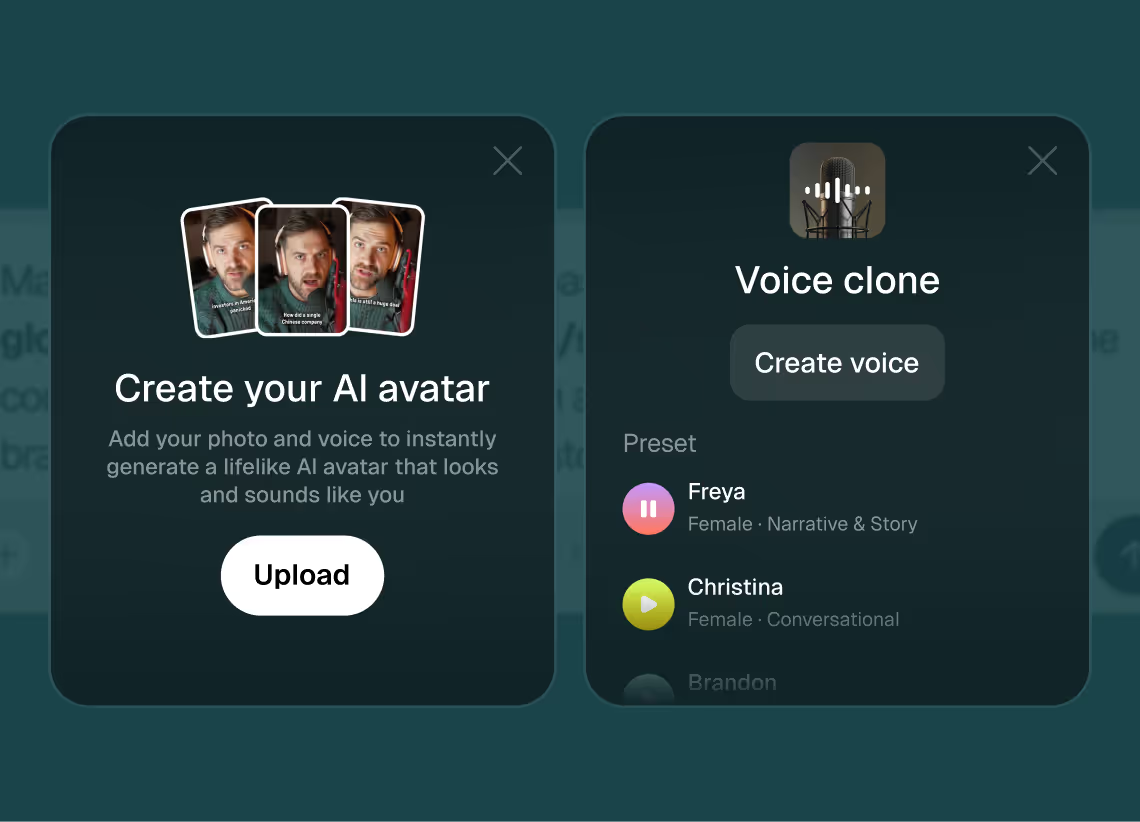
3Choose voice and avatar
Choose voice (clone yours or pick an AI voice) and avatar style (user or AI).
 4
4Generate and publish-ready
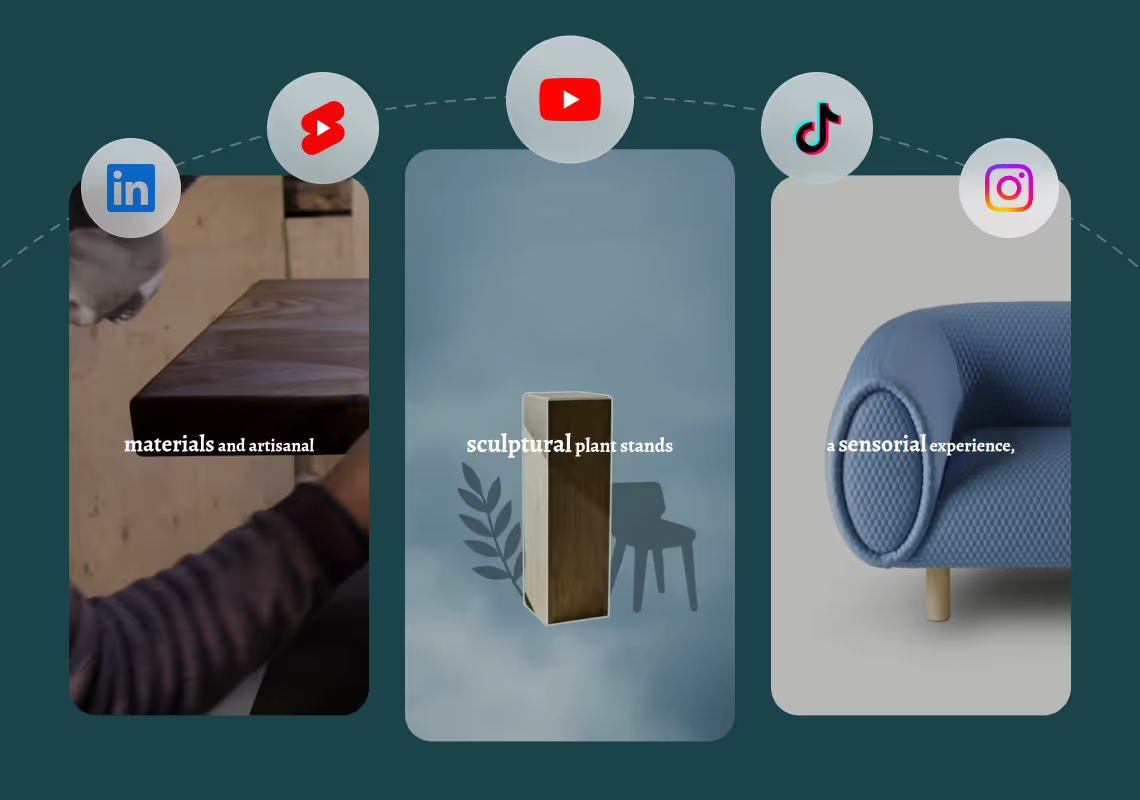
Click generate and download your finished promo video in seconds, ready to publish across all platforms.


8 powerful features of Agent Opus' Math Explainer Video Maker
Problem Walkthrough Videos
Create narrated videos that break down complex math problems into clear, sequential solution steps.
Theorem Demonstration
Generate videos that prove mathematical theorems through visual proofs and animated geometric constructions.
AI Voice Narration
Add professional AI voiceovers that explain each mathematical operation and reasoning in natural language.
Concept Visualization
Generate videos that illustrate abstract math concepts with dynamic graphs, diagrams, and motion graphics.
Formula to Scene
Transform written equations into engaging video scenes with highlighted variables and animated transitions.
Equation to Animation
Turn mathematical formulas and proofs into step-by-step animated videos that visualize every calculation.
Graph Animation
Create videos that animate function plots, coordinate systems, and mathematical relationships in real time.
Multi-Step Solutions
Produce videos showing complete problem-solving workflows with synchronized visuals and explanatory narration.
Testimonials
This looks like a game-changer for us. We're building narrative-driven, visually layered content — and the ability to maintain character and motion consistency across episodes would be huge. If Agent Opus can sync branded motion graphics, tone, and avatar style seamlessly, it could easily become part of our production stack for short-form explainers and long-form investigative visuals.
srtaduck
I reviewed version a and I was very impressed with this version, it did very well in almost all aspects that users need, you would only have to make very small changes and maybe replace one of 2 of the pictures, but even saying that it could be used as is and still receive decent views or even chances at going viral depending on the story or the content the user chooses.
Jeremy
all in all LOVE THIS agent. I'm curious to see how I can push it (within reason) Just need to learn to get the consistency right with my prompts
Rebecca
Frequently Asked Questions
How does a Math Explainer Video Maker handle complex equations and multi-step proofs?
Agent Opus treats each math concept as a sequence of visual beats. When you provide a script or outline that includes equations, the system parses the mathematical notation and renders it cleanly on screen using LaTeX-style formatting. For multi-step proofs or derivations, Agent Opus breaks the logic into individual frames: it might show the initial equation, then highlight the term being manipulated, reveal the next line, and annotate the reasoning at each step. This choreography happens automatically based on your script's structure. If you write 'First, factor the quadratic. Next, apply the zero-product property,' Agent Opus will generate a frame showing the factored form, then a second frame highlighting each factor set to zero, complete with motion graphics that draw the viewer's eye to the relevant parts. You can also include natural-language explanations between steps, and the voiceover will narrate while the visuals update in sync. The result is a lesson that feels like a live whiteboard session, but produced in minutes instead of hours. Best practice: structure your script with clear step markers and include the exact notation you want displayed. Agent Opus will handle rendering, timing, and transitions, ensuring every equation is legible and every proof flows logically from premise to conclusion.
What types of math topics work best with this Math Explainer Video Maker, and are there any limitations?
Agent Opus excels at topics that benefit from visual progression: algebra (solving equations, factoring), calculus (limits, derivatives, integrals with graphs), geometry (proofs, constructions, transformations), statistics (probability distributions, hypothesis tests with charts), and linear algebra (matrix operations, vector spaces). Any concept you can script step-by-step translates well into a video. The system auto-sources diagrams for standard topics like the unit circle, normal distribution curves, or coordinate planes, and it can generate custom graphs when you describe axes, functions, or data points in your prompt. Limitations include highly abstract topics with minimal visual anchors (pure set theory or formal logic without diagrams may need extra descriptive prompts), and extremely niche notation that isn't widely recognized. For those cases, you can upload reference images of the notation or diagrams you want, and Agent Opus will incorporate them into the video. Another edge case: real-time interactive elements like draggable sliders or live calculations aren't part of the output, since Agent Opus produces static video files optimized for platforms like YouTube and TikTok. However, you can simulate interactivity by scripting 'what-if' scenarios and generating separate videos for each case. Overall, if you can write or outline the concept in text, Agent Opus can visualize it. The key is providing enough detail in your script so the system knows which equations to render, which steps to highlight, and where to insert diagrams or annotations.
Can I use my own branding, logos, and teaching style in a Math Explainer Video Maker workflow?
Absolutely. Agent Opus is built for creators and educators who want consistent, on-brand content at scale. You can upload your logo, color palette, and any custom graphics (like a branded intro slate or watermark), and the system will composite them into every video you generate. For teaching style, voice cloning is a game-changer: record a short sample of your voice, and Agent Opus will use that clone for all narration, so every lesson sounds like you. If you prefer an AI voice, you can select from a library of tones and accents that match your audience, whether that's a calm, patient tutor voice for middle-school algebra or a more energetic, conversational tone for adult learners. You can also choose to include an AI avatar or your own video avatar if you want an on-screen instructor presence. The avatar will lip-sync to the voiceover and appear in a corner or full-frame layout, depending on your preference. For visual consistency, describe your preferred style in the prompt: 'Use a dark chalkboard aesthetic with white handwriting-style equations' or 'Modern minimalist design with sans-serif fonts and pastel highlights.' Agent Opus will apply those design cues across scenes. You can even reference a previous video and ask Agent Opus to match that look. This level of customization means your entire course library or content series maintains a unified brand identity, even though each video is generated from scratch in minutes. No need to rebuild templates or manually apply styles in an editor.
How do I write effective prompts for a Math Explainer Video Maker to get the best results?
Great prompts for math explainer videos combine clear structure, explicit notation, and teaching intent. Start with a one-sentence summary of the concept, then break the explanation into numbered or bulleted steps. For example: 'Explain the quadratic formula. Step 1: Show the standard form ax² + bx + c = 0. Step 2: Derive the formula by completing the square. Step 3: Highlight the discriminant and its role. Step 4: Work through an example with real roots.' This structure tells Agent Opus exactly which equations to render and in what order. Include the actual math notation you want displayed, either inline or as separate lines, so the system knows to render it visually rather than just narrate it. If you want specific diagrams, describe them: 'Show a parabola opening upward with vertex labeled and x-intercepts marked.' Agent Opus will generate or source that graphic. For pacing, indicate where you want pauses or emphasis: 'Pause here to let the viewer absorb the substitution' or 'Highlight the exponent in red and zoom in briefly.' These cues guide the motion graphics engine. If you're working from a longer script or blog post, Agent Opus will extract the key steps automatically, but you'll get tighter results if you format headings and subheadings clearly. You can also specify tone and audience: 'Explain like I'm teaching high-school students' versus 'Use formal academic language for college-level calculus.' Finally, if you have reference materials like a textbook page or a whiteboard photo, mention them in the prompt or upload them, and Agent Opus will align the video's visual style and notation to match. The more detail you provide upfront, the less iteration you'll need, but even a rough outline will produce a solid first draft you can refine with a follow-up prompt.