Philosophy Explainer Video Maker
Turn dense philosophical concepts into clear, engaging videos your audience will actually watch. Agent Opus is a philosophy explainer video maker that generates complete, publish-ready videos from your brief, script, or outline. Describe the concept you want to explain, and Agent Opus assembles scenes, sources visuals, adds AI motion graphics, and delivers a finished video ready for YouTube, social media, or your course platform. No timeline editing, no stock footage hunting, no manual assembly required.

Explore what's possible with Agent Opus

Reasons why creators love Agent Opus' Philosophy Explainer Video Maker
Reach Learners Everywhere
Make philosophy accessible to visual learners, busy students, and global audiences who prefer video over text.
Complex Ideas, Crystal Clear
Turn dense philosophical concepts into visual narratives your audience actually understands and remembers.
On-Brand Every Time
Maintain your unique teaching voice and visual style across every explainer without hiring a production team.
Scale Your Thought Leadership
Produce multiple philosophy explainers weekly without burning out or sacrificing depth and quality.
Launch-Ready in Minutes
Skip weeks of scripting, filming, and editing - publish polished philosophy content the same day you conceive it.
Studio-Quality Without the Studio
Sound like a professional philosopher and look camera-ready even when you're working from your home office.
How to use Agent Opus’ Philosophy Explainer Video Maker
 1
1Describe your video
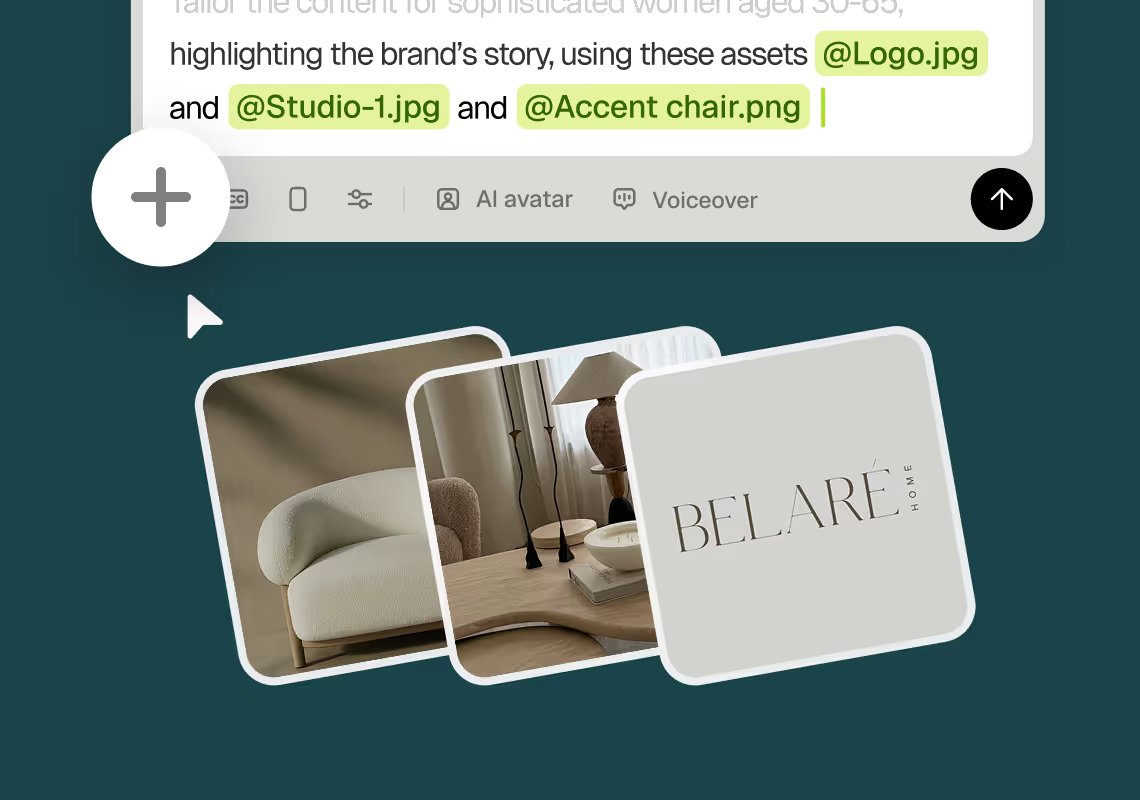
Paste your promo brief, script, outline, or blog URL into Agent Opus.
 2
2Add assets and sources
Upload brand assets like logos and product images, or let the AI source stock visuals automatically.
 3
3Choose voice and avatar
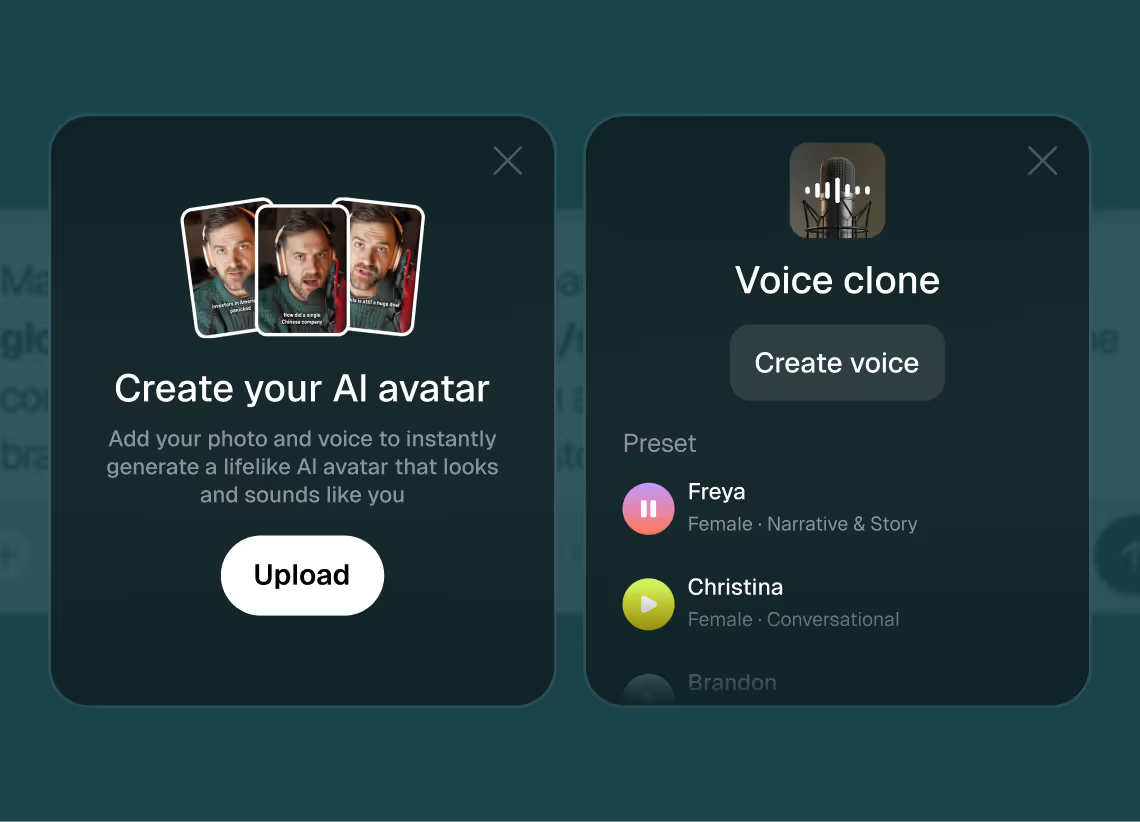
Choose voice (clone yours or pick an AI voice) and avatar style (user or AI).
 4
4Generate and publish-ready
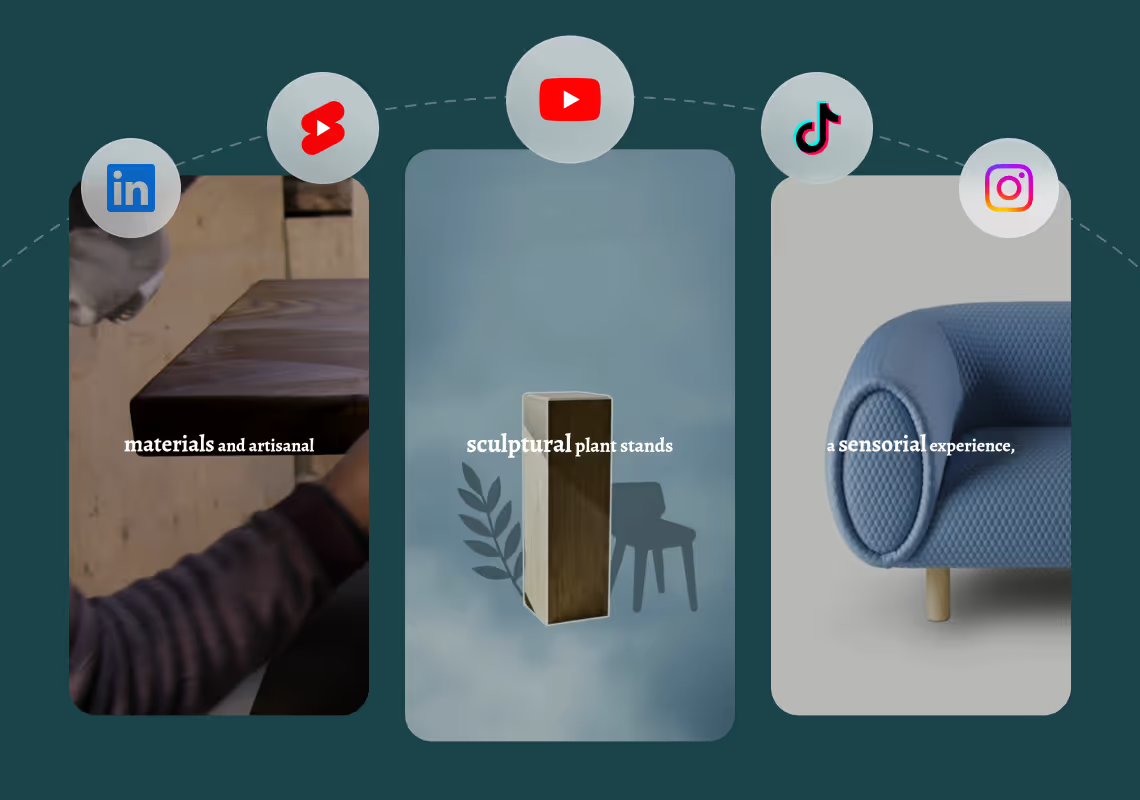
Click generate and download your finished promo video in seconds, ready to publish across all platforms.


8 powerful features of Agent Opus' Philosophy Explainer Video Maker
Educational Pacing Control
Generate videos with deliberate pacing that allows viewers time to process complex philosophical reasoning.
Automated Thought Experiments
Generate videos that illustrate abstract thought experiments through dynamic scenes and motion graphics.
Argument Visualization
Turn logical arguments and premises into step-by-step video sequences that clarify reasoning.
Philosopher Avatar Narration
Create AI avatars that deliver philosophical explanations with natural gestures and academic tone.
Historical Context Scenes
Generate period-appropriate visuals that place philosophical ideas within their historical and cultural settings.
Metaphor to Motion
Convert philosophical metaphors and analogies into animated visuals that make abstract concepts concrete.
Concept to Visual Story
Transform complex philosophical ideas into clear, engaging video narratives with AI-generated visuals.
Debate Format Videos
Produce multi-perspective videos showing contrasting philosophical positions with balanced visual representation.
Testimonials
This looks like a game-changer for us. We're building narrative-driven, visually layered content — and the ability to maintain character and motion consistency across episodes would be huge. If Agent Opus can sync branded motion graphics, tone, and avatar style seamlessly, it could easily become part of our production stack for short-form explainers and long-form investigative visuals.
srtaduck
I reviewed version a and I was very impressed with this version, it did very well in almost all aspects that users need, you would only have to make very small changes and maybe replace one of 2 of the pictures, but even saying that it could be used as is and still receive decent views or even chances at going viral depending on the story or the content the user chooses.
Jeremy
all in all LOVE THIS agent. I'm curious to see how I can push it (within reason) Just need to learn to get the consistency right with my prompts
Rebecca
Frequently Asked Questions
How does a philosophy explainer video maker handle abstract concepts versus concrete examples?
Agent Opus approaches philosophical content by analyzing the conceptual structure of your input and matching it to appropriate visual strategies. When you describe an abstract concept like phenomenology or the categorical imperative, the system identifies key metaphors, logical relationships, and historical context, then sources visuals that make those abstractions concrete. For example, if you're explaining Plato's cave allegory, Agent Opus will generate scenes showing the cave, shadows, and the journey to sunlight, using motion graphics to illustrate the transition from ignorance to knowledge. For more abstract arguments like modal logic or epistemological frameworks, the system creates diagrams, animated flowcharts, and visual metaphors that represent relationships between ideas. The key is specificity in your prompt or script. If you write 'Explain Kant's categorical imperative using the lying promise example,' Agent Opus will generate scenes that show the scenario, the maxim being tested, the universalization process, and the contradiction that emerges. If your script includes technical terms like 'synthetic a priori' or 'dialectical materialism,' the system recognizes these as philosophical vocabulary and builds visual explanations around them. You can also guide the visual approach by specifying 'use historical paintings,' 'create modern minimalist diagrams,' or 'show real-world examples.' The motion graphics engine is particularly effective for philosophy because it can animate logical progressions, show cause-and-effect chains, and build complex arguments step by step on screen. This makes even dense philosophical reasoning accessible to viewers who learn visually rather than through pure text.
What are best practices for writing prompts or scripts for a philosophy explainer video maker?
Effective prompts for philosophy explainer videos balance conceptual depth with narrative clarity. Start by stating the core question or concept you're addressing, then outline the argument structure you want the video to follow. For example, instead of just 'Make a video about existentialism,' write 'Explain existentialism by contrasting essence and existence, using Sartre's example of the paper knife, then showing how this applies to human freedom and responsibility.' This gives Agent Opus a clear narrative arc and specific visual anchors. When writing scripts, break complex arguments into discrete steps and include visual cues. If you're explaining the trolley problem, your script might say 'Show a trolley approaching a fork in the tracks. Five people are tied to the main track. One person is on the side track. A lever can redirect the trolley. Pause here and ask: what should you do?' These stage directions help the system generate scenes that match your pedagogical intent. Use concrete examples and thought experiments liberally. Philosophy often deals with abstractions, but your video needs visual hooks. If you're explaining utilitarianism, reference specific scenarios like 'a doctor choosing which patient receives a scarce organ' or 'a government deciding how to allocate disaster relief funds.' Agent Opus will source or generate visuals for these scenarios. For historical philosophy, mention specific philosophers, time periods, and cultural contexts. 'Explain Confucian ethics in the context of Han Dynasty social structure' gives the system historical imagery to work with. If you're covering contemporary philosophy, reference modern examples: 'Apply Rawls's veil of ignorance to debates about universal basic income.' Finally, specify your audience level. 'Explain Heidegger's concept of Dasein for undergraduate students' will produce different pacing and visual complexity than 'Explain Dasein for viewers with no philosophy background.' The system adjusts terminology, example complexity, and visual density based on audience cues.
Can a philosophy explainer video maker maintain consistent visual style and voice across a series of videos?
Yes, and this is critical for educators and content creators building a philosophy channel or course library. Agent Opus supports brand consistency through several mechanisms. First, voice cloning ensures every video in your series uses the same narrator voice. Upload a sample of your voice once, and every subsequent philosophy explainer video will use that cloned voice for narration, maintaining the personal teaching presence your audience expects. This is especially valuable for course creators who want students to feel like they're learning directly from the instructor across dozens of videos. Second, you can specify visual style preferences in your prompts. If your first video on Stoicism uses a minimalist, diagram-heavy approach with muted colors, you can instruct Agent Opus to 'use the same minimalist visual style with diagrams and muted earth tones' for your next video on Epicureanism. The system will apply similar motion graphics templates, color palettes, and visual metaphor strategies. Third, brand elements like logos, intro sequences, and visual identity carry across videos. Upload your educational brand logo once, and it appears consistently in the same position across your entire philosophy series. If you're creating a 'History of Ethics' series, you can establish visual conventions in early videos, like using historical paintings for ancient philosophy and modern photography for contemporary topics, then reference those conventions in later prompts. Fourth, structural consistency is easy to maintain. If you establish a format like 'start with the core question, present the philosopher's argument, show a thought experiment, then discuss modern applications,' you can use that same script structure for every video in your series. Agent Opus will recognize the pattern and generate videos with consistent pacing and section breaks. For avatar-based videos, using the same AI avatar or your own video avatar across the series creates visual continuity. Students come to associate that on-screen presence with your philosophy content. The combination of consistent voice, visual style, branding, and structure makes it possible to build a cohesive library of philosophy explainer videos that feel like a unified course or channel, not a random collection of one-off videos.
How does a philosophy explainer video maker handle different philosophical traditions and cultural contexts?
Agent Opus is designed to respect the cultural and historical specificity of different philosophical traditions while making them accessible to diverse audiences. When you're explaining Western philosophy, the system draws on a rich library of European historical imagery, classical architecture, Renaissance art, and Enlightenment-era visuals. If you're creating a video on Descartes, Agent Opus can source period-appropriate imagery from 17th-century France, portraits of Descartes, and visual representations of his scientific work. For Eastern philosophy, the system accesses imagery from Chinese, Indian, Japanese, and other Asian cultural contexts. A video on Confucianism will include Chinese calligraphy, historical paintings from imperial China, temple architecture, and visual metaphors drawn from Confucian texts like the Analects. A video on Buddhist philosophy will incorporate imagery from Buddhist art traditions, mandalas, meditation practices, and the historical context of the Buddha's life in ancient India. The key is providing cultural context in your prompt or script. If you write 'Explain the concept of wu wei in Daoism, using imagery from classical Chinese landscape painting and references to the Dao De Jing,' Agent Opus will generate visuals that honor that tradition. For African philosophy, specify traditions like Ubuntu, Egyptian philosophy, or contemporary African philosophical movements, and the system will source appropriate cultural imagery and examples. Indigenous philosophical traditions require similar specificity: 'Explain the Haudenosaunee concept of the Seventh Generation using imagery from Iroquois culture and environmental stewardship practices.' The motion graphics engine adapts to different visual traditions as well. Western philosophical diagrams might use Aristotelian logic trees or Cartesian coordinate systems, while Eastern philosophy videos might use circular diagrams representing yin-yang relationships or mandala structures. You can also address cross-cultural philosophy by explicitly comparing traditions: 'Compare Stoic apatheia with Buddhist equanimity, showing how both traditions approach emotional regulation differently.' Agent Opus will generate split-screen comparisons, parallel visual metaphors, and side-by-side examples that highlight both similarities and differences. This makes the philosophy explainer video maker valuable not just for teaching single traditions, but for comparative philosophy, world philosophy surveys, and intercultural dialogue.