Space Exploration Explainer Video Maker
Transform complex space concepts into captivating explainer videos in minutes. Agent Opus is a Space Exploration Explainer Video Maker that turns your prompts, scripts, or outlines into polished, publish-ready videos. Describe your topic—black holes, Mars missions, satellite technology, or the James Webb telescope—and watch as AI assembles scenes, motion graphics, voiceover, and visuals into a complete video. No timeline. No manual editing. Just prompt to publish for YouTube, social media, or educational platforms.

Explore what's possible with Agent Opus

Reasons why creators love Agent Opus' Space Exploration Explainer Video Maker
Consistent Channel Identity
Every explainer matches your brand's look and voice, so viewers recognize your space content instantly.
Credibility Without the Budget
Deliver NASA-quality visuals and narration that build trust with your audience, all at a fraction of traditional costs.
Audience Growth on Autopilot
High-quality space explainers keep viewers watching longer, boosting your reach and subscriber count organically.
Scale Your Content Pipeline
Produce weekly deep dives on Mars missions, exoplanets, and black holes without burning out your team.
Launch-Ready in Minutes
Go from script to polished space explainer without waiting weeks for animation studios or freelancers.
Complex Concepts Made Clear
Turn orbital mechanics and cosmic phenomena into visuals anyone can grasp, no physics degree required.
How to use Agent Opus’ Space Exploration Explainer Video Maker
 1
1Describe your video
Paste your promo brief, script, outline, or blog URL into Agent Opus.
 2
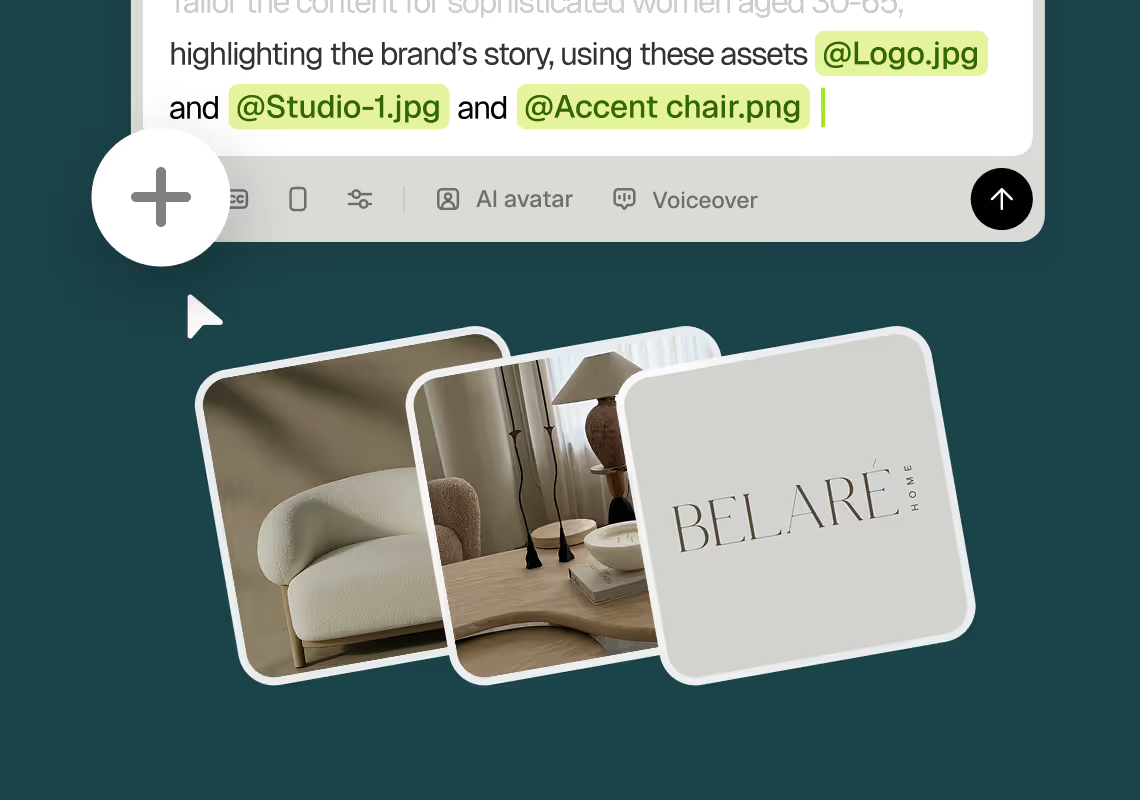
2Add assets and sources
Upload brand assets like logos and product images, or let the AI source stock visuals automatically.
 3
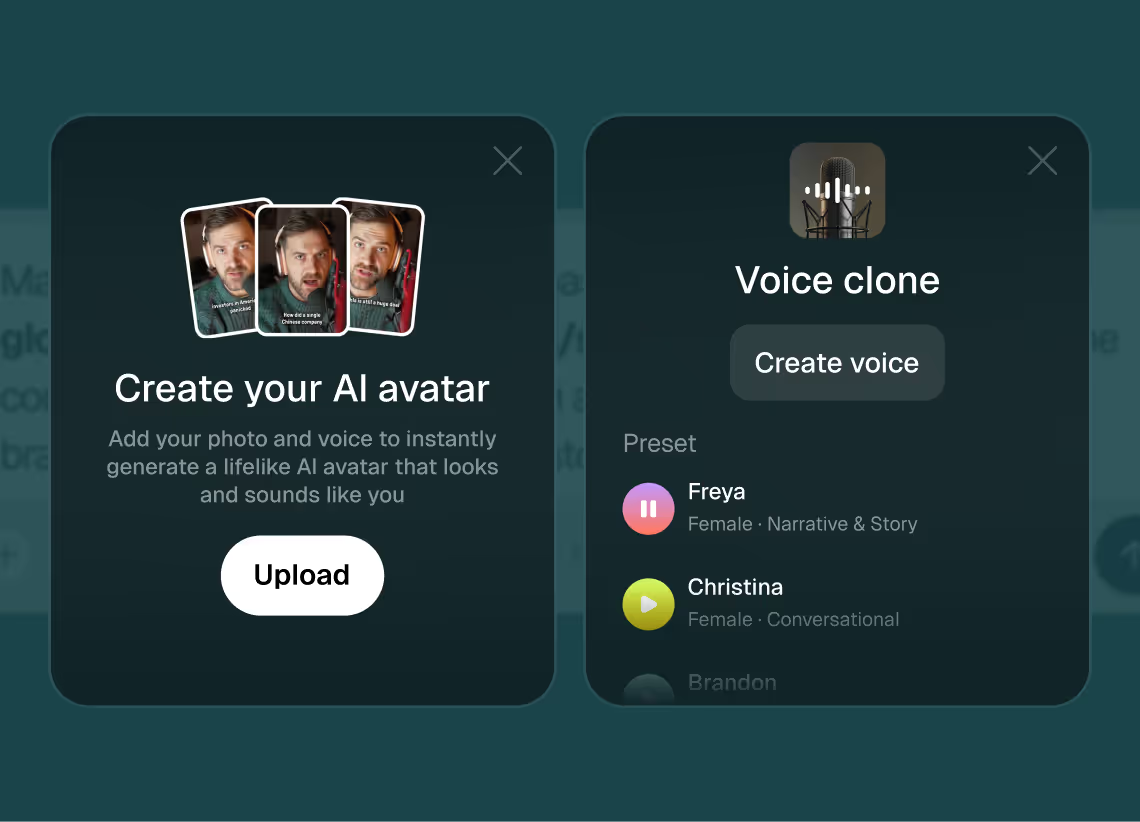
3Choose voice and avatar
Choose voice (clone yours or pick an AI voice) and avatar style (user or AI).
 4
4Generate and publish-ready
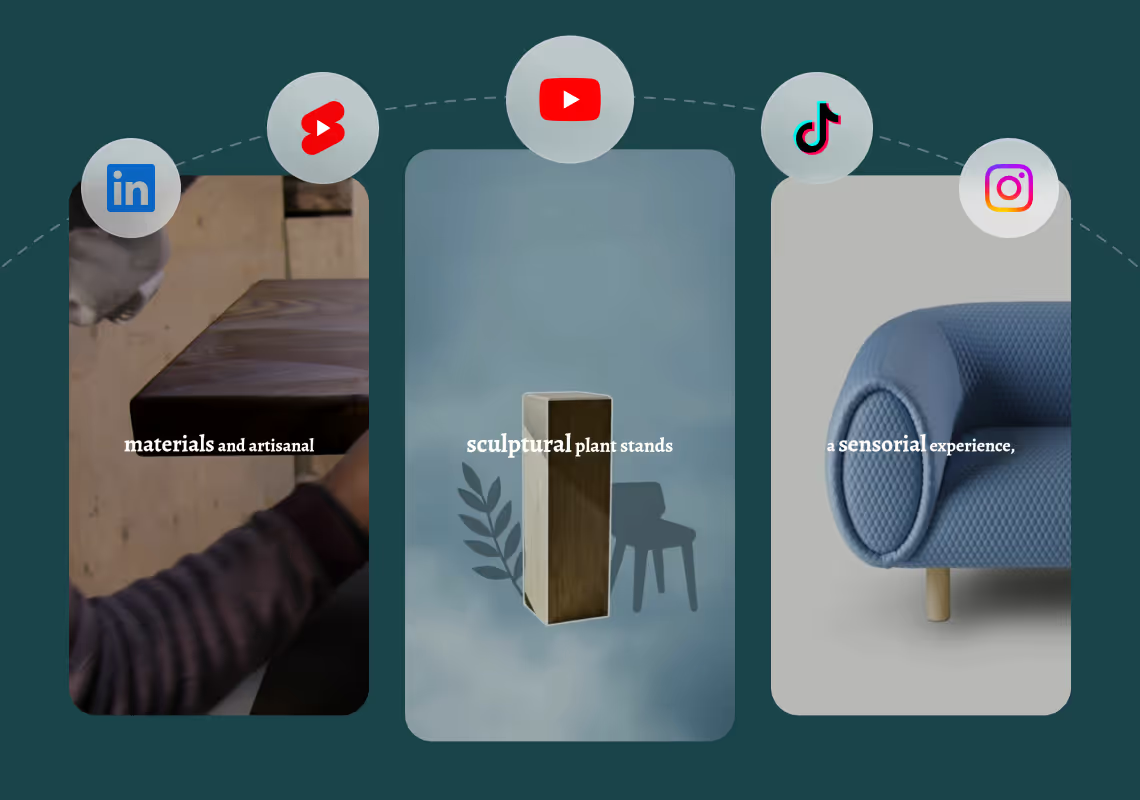
Click generate and download your finished promo video in seconds, ready to publish across all platforms.


8 powerful features of Agent Opus' Space Exploration Explainer Video Maker
Astronaut Avatar Presenters
Use AI avatars in space suits to deliver mission briefings and exploration updates.
Cosmic Visuals from Text
Transform space exploration scripts into stunning videos with planets, rockets, and galaxies rendered automatically.
Space Music Soundtracks
Add ambient cosmic music and sound effects that match your exploration narrative perfectly.
Astronomy Concept Narration
Generate voiceover explanations for black holes, orbits, and missions using natural AI voices.
Scientific Data Visualization
Turn space statistics and research findings into engaging animated charts and infographics.
Mission Timeline Graphics
Illustrate launch sequences, orbital maneuvers, and landing phases with animated motion graphics.
Educational Space Scenes
Create explainer videos showing solar systems, spacecraft, and celestial phenomena in seconds.
Planetary Comparison Videos
Generate side-by-side visuals comparing planet sizes, atmospheres, and surface conditions automatically.
Testimonials
This looks like a game-changer for us. We're building narrative-driven, visually layered content — and the ability to maintain character and motion consistency across episodes would be huge. If Agent Opus can sync branded motion graphics, tone, and avatar style seamlessly, it could easily become part of our production stack for short-form explainers and long-form investigative visuals.
srtaduck
I reviewed version a and I was very impressed with this version, it did very well in almost all aspects that users need, you would only have to make very small changes and maybe replace one of 2 of the pictures, but even saying that it could be used as is and still receive decent views or even chances at going viral depending on the story or the content the user chooses.
Jeremy
all in all LOVE THIS agent. I'm curious to see how I can push it (within reason) Just need to learn to get the consistency right with my prompts
Rebecca
Frequently Asked Questions
How does a Space Exploration Explainer Video Maker handle technical astronomy concepts versus simple overviews?
Agent Opus adapts its visual and narrative approach based on the complexity and detail in your input. For simple overviews like 'What is a nebula,' the system generates broad, visually stunning sequences with accessible narration, sourcing colorful Hubble-style imagery and creating smooth transitions between concept stages. For technical deep-dives—say, a script explaining orbital mechanics, Lagrange points, or spectroscopy—the system assembles more detailed visual sequences, including diagrams, labeled graphics, and step-by-step motion graphics that illustrate forces, trajectories, or light wavelengths. The key is your input specificity. A short prompt yields a concise, high-level explainer perfect for social media. A detailed script with equations, mission phases, or instrument specifications triggers the AI to source technical diagrams, mission schematics, and data visualizations, then pace the video to allow viewers time to absorb complex information. You can also guide tone in your prompt: 'Create an engaging intro to Mars rovers for middle schoolers' versus 'Explain the Perseverance sample-return mission for aerospace professionals' will yield very different visual density and narration styles. The motion graphics engine understands spatial relationships, so when you describe planetary orbits, satellite deployments, or gravitational assists, it generates accurate visual representations with appropriate scale and movement. For best results with technical content, include key terms, mission names, or specific phenomena in your script so the AI can source the right imagery and construct graphics that match the science.
What are best practices for prompts when using a Space Exploration Explainer Video Maker?
Effective prompts for space explainer videos balance clarity, structure, and visual cues. Start by defining your core concept and target audience. 'Explain how the James Webb Space Telescope works for a general audience' is stronger than just 'James Webb telescope' because it sets tone and depth. Include the narrative arc you want: introduction, problem or question, explanation, and conclusion. For example, 'Start with why we need infrared astronomy, explain Webb's mirror design and sunshield, show how it captures distant galaxies, end with its first discoveries.' This gives the AI a clear sequence to visualize. Mention specific visuals you want sourced: 'Include images of the telescope's hexagonal mirrors, the Carina Nebula, and comparison shots with Hubble.' The system will prioritize those elements when sourcing and assembling scenes. If you're explaining a process—like how rockets achieve orbit or how we detect exoplanets—break it into steps in your prompt or script. 'First, show the rocket on the launchpad. Second, illustrate the gravity turn and staging. Third, demonstrate orbital insertion with a diagram.' This structure helps the motion graphics engine create logical, sequential visuals. For voice and pacing, specify if you want a fast-paced social video or a slower educational piece. 'Create a 60-second TikTok explaining supernovas with energetic pacing' versus 'Generate a 3-minute YouTube explainer on stellar evolution with detailed narration.' If you have a brand voice or existing space education series, mention it: 'Use an enthusiastic, Carl Sagan-inspired tone' or 'Match the style of our previous Mars mission videos.' Finally, if you're working from a blog or article URL, ensure the source content is well-structured with clear headings and concepts—the AI extracts narrative flow and key points from that structure to build the video sequence.
Can a Space Exploration Explainer Video Maker maintain consistent branding and visual style across a video series?
Yes, and this is critical for educators, space organizations, and science communicators building a recognizable content library. Agent Opus supports brand consistency through several mechanisms. First, you can upload your logo, which the system integrates into the video—typically as a corner watermark or intro/outro element. If you're a space tech company, planetarium, or educational channel, this ensures every explainer carries your identity. Second, voice cloning creates perfect narration consistency. Record a short voice sample once, and every subsequent space explainer uses your cloned voice, whether you're explaining lunar geology, satellite constellations, or cosmic microwave background radiation. This is invaluable for series like 'Solar System Explained' or 'Space Missions Breakdown' where viewers expect the same narrator. Third, you can reference previous videos or style in your prompts. 'Generate this exoplanet video in the same visual style as our black hole explainer' helps the AI match motion graphics aesthetics, pacing, and visual density. If you've established a pattern—say, always starting with a wide cosmic zoom, using specific color palettes for diagrams, or ending with a call-to-action about your space education platform—describe that pattern in your prompt or script. The system will attempt to replicate it. For organizations producing regular content, consider creating a 'style guide' prompt template that you prepend to each new video brief: 'Use our blue-and-white color scheme for diagrams, include our logo in the bottom right, use our cloned voice, and maintain an enthusiastic but authoritative tone.' Then add your specific topic. This approach ensures every video in your space exploration series feels cohesive, building audience familiarity and trust. The AI also learns from the structure of your inputs—if you consistently format scripts with 'Hook / Explanation / Visual Example / Conclusion,' it will recognize and optimize for that flow, making each new video feel like part of a unified educational journey through space concepts.
What are the limitations or edge cases when generating space exploration explainer videos from text?
While Agent Opus excels at turning space concepts into visual stories, understanding its boundaries helps you craft better inputs and set realistic expectations. First, highly specialized or cutting-edge research may have limited visual references. If you're explaining a brand-new exoplanet discovery announced yesterday or a theoretical concept with no established imagery, the AI will source the closest available visuals—similar exoplanets, artist renderings, or conceptual diagrams—but may not have exact matches. In these cases, provide descriptive prompts: 'Use artist concepts of hot Jupiters' or 'Show generic telescope data visualizations' so the system knows what to substitute. Second, the motion graphics engine is powerful but works best with concepts that have clear spatial or sequential logic. Abstract topics like 'the philosophy of space exploration' or 'the emotional impact of seeing Earth from space' are harder to visualize than concrete processes like 'how ion drives work' or 'the stages of a solar eclipse.' For abstract topics, ground your script in specific examples, missions, or visual metaphors the AI can render. Third, video length and complexity have practical limits. A 30-second social explainer on 'What is a comet' is straightforward. A 15-minute deep-dive on 'The complete history of Mars exploration missions' will test the system's ability to maintain narrative coherence and visual variety across dozens of scenes. For longer content, consider breaking it into a series of shorter, focused videos. Fourth, accuracy depends on your input. If your script contains scientific errors—wrong planetary order, incorrect mission dates, or misunderstood physics—the AI will visualize what you wrote, not correct it. Always fact-check your space content before generation. Fifth, real-time or live footage isn't available. Agent Opus sources existing imagery and stock, so if you need footage of a rocket launch happening next week, you'll need to wait until that media is publicly available and indexed. Finally, while the system handles most astronomy and space mission topics beautifully, extremely niche subjects—like specific engineering tolerances of a spacecraft component or proprietary mission data—may require you to supply custom images or diagrams in your prompt, which the AI can then incorporate into the visual flow.