
What Is Clipping? How Film, TV & Music IPs are Winning New Audiences in 2026

September 14, 2026
Clipping is how a 40-year-old album, a mid-season streaming show, and a brand new single all end up on the same For You page. It is now one of the most-used promotional channels in entertainment, and most people scrolling past it have no idea it is marketing at all.

This is a breakdown of what clipping actually is, why it works so well for entertainment IP specifically, how a campaign runs from brief to payout, who the major agencies are, and where the tooling fits.

What is clipping?

Clipping is the practice of taking long-form content and redistributing it as short-form clips across hundreds or thousands of independent social accounts, with the people posting those clips paid based on the views they generate.

In practice, that means taking anything long, whether it is a music video, a live performance, a behind-the-scenes reel, or a sit-down interview, and cutting it into short pieces built for a feed. (Music Ally’s explainer on clipping in music is a good deeper read.)

The important distinction is what clipping is not. It is not influencer marketing.

In a traditional creator campaign, a label pays a handful of curated influencers a flat fee to post about a release. In a clipping campaign, an agency provides approved footage to a large network of independent clippers, who each cut their own version and post it to their own account. Nobody gets a flat fee. Everyone gets paid per thousand views.

The difference shows up in how it looks. Clipping resembles the fan content that springs up on its own around a song or a cultural moment, not like a small, hand-picked group of creators posting on cue for a release. The result is high-volume, native-looking distribution rather than a few polished placements.

The tactic started in livestreaming. Creators like Adin Ross, Kai Cenat, Druski, and MrBeast built early clipper armies to pull highlights out of hours-long streams. Music adopted it next. Film and television are adopting it now.

Why clipping works so well for entertainment IP

Entertainment is arguably the best-suited category for clipping of any industry, for a few structural reasons.

The content already exists

This is the big one. A studio, label, or production company is sitting on an enormous archive: music videos, performance footage, press junkets, behind-the-scenes reels, episodes, trailers, interviews, awards show appearances. Clipping monetizes that archive without asking anyone to produce anything new.

For music in particular, this solves a real and expensive problem. Asking artists to produce fresh social content every day burns them out and strains the relationship with their teams. Clipping sidesteps that, since most campaigns need nothing new from the artist to get started.

The same logic applies to a show that has already wrapped or a film that is already in the can. The asset is finished. Clipping just puts it in front of people.

The For You page fragmented, and clipping targets the pieces

The old playbook of paying one huge creator for a single post has stopped working, because the For You page is now split into thousands of niches and no single post reaches all of them. Music marketers interviewed by Music Ally describe clipping as the answer: a way to go after those niches one at a time.

Instead of one big placement, a campaign can push into anime edits, TV edits, concert edits, gym content, and film analysis simultaneously, testing which pocket of the internet responds hardest. That is much closer to how entertainment audiences actually cluster.

The cost structure is not close

Clipping campaigns run on CPM, and the numbers are dramatically lower than paid media. Industry estimates put a typical campaign at roughly $1,000 per million views, a small fraction of what the same impressions cost through paid social ads.

Published campaign results back this up. The Clip Ship reports ending CPMs of $0.16 on a Logic album rollout and $0.60 on a Netflix title.

It reaches the audience that does not watch ads

Clips do not enter the ad system, so platforms treat them as regular organic posts and distribute them accordingly. For entertainment brands trying to reach viewers under 30, who skip advertising by default, that is the whole ballgame. It is also why clipping has become a go-to for catalog rediscovery: introducing a 1960s performance or a decade-old sync to an audience that was never going to encounter it otherwise.

It is not just for new releases

Clipping is just as useful for bringing older catalog back into circulation: album anniversaries, holiday records, and sync moments when a track shows up in a new season of a show. The same is true for a streaming back catalog: a show’s fourth season dropping is a reason to re-clip seasons one through three.

"Traditional marketing is running out of road. Billboards are stuck in one zip code, and people have tuned ads out. Clipping meets consumers where they're actually making the decision to buy: to stream a show, grab a ticket, whatever that next step looks like.
There's a psychology behind it too. When the algorithm puts something in your feed, there's an implicit endorsement baked in: it thinks you'll like this, so you trust it more than an ad. And because clips keep living online long after spend stops, distributing at scale in the feeds doesn't just seed content during the release window. It keeps finding new audiences who didn't even know they were fans yet."

- Alec Schweitzer, founder and CEO, The Clip Ship

How clipping campaigns actually work

Most entertainment clipping runs through an agency rather than in-house, and most agency campaigns are hosted on Whop’s Content Rewards. Here is the full loop.

1. The agency sets up the campaign

The label, studio, or artist team hands over approved source material and agrees on the objective. The agency turns that into a campaign: a budget, a payout rate per thousand views, eligible platforms, and a set of rules.

Those rules do real work. They cover which hashtags to use, who to tag, minimum clip length, required on-screen text, and sometimes geographic targeting. Agencies typically supply a curated selection of footage rather than the raw archive, often somewhere between four and ten moments for clippers to choose from per campaign.

The campaign then goes live on a platform like Content Rewards, where it sits in a public marketplace alongside everything else currently recruiting.

2. Clippers find the campaign and join

Independent clippers browse the marketplace, filter by category and payout rate, and join the campaigns that fit what they are good at. There is no follower minimum and usually no application. Someone who runs a film-edit page can pick up a studio campaign the same day it launches.

This is why the agency model scales. The Clip Ship reports a network of 175,000+ creators. Clipping Culture reports 300,000+. A campaign can be in front of thousands of potential posters within hours of going live.

3. Clippers cut and post the content

Each clipper pulls the approved footage, finds a moment worth posting, edits it into a short, and publishes it to their own TikTok, Reels, or Shorts account. This is where tooling matters, and where most clippers now use AI editors like OpusClip to get from a two-hour source file to a batch of finished clips in minutes rather than an evening.

Volume is the whole game here. A campaign’s reach is the sum of every clipper’s output, so anything that raises output per clipper raises campaign performance.

4. Submission, verification, and payout

Clippers submit their post URLs back through the campaign. The agency reviews each submission against the guidelines, rejects anything non-compliant, and verifies the views that count. Payouts run on verified views up to a per-clip cap.

That verification step is what separates a real campaign from a vanity metric, and reputable agencies report results only on views they have verified. Turnaround from assets to live clips is fast across the board, typically one to two days.

Examples of entertainment clipping campaigns

Film and television

  • SERHANT, “Owning Manhattan” (Netflix). The Clip Ship ran a campaign around the series that reached the Netflix Top 10, at a reported ending CPM of $0.60.
  • Super Mario Galaxy. An animation and gaming IP campaign run across 15 creators at a $0.41 ending CPM.
  • Harry Styles on “Royal Court.” According to Variety, Whop hosted a clipping campaign around the appearance on Brittany Broski’s podcast, an example of talent-driven press being clipped as distribution rather than just coverage.

Music

  • bbno$. Clipping Culture’s largest published case study: 2.01 billion verified views across 25,245 clips. An earlier phase of the work reportedly generated 190 million views on a $9,000 budget.
  • Logic, “Paradise Records.” The Clip Ship generated 125M+ views on the album rollout at a $0.16 CPM.
  • Drake and PartyNextDoor. According to Music Ally’s coverage, their campaign for a recent joint album passed 100 million views.
  • John Summit, “Lights Go Out.” Variety reported that a campaign with a $1,050 initial budget produced 32.4 million views and 1.4 million likes across 29 approved clips from 13 creators in eight days. The top clip alone did 5.3 million.
  • ian, “Magic Johnson.” Widely cited as the first breakout case of an artist built substantially through clipping. He now has an XXL Freshman placement and 100M+ Spotify streams.
  • Others with public campaigns: Yung Gravy (401M+ views), Lucki, RUSS, The Rolling Stones, Lady Gaga, Selena Gomez, Jonas Brothers, Tate McRae, Mumford & Sons, and Brandi Carlile.

The pattern across all of them: nobody in front of the camera had to do anything new.

Top clipping agencies for entertainment brands

1. The Clip Ship

The most entertainment-native of the major agencies. Their published work spans music (Logic, Universal Music Group, Capitol Records), streaming television (Netflix), animation and gaming IP (Super Mario Galaxy), and live sports (Baller League). They run a network of 175,000+ creators across TikTok, Reels, and Shorts.

Their differentiator is pricing transparency. They run on a roughly $1 fixed CPM, say they do not mark up the rate between client and clipper or pad the reported numbers, and pitch themselves as a long-term partner rather than a one-off vendor. For a studio or label that needs defensible reporting, published ending CPMs on named titles are unusually concrete.

Best for: film, TV, and streaming campaigns, and any rights holder who needs clean, auditable numbers.

2. Clipping Culture

The largest network on this list, with 300,000+ active clippers and more than 10 billion verified views delivered. Their music case studies are the deepest published anywhere: bbno$ at 2.01B views across 25,245 clips, Yung Gravy at 401M, plus campaigns for The Rolling Stones, Lady Gaga, Selena Gomez, Jonas Brothers, and Tate McRae.

They run a pay-per-verified-view model with published pricing tiers, and campaigns go live one to two days after assets land. They also run podcast, public figure, and logo campaign formats alongside music.

Best for: music campaigns at scale, and rights holders who want the largest possible distribution network.

3. cliphaus

The broadest platform coverage of the three, distributing across TikTok, Instagram Reels, YouTube Shorts, X, and Facebook rather than the usual three. Their entertainment client list includes Atlantic Records, Universal Music Group, and Twenty One Pilots, and they run dedicated music, podcast, and streamer campaign formats through a network of 150,000+ creators.

They claim the fastest launch window in the category at 24 to 48 hours, which matters for reactive moments like an awards show performance or a viral press clip.

Best for: campaigns that need to move within a day, or that want reach on X and Facebook alongside the core three platforms.

How OpusClip fits into entertainment clipping

Every campaign above depends on the same thing: enough clippers producing enough clips. A campaign with 2,000 participating accounts and low output per account underperforms one with 300 accounts producing consistently. Supply-side throughput is the constraint.

That is the specific problem OpusClip solves, and entertainment footage is where it has the most to work with.

Finding the moment in long-form source material. Campaigns hand clippers concert footage, full episodes, press junkets, and hour-long interviews. OpusClip’s AI analyzes the transcript, audio, and visuals together and pulls self-contained segments with a real hook and a clean in and out point, so a clipper is not scrubbing a two-hour file to find four usable moments.

ClipAnything, for footage where the words are not the story. This matters more in entertainment than anywhere else. A music video, a performance, a fight scene, an animated sequence: none of these are legible to a transcript-based tool. ClipAnything reads visual scenes, audio cues, actions, and on-screen text, and takes plain-language direction like “find the moments where the crowd goes off” or “every shot with the lead in frame.”

Virality Score, for choosing what to actually post. A single source video can generate dozens of candidate clips. Each one gets scored 0 to 100 with a breakdown across hook, flow, value, and trend, so clippers can prioritize the handful most likely to land rather than posting everything and hoping.

Campaign compliance, built in. Most rejected submissions are not bad clips. They are good clips that missed a requirement. Brand Templates let a clipper save a campaign’s caption style, required on-screen text, tags, and logo placement once, so every clip for that campaign comes out compliant. Auto-captioning, 9:16 reframing with speaker tracking, and built-in post scheduling handle the rest of the mechanical work.

The net effect is throughput. A clipper who could produce two finished clips in an evening can produce dozens, which means more shots at a viral hit for them, and more total reach for the campaign they are working on.

The takeaway

Clipping has moved from a livestreaming curiosity to a standard line item in entertainment marketing budgets, and the reason is not complicated. It monetizes footage that already exists, it reaches an audience that actively avoids advertising, it costs a fraction of paid media per impression, and it does not require the talent to do anything at all.

For rights holders sitting on a catalog, the question has quietly shifted from whether to clip to who runs it and how fast it can go live.

Working on clips for an entertainment campaign? Try OpusClip free and turn long-form footage into a batch of ready-to-post clips in minutes.
On this page

Use our Free Forever Plan

Find the moment. Skip the scrubbing.

From script to polished video — in one click.

Create and post one short video every day for free, and grow faster.

OpusSearch uses AI to surface the exact clip you need from hours of footage — in seconds, not afternoons.

Agent Opus runs the entire video pipeline for you: research, scriptwriting, storyboarding, motion, voice, and edit. Upload the idea, post the result.

What Is Clipping? How Film, TV & Music IPs are Winning New Audiences in 2026

Clipping is how a 40-year-old album, a mid-season streaming show, and a brand new single all end up on the same For You page. It is now one of the most-used promotional channels in entertainment, and most people scrolling past it have no idea it is marketing at all.

This is a breakdown of what clipping actually is, why it works so well for entertainment IP specifically, how a campaign runs from brief to payout, who the major agencies are, and where the tooling fits.

What is clipping?

Clipping is the practice of taking long-form content and redistributing it as short-form clips across hundreds or thousands of independent social accounts, with the people posting those clips paid based on the views they generate.

In practice, that means taking anything long, whether it is a music video, a live performance, a behind-the-scenes reel, or a sit-down interview, and cutting it into short pieces built for a feed. (Music Ally’s explainer on clipping in music is a good deeper read.)

The important distinction is what clipping is not. It is not influencer marketing.

In a traditional creator campaign, a label pays a handful of curated influencers a flat fee to post about a release. In a clipping campaign, an agency provides approved footage to a large network of independent clippers, who each cut their own version and post it to their own account. Nobody gets a flat fee. Everyone gets paid per thousand views.

The difference shows up in how it looks. Clipping resembles the fan content that springs up on its own around a song or a cultural moment, not like a small, hand-picked group of creators posting on cue for a release. The result is high-volume, native-looking distribution rather than a few polished placements.

The tactic started in livestreaming. Creators like Adin Ross, Kai Cenat, Druski, and MrBeast built early clipper armies to pull highlights out of hours-long streams. Music adopted it next. Film and television are adopting it now.

Why clipping works so well for entertainment IP

Entertainment is arguably the best-suited category for clipping of any industry, for a few structural reasons.

The content already exists

This is the big one. A studio, label, or production company is sitting on an enormous archive: music videos, performance footage, press junkets, behind-the-scenes reels, episodes, trailers, interviews, awards show appearances. Clipping monetizes that archive without asking anyone to produce anything new.

For music in particular, this solves a real and expensive problem. Asking artists to produce fresh social content every day burns them out and strains the relationship with their teams. Clipping sidesteps that, since most campaigns need nothing new from the artist to get started.

The same logic applies to a show that has already wrapped or a film that is already in the can. The asset is finished. Clipping just puts it in front of people.

The For You page fragmented, and clipping targets the pieces

The old playbook of paying one huge creator for a single post has stopped working, because the For You page is now split into thousands of niches and no single post reaches all of them. Music marketers interviewed by Music Ally describe clipping as the answer: a way to go after those niches one at a time.

Instead of one big placement, a campaign can push into anime edits, TV edits, concert edits, gym content, and film analysis simultaneously, testing which pocket of the internet responds hardest. That is much closer to how entertainment audiences actually cluster.

The cost structure is not close

Clipping campaigns run on CPM, and the numbers are dramatically lower than paid media. Industry estimates put a typical campaign at roughly $1,000 per million views, a small fraction of what the same impressions cost through paid social ads.

Published campaign results back this up. The Clip Ship reports ending CPMs of $0.16 on a Logic album rollout and $0.60 on a Netflix title.

It reaches the audience that does not watch ads

Clips do not enter the ad system, so platforms treat them as regular organic posts and distribute them accordingly. For entertainment brands trying to reach viewers under 30, who skip advertising by default, that is the whole ballgame. It is also why clipping has become a go-to for catalog rediscovery: introducing a 1960s performance or a decade-old sync to an audience that was never going to encounter it otherwise.

It is not just for new releases

Clipping is just as useful for bringing older catalog back into circulation: album anniversaries, holiday records, and sync moments when a track shows up in a new season of a show. The same is true for a streaming back catalog: a show’s fourth season dropping is a reason to re-clip seasons one through three.

"Traditional marketing is running out of road. Billboards are stuck in one zip code, and people have tuned ads out. Clipping meets consumers where they're actually making the decision to buy: to stream a show, grab a ticket, whatever that next step looks like.
There's a psychology behind it too. When the algorithm puts something in your feed, there's an implicit endorsement baked in: it thinks you'll like this, so you trust it more than an ad. And because clips keep living online long after spend stops, distributing at scale in the feeds doesn't just seed content during the release window. It keeps finding new audiences who didn't even know they were fans yet."

- Alec Schweitzer, founder and CEO, The Clip Ship

How clipping campaigns actually work

Most entertainment clipping runs through an agency rather than in-house, and most agency campaigns are hosted on Whop’s Content Rewards. Here is the full loop.

1. The agency sets up the campaign

The label, studio, or artist team hands over approved source material and agrees on the objective. The agency turns that into a campaign: a budget, a payout rate per thousand views, eligible platforms, and a set of rules.

Those rules do real work. They cover which hashtags to use, who to tag, minimum clip length, required on-screen text, and sometimes geographic targeting. Agencies typically supply a curated selection of footage rather than the raw archive, often somewhere between four and ten moments for clippers to choose from per campaign.

The campaign then goes live on a platform like Content Rewards, where it sits in a public marketplace alongside everything else currently recruiting.

2. Clippers find the campaign and join

Independent clippers browse the marketplace, filter by category and payout rate, and join the campaigns that fit what they are good at. There is no follower minimum and usually no application. Someone who runs a film-edit page can pick up a studio campaign the same day it launches.

This is why the agency model scales. The Clip Ship reports a network of 175,000+ creators. Clipping Culture reports 300,000+. A campaign can be in front of thousands of potential posters within hours of going live.

3. Clippers cut and post the content

Each clipper pulls the approved footage, finds a moment worth posting, edits it into a short, and publishes it to their own TikTok, Reels, or Shorts account. This is where tooling matters, and where most clippers now use AI editors like OpusClip to get from a two-hour source file to a batch of finished clips in minutes rather than an evening.

Volume is the whole game here. A campaign’s reach is the sum of every clipper’s output, so anything that raises output per clipper raises campaign performance.

4. Submission, verification, and payout

Clippers submit their post URLs back through the campaign. The agency reviews each submission against the guidelines, rejects anything non-compliant, and verifies the views that count. Payouts run on verified views up to a per-clip cap.

That verification step is what separates a real campaign from a vanity metric, and reputable agencies report results only on views they have verified. Turnaround from assets to live clips is fast across the board, typically one to two days.

Examples of entertainment clipping campaigns

Film and television

  • SERHANT, “Owning Manhattan” (Netflix). The Clip Ship ran a campaign around the series that reached the Netflix Top 10, at a reported ending CPM of $0.60.
  • Super Mario Galaxy. An animation and gaming IP campaign run across 15 creators at a $0.41 ending CPM.
  • Harry Styles on “Royal Court.” According to Variety, Whop hosted a clipping campaign around the appearance on Brittany Broski’s podcast, an example of talent-driven press being clipped as distribution rather than just coverage.

Music

  • bbno$. Clipping Culture’s largest published case study: 2.01 billion verified views across 25,245 clips. An earlier phase of the work reportedly generated 190 million views on a $9,000 budget.
  • Logic, “Paradise Records.” The Clip Ship generated 125M+ views on the album rollout at a $0.16 CPM.
  • Drake and PartyNextDoor. According to Music Ally’s coverage, their campaign for a recent joint album passed 100 million views.
  • John Summit, “Lights Go Out.” Variety reported that a campaign with a $1,050 initial budget produced 32.4 million views and 1.4 million likes across 29 approved clips from 13 creators in eight days. The top clip alone did 5.3 million.
  • ian, “Magic Johnson.” Widely cited as the first breakout case of an artist built substantially through clipping. He now has an XXL Freshman placement and 100M+ Spotify streams.
  • Others with public campaigns: Yung Gravy (401M+ views), Lucki, RUSS, The Rolling Stones, Lady Gaga, Selena Gomez, Jonas Brothers, Tate McRae, Mumford & Sons, and Brandi Carlile.

The pattern across all of them: nobody in front of the camera had to do anything new.

Top clipping agencies for entertainment brands

1. The Clip Ship

The most entertainment-native of the major agencies. Their published work spans music (Logic, Universal Music Group, Capitol Records), streaming television (Netflix), animation and gaming IP (Super Mario Galaxy), and live sports (Baller League). They run a network of 175,000+ creators across TikTok, Reels, and Shorts.

Their differentiator is pricing transparency. They run on a roughly $1 fixed CPM, say they do not mark up the rate between client and clipper or pad the reported numbers, and pitch themselves as a long-term partner rather than a one-off vendor. For a studio or label that needs defensible reporting, published ending CPMs on named titles are unusually concrete.

Best for: film, TV, and streaming campaigns, and any rights holder who needs clean, auditable numbers.

2. Clipping Culture

The largest network on this list, with 300,000+ active clippers and more than 10 billion verified views delivered. Their music case studies are the deepest published anywhere: bbno$ at 2.01B views across 25,245 clips, Yung Gravy at 401M, plus campaigns for The Rolling Stones, Lady Gaga, Selena Gomez, Jonas Brothers, and Tate McRae.

They run a pay-per-verified-view model with published pricing tiers, and campaigns go live one to two days after assets land. They also run podcast, public figure, and logo campaign formats alongside music.

Best for: music campaigns at scale, and rights holders who want the largest possible distribution network.

3. cliphaus

The broadest platform coverage of the three, distributing across TikTok, Instagram Reels, YouTube Shorts, X, and Facebook rather than the usual three. Their entertainment client list includes Atlantic Records, Universal Music Group, and Twenty One Pilots, and they run dedicated music, podcast, and streamer campaign formats through a network of 150,000+ creators.

They claim the fastest launch window in the category at 24 to 48 hours, which matters for reactive moments like an awards show performance or a viral press clip.

Best for: campaigns that need to move within a day, or that want reach on X and Facebook alongside the core three platforms.

How OpusClip fits into entertainment clipping

Every campaign above depends on the same thing: enough clippers producing enough clips. A campaign with 2,000 participating accounts and low output per account underperforms one with 300 accounts producing consistently. Supply-side throughput is the constraint.

That is the specific problem OpusClip solves, and entertainment footage is where it has the most to work with.

Finding the moment in long-form source material. Campaigns hand clippers concert footage, full episodes, press junkets, and hour-long interviews. OpusClip’s AI analyzes the transcript, audio, and visuals together and pulls self-contained segments with a real hook and a clean in and out point, so a clipper is not scrubbing a two-hour file to find four usable moments.

ClipAnything, for footage where the words are not the story. This matters more in entertainment than anywhere else. A music video, a performance, a fight scene, an animated sequence: none of these are legible to a transcript-based tool. ClipAnything reads visual scenes, audio cues, actions, and on-screen text, and takes plain-language direction like “find the moments where the crowd goes off” or “every shot with the lead in frame.”

Virality Score, for choosing what to actually post. A single source video can generate dozens of candidate clips. Each one gets scored 0 to 100 with a breakdown across hook, flow, value, and trend, so clippers can prioritize the handful most likely to land rather than posting everything and hoping.

Campaign compliance, built in. Most rejected submissions are not bad clips. They are good clips that missed a requirement. Brand Templates let a clipper save a campaign’s caption style, required on-screen text, tags, and logo placement once, so every clip for that campaign comes out compliant. Auto-captioning, 9:16 reframing with speaker tracking, and built-in post scheduling handle the rest of the mechanical work.

The net effect is throughput. A clipper who could produce two finished clips in an evening can produce dozens, which means more shots at a viral hit for them, and more total reach for the campaign they are working on.

The takeaway

Clipping has moved from a livestreaming curiosity to a standard line item in entertainment marketing budgets, and the reason is not complicated. It monetizes footage that already exists, it reaches an audience that actively avoids advertising, it costs a fraction of paid media per impression, and it does not require the talent to do anything at all.

For rights holders sitting on a catalog, the question has quietly shifted from whether to clip to who runs it and how fast it can go live.

Working on clips for an entertainment campaign? Try OpusClip free and turn long-form footage into a batch of ready-to-post clips in minutes.

Creator name

Creator type

Team size

Channels

linkYouTubefacebookXTikTok

Pain point

Time to see positive ROI

About the creator

Don't miss these

47K to 300K: How Dr. Nick Turns Research Into $15K Clients
No items found.

47K to 300K: How Dr. Nick Turns Research Into $15K Clients

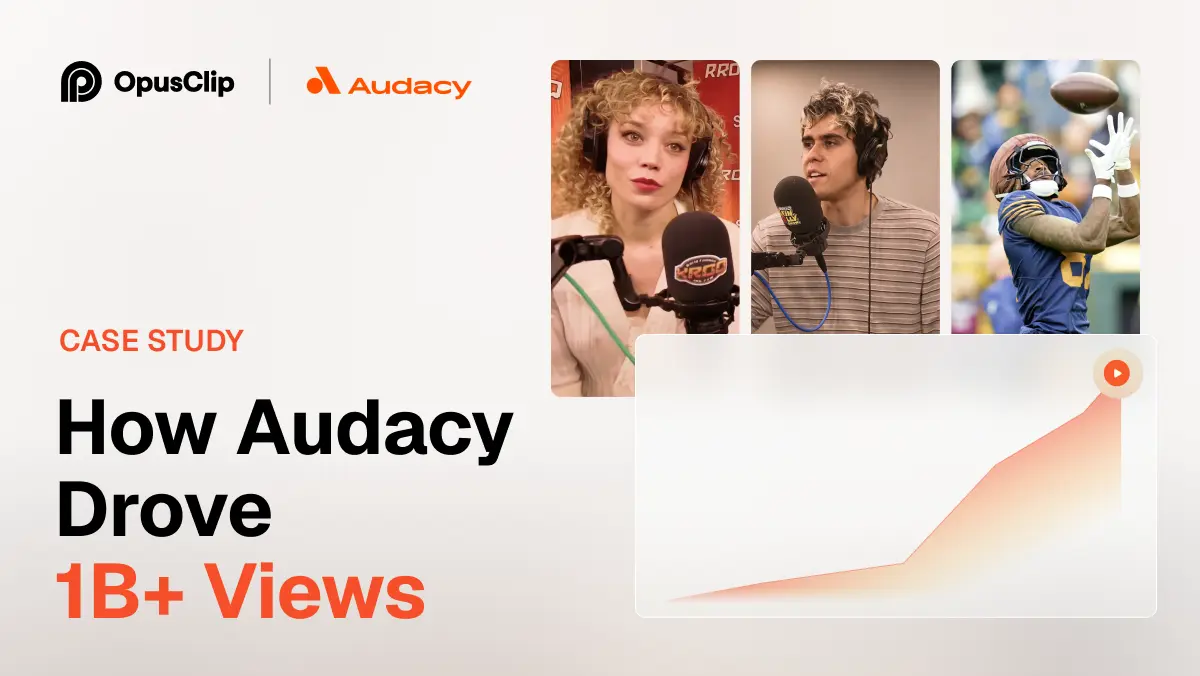
How Audacy Drove 1B+ Views by Taking a Tech-Forward Approach to Radio with OpusClip
No items found.

How Audacy Drove 1B+ Views by Taking a Tech-Forward Approach to Radio with OpusClip

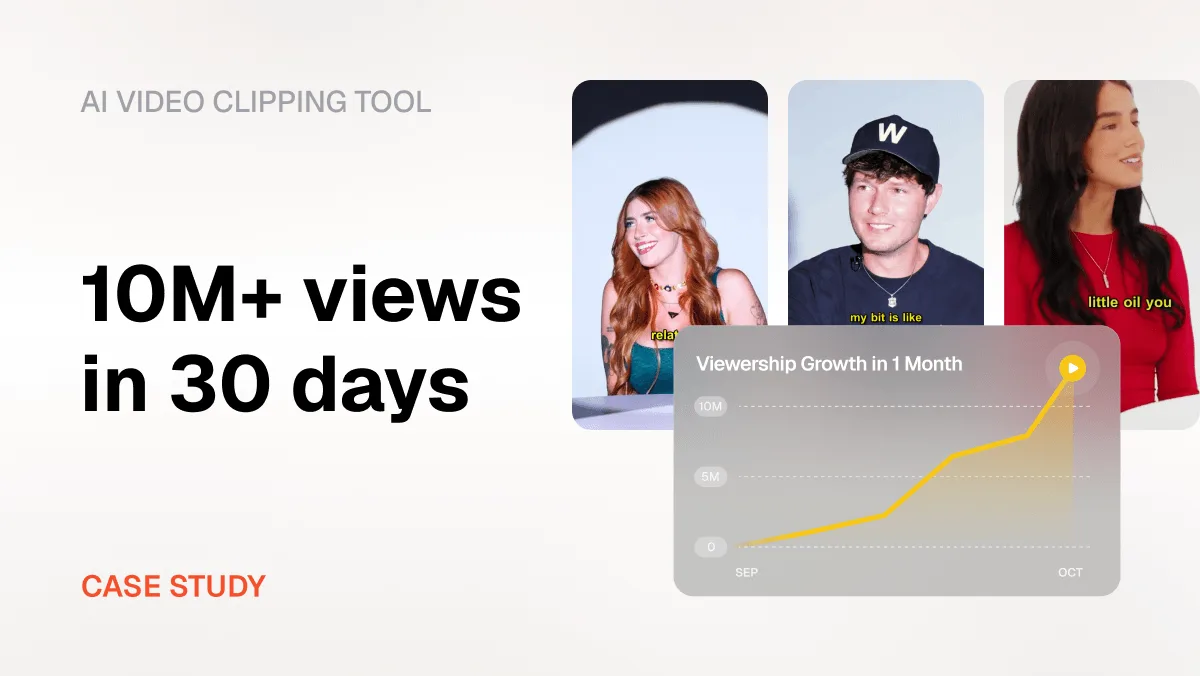
How creators are earning 10M+ views in 1 month using video clipping
No items found.

How creators are earning 10M+ views in 1 month using video clipping

What Is Clipping? How Film, TV & Music IPs are Winning New Audiences in 2026

No items found.
No items found.

Boost your social media growth with OpusClip

Create and post one short video every day for your social media and grow faster.

What Is Clipping? How Film, TV & Music IPs are Winning New Audiences in 2026

Clipping is how a 40-year-old album, a mid-season streaming show, and a brand new single all end up on the same For You page. It is now one of the most-used promotional channels in entertainment, and most people scrolling past it have no idea it is marketing at all.

This is a breakdown of what clipping actually is, why it works so well for entertainment IP specifically, how a campaign runs from brief to payout, who the major agencies are, and where the tooling fits.

What is clipping?

Clipping is the practice of taking long-form content and redistributing it as short-form clips across hundreds or thousands of independent social accounts, with the people posting those clips paid based on the views they generate.

In practice, that means taking anything long, whether it is a music video, a live performance, a behind-the-scenes reel, or a sit-down interview, and cutting it into short pieces built for a feed. (Music Ally’s explainer on clipping in music is a good deeper read.)

The important distinction is what clipping is not. It is not influencer marketing.

In a traditional creator campaign, a label pays a handful of curated influencers a flat fee to post about a release. In a clipping campaign, an agency provides approved footage to a large network of independent clippers, who each cut their own version and post it to their own account. Nobody gets a flat fee. Everyone gets paid per thousand views.

The difference shows up in how it looks. Clipping resembles the fan content that springs up on its own around a song or a cultural moment, not like a small, hand-picked group of creators posting on cue for a release. The result is high-volume, native-looking distribution rather than a few polished placements.

The tactic started in livestreaming. Creators like Adin Ross, Kai Cenat, Druski, and MrBeast built early clipper armies to pull highlights out of hours-long streams. Music adopted it next. Film and television are adopting it now.

Why clipping works so well for entertainment IP

Entertainment is arguably the best-suited category for clipping of any industry, for a few structural reasons.

The content already exists

This is the big one. A studio, label, or production company is sitting on an enormous archive: music videos, performance footage, press junkets, behind-the-scenes reels, episodes, trailers, interviews, awards show appearances. Clipping monetizes that archive without asking anyone to produce anything new.

For music in particular, this solves a real and expensive problem. Asking artists to produce fresh social content every day burns them out and strains the relationship with their teams. Clipping sidesteps that, since most campaigns need nothing new from the artist to get started.

The same logic applies to a show that has already wrapped or a film that is already in the can. The asset is finished. Clipping just puts it in front of people.

The For You page fragmented, and clipping targets the pieces

The old playbook of paying one huge creator for a single post has stopped working, because the For You page is now split into thousands of niches and no single post reaches all of them. Music marketers interviewed by Music Ally describe clipping as the answer: a way to go after those niches one at a time.

Instead of one big placement, a campaign can push into anime edits, TV edits, concert edits, gym content, and film analysis simultaneously, testing which pocket of the internet responds hardest. That is much closer to how entertainment audiences actually cluster.

The cost structure is not close

Clipping campaigns run on CPM, and the numbers are dramatically lower than paid media. Industry estimates put a typical campaign at roughly $1,000 per million views, a small fraction of what the same impressions cost through paid social ads.

Published campaign results back this up. The Clip Ship reports ending CPMs of $0.16 on a Logic album rollout and $0.60 on a Netflix title.

It reaches the audience that does not watch ads

Clips do not enter the ad system, so platforms treat them as regular organic posts and distribute them accordingly. For entertainment brands trying to reach viewers under 30, who skip advertising by default, that is the whole ballgame. It is also why clipping has become a go-to for catalog rediscovery: introducing a 1960s performance or a decade-old sync to an audience that was never going to encounter it otherwise.

It is not just for new releases

Clipping is just as useful for bringing older catalog back into circulation: album anniversaries, holiday records, and sync moments when a track shows up in a new season of a show. The same is true for a streaming back catalog: a show’s fourth season dropping is a reason to re-clip seasons one through three.

"Traditional marketing is running out of road. Billboards are stuck in one zip code, and people have tuned ads out. Clipping meets consumers where they're actually making the decision to buy: to stream a show, grab a ticket, whatever that next step looks like.
There's a psychology behind it too. When the algorithm puts something in your feed, there's an implicit endorsement baked in: it thinks you'll like this, so you trust it more than an ad. And because clips keep living online long after spend stops, distributing at scale in the feeds doesn't just seed content during the release window. It keeps finding new audiences who didn't even know they were fans yet."

- Alec Schweitzer, founder and CEO, The Clip Ship

How clipping campaigns actually work

Most entertainment clipping runs through an agency rather than in-house, and most agency campaigns are hosted on Whop’s Content Rewards. Here is the full loop.

1. The agency sets up the campaign

The label, studio, or artist team hands over approved source material and agrees on the objective. The agency turns that into a campaign: a budget, a payout rate per thousand views, eligible platforms, and a set of rules.

Those rules do real work. They cover which hashtags to use, who to tag, minimum clip length, required on-screen text, and sometimes geographic targeting. Agencies typically supply a curated selection of footage rather than the raw archive, often somewhere between four and ten moments for clippers to choose from per campaign.

The campaign then goes live on a platform like Content Rewards, where it sits in a public marketplace alongside everything else currently recruiting.

2. Clippers find the campaign and join

Independent clippers browse the marketplace, filter by category and payout rate, and join the campaigns that fit what they are good at. There is no follower minimum and usually no application. Someone who runs a film-edit page can pick up a studio campaign the same day it launches.

This is why the agency model scales. The Clip Ship reports a network of 175,000+ creators. Clipping Culture reports 300,000+. A campaign can be in front of thousands of potential posters within hours of going live.

3. Clippers cut and post the content

Each clipper pulls the approved footage, finds a moment worth posting, edits it into a short, and publishes it to their own TikTok, Reels, or Shorts account. This is where tooling matters, and where most clippers now use AI editors like OpusClip to get from a two-hour source file to a batch of finished clips in minutes rather than an evening.

Volume is the whole game here. A campaign’s reach is the sum of every clipper’s output, so anything that raises output per clipper raises campaign performance.

4. Submission, verification, and payout

Clippers submit their post URLs back through the campaign. The agency reviews each submission against the guidelines, rejects anything non-compliant, and verifies the views that count. Payouts run on verified views up to a per-clip cap.

That verification step is what separates a real campaign from a vanity metric, and reputable agencies report results only on views they have verified. Turnaround from assets to live clips is fast across the board, typically one to two days.

Examples of entertainment clipping campaigns

Film and television

  • SERHANT, “Owning Manhattan” (Netflix). The Clip Ship ran a campaign around the series that reached the Netflix Top 10, at a reported ending CPM of $0.60.
  • Super Mario Galaxy. An animation and gaming IP campaign run across 15 creators at a $0.41 ending CPM.
  • Harry Styles on “Royal Court.” According to Variety, Whop hosted a clipping campaign around the appearance on Brittany Broski’s podcast, an example of talent-driven press being clipped as distribution rather than just coverage.

Music

  • bbno$. Clipping Culture’s largest published case study: 2.01 billion verified views across 25,245 clips. An earlier phase of the work reportedly generated 190 million views on a $9,000 budget.
  • Logic, “Paradise Records.” The Clip Ship generated 125M+ views on the album rollout at a $0.16 CPM.
  • Drake and PartyNextDoor. According to Music Ally’s coverage, their campaign for a recent joint album passed 100 million views.
  • John Summit, “Lights Go Out.” Variety reported that a campaign with a $1,050 initial budget produced 32.4 million views and 1.4 million likes across 29 approved clips from 13 creators in eight days. The top clip alone did 5.3 million.
  • ian, “Magic Johnson.” Widely cited as the first breakout case of an artist built substantially through clipping. He now has an XXL Freshman placement and 100M+ Spotify streams.
  • Others with public campaigns: Yung Gravy (401M+ views), Lucki, RUSS, The Rolling Stones, Lady Gaga, Selena Gomez, Jonas Brothers, Tate McRae, Mumford & Sons, and Brandi Carlile.

The pattern across all of them: nobody in front of the camera had to do anything new.

Top clipping agencies for entertainment brands

1. The Clip Ship

The most entertainment-native of the major agencies. Their published work spans music (Logic, Universal Music Group, Capitol Records), streaming television (Netflix), animation and gaming IP (Super Mario Galaxy), and live sports (Baller League). They run a network of 175,000+ creators across TikTok, Reels, and Shorts.

Their differentiator is pricing transparency. They run on a roughly $1 fixed CPM, say they do not mark up the rate between client and clipper or pad the reported numbers, and pitch themselves as a long-term partner rather than a one-off vendor. For a studio or label that needs defensible reporting, published ending CPMs on named titles are unusually concrete.

Best for: film, TV, and streaming campaigns, and any rights holder who needs clean, auditable numbers.

2. Clipping Culture

The largest network on this list, with 300,000+ active clippers and more than 10 billion verified views delivered. Their music case studies are the deepest published anywhere: bbno$ at 2.01B views across 25,245 clips, Yung Gravy at 401M, plus campaigns for The Rolling Stones, Lady Gaga, Selena Gomez, Jonas Brothers, and Tate McRae.

They run a pay-per-verified-view model with published pricing tiers, and campaigns go live one to two days after assets land. They also run podcast, public figure, and logo campaign formats alongside music.

Best for: music campaigns at scale, and rights holders who want the largest possible distribution network.

3. cliphaus

The broadest platform coverage of the three, distributing across TikTok, Instagram Reels, YouTube Shorts, X, and Facebook rather than the usual three. Their entertainment client list includes Atlantic Records, Universal Music Group, and Twenty One Pilots, and they run dedicated music, podcast, and streamer campaign formats through a network of 150,000+ creators.

They claim the fastest launch window in the category at 24 to 48 hours, which matters for reactive moments like an awards show performance or a viral press clip.

Best for: campaigns that need to move within a day, or that want reach on X and Facebook alongside the core three platforms.

How OpusClip fits into entertainment clipping

Every campaign above depends on the same thing: enough clippers producing enough clips. A campaign with 2,000 participating accounts and low output per account underperforms one with 300 accounts producing consistently. Supply-side throughput is the constraint.

That is the specific problem OpusClip solves, and entertainment footage is where it has the most to work with.

Finding the moment in long-form source material. Campaigns hand clippers concert footage, full episodes, press junkets, and hour-long interviews. OpusClip’s AI analyzes the transcript, audio, and visuals together and pulls self-contained segments with a real hook and a clean in and out point, so a clipper is not scrubbing a two-hour file to find four usable moments.

ClipAnything, for footage where the words are not the story. This matters more in entertainment than anywhere else. A music video, a performance, a fight scene, an animated sequence: none of these are legible to a transcript-based tool. ClipAnything reads visual scenes, audio cues, actions, and on-screen text, and takes plain-language direction like “find the moments where the crowd goes off” or “every shot with the lead in frame.”

Virality Score, for choosing what to actually post. A single source video can generate dozens of candidate clips. Each one gets scored 0 to 100 with a breakdown across hook, flow, value, and trend, so clippers can prioritize the handful most likely to land rather than posting everything and hoping.

Campaign compliance, built in. Most rejected submissions are not bad clips. They are good clips that missed a requirement. Brand Templates let a clipper save a campaign’s caption style, required on-screen text, tags, and logo placement once, so every clip for that campaign comes out compliant. Auto-captioning, 9:16 reframing with speaker tracking, and built-in post scheduling handle the rest of the mechanical work.

The net effect is throughput. A clipper who could produce two finished clips in an evening can produce dozens, which means more shots at a viral hit for them, and more total reach for the campaign they are working on.

The takeaway

Clipping has moved from a livestreaming curiosity to a standard line item in entertainment marketing budgets, and the reason is not complicated. It monetizes footage that already exists, it reaches an audience that actively avoids advertising, it costs a fraction of paid media per impression, and it does not require the talent to do anything at all.

For rights holders sitting on a catalog, the question has quietly shifted from whether to clip to who runs it and how fast it can go live.

Working on clips for an entertainment campaign? Try OpusClip free and turn long-form footage into a batch of ready-to-post clips in minutes.

Ready to start streaming differently?

Opus is completely FREE for one year for all private beta users. You can get access to all our premium features during this period. We also offer free support for production, studio design, and content repurposing to help you grow.
Join the beta
Limited spots remaining

Try OPUS today

Try Opus Studio

Make your live stream your Magnum Opus