Canva's Magic Layers Shows Why AI-Native Video Tools Are Winning

March 11, 2026
Canva's Magic Layers Shows Why AI-Native Video Tools Are Winning

Canva's Magic Layers Shows Why AI-Native Video Tools Are Winning

Canva just dropped a feature that should make every content creator pay attention. Magic Layers, now in public beta across the US, UK, Canada, and Australia, transforms flat images and AI-generated visuals into fully editable, layered designs. Objects, text boxes, and graphics become individually selectable while preserving the original layout.

This is not just a cool feature update. It signals something bigger: the entire creative software industry is racing toward AI-native architecture. And for video creators, this shift explains exactly why AI-native video tools are winning the battle for attention, efficiency, and output quality in 2026.

The question is no longer whether AI will transform creative workflows. The question is whether you are using tools built from the ground up for this new reality.

What Canva's Magic Layers Actually Does

Before diving into the broader implications, let us understand what Canva shipped. Magic Layers uses AI to analyze any flat image file or AI-generated visual and automatically separates it into distinct, editable components.

The Technical Breakdown

Traditional image editing requires manual layer creation. You import a flat PNG or JPEG, and everything sits on one layer. Want to move that text? You need to recreate it. Want to adjust that background element? Time to mask and cut.

Magic Layers eliminates this friction entirely:

  • Automatic object detection identifies distinct visual elements
  • Layer separation preserves spatial relationships and original positioning
  • Non-destructive editing lets you modify individual components without affecting others
  • AI-powered reconstruction fills gaps when you move or remove elements

This means a social media graphic you downloaded, an AI-generated image from any tool, or even a screenshot can become a fully editable design in seconds.

Why This Matters for the Industry

Canva is not a small player experimenting with AI. They serve over 170 million monthly active users. When they ship AI-native features to their core product, it validates a fundamental shift in how creative software must work.

The message is clear: tools that treat AI as an add-on will lose to tools built with AI at their foundation.

The Rise of AI-Native Creative Tools

What does "AI-native" actually mean? It is not just slapping an AI feature onto existing software. AI-native tools are architected from the ground up to leverage machine learning at every step of the creative process.

AI-Native vs. AI-Enhanced: The Critical Difference

CharacteristicAI-Enhanced ToolsAI-Native Tools
ArchitectureAI bolted onto legacy codebaseAI integrated at core level
User ExperienceAI features feel separateAI invisible, results feel magical
SpeedIncremental improvements10x faster workflows
Learning CurveStill requires expertiseAccessible to beginners
Output QualityDepends on user skillConsistently professional

Think about the difference between a car with lane assist added as an afterthought versus a Tesla designed from scratch around autonomous driving. Both have AI, but the experience and capability gap is enormous.

Video Creation: Where AI-Native Wins Biggest

Nowhere is this distinction more important than in video creation. Video has always been the most time-intensive content format. A single polished video could take hours or days to produce.

AI-native video tools flip this equation entirely. Instead of starting with a blank timeline and manually assembling every element, you start with content and let AI handle the heavy lifting.

OpusClip exemplifies this approach. Rather than adding AI features to a traditional video editor, OpusClip was built from day one to use AI for the most tedious parts of video production:

  • Intelligent clipping identifies the most engaging moments from long-form content
  • Automatic captions generate accurate, styled subtitles without manual transcription
  • Smart reframing adapts horizontal video to vertical formats for social platforms
  • Brand kit integration applies consistent visual identity across all outputs

The result? What used to take a video editor hours now happens in minutes.

Why Traditional Video Editing Cannot Keep Up

Legacy video editing software was designed for a different era. Adobe Premiere, Final Cut Pro, and DaVinci Resolve are powerful tools, but they were built around manual, frame-by-frame editing workflows.

The Content Volume Problem

In 2026, content demands have exploded. A single podcast episode needs to become:

  • 10-15 short clips for TikTok and Reels
  • Quote graphics for Instagram and LinkedIn
  • Audiograms for Twitter/X
  • Highlight reels for YouTube Shorts
  • Promotional teasers for email and ads

Doing this manually in traditional software is not just slow. It is unsustainable. Creators and marketing teams face an impossible choice: spend all their time editing or sacrifice content output.

The Skill Gap Challenge

Traditional video editing requires significant expertise. Color correction, audio mixing, motion graphics, and pacing all demand years of practice to master.

AI-native tools democratize these skills. When AI handles technical execution, creators can focus on what humans do best: storytelling, strategy, and creative direction.

The Platform Fragmentation Reality

Every social platform has different requirements:

  • TikTok favors 9:16 vertical video under 60 seconds
  • YouTube Shorts wants vertical but allows up to 3 minutes
  • Instagram Reels performs best at 15-30 seconds
  • LinkedIn prefers square or horizontal with captions

Manually reformatting content for each platform multiplies editing time. AI-native tools handle this automatically, producing platform-optimized outputs from a single source.

How OpusClip Embodies the AI-Native Approach

OpusClip was designed specifically to solve the video repurposing challenge using AI-native architecture. Here is how it works in practice.

Intelligent Content Analysis

When you upload a long-form video to OpusClip, AI analyzes the entire piece to identify:

  • Engagement peaks where viewers are most likely to stay hooked
  • Complete thought segments that work as standalone clips
  • Emotional moments that drive shares and comments
  • Key quotes that capture the essence of your message

This is not random cutting. The AI understands context, pacing, and what makes content perform on short-form platforms.

Automatic Caption Generation

Captions are no longer optional. Over 85% of social video is watched without sound. OpusClip generates accurate captions automatically, with multiple style options that match your brand.

The AI handles speaker identification, punctuation, and timing. You review and publish rather than transcribe and sync.

Smart Reframing for Any Platform

Horizontal video does not work on vertical platforms. Traditional reframing requires manually keyframing the crop position throughout the video.

OpusClip's AI tracks speakers and important visual elements, automatically adjusting the frame to keep the action centered. A 16:9 podcast becomes a 9:16 TikTok without losing the conversation.

Brand Kit Consistency

Every clip needs to look like it came from your brand. OpusClip's brand kit feature applies your colors, fonts, logos, and caption styles automatically across all outputs.

No more recreating lower thirds or hunting for the right hex code. Set it once, apply it everywhere.

Practical Steps to Adopt AI-Native Video Workflows

Ready to make the shift? Here is how to transition from traditional editing to AI-native video production.

Step 1: Audit Your Current Workflow

Document how long each video task takes. Track time spent on:

  • Reviewing footage and identifying clips
  • Cutting and trimming segments
  • Adding captions and subtitles
  • Reformatting for different platforms
  • Applying brand elements

This baseline shows where AI can save the most time.

Step 2: Identify Your Repurposing Opportunities

Look at your existing long-form content. Podcasts, webinars, interviews, and live streams are goldmines for short-form clips. Most creators have hours of untapped content sitting in their archives.

Step 3: Start with One Content Type

Do not try to transform everything at once. Pick your highest-volume content type and run it through OpusClip. See how the AI-generated clips compare to what you would create manually.

Step 4: Refine Your Brand Kit

Upload your brand assets to OpusClip. Configure caption styles, colors, and logo placement. This upfront investment pays off across every future clip.

Step 5: Establish a Review Process

AI-native does not mean fully automated. Build a quick review step where you approve clips before publishing. This maintains quality while capturing the speed benefits.

Step 6: Scale Your Output

Once your workflow is dialed in, increase volume. A single hour-long video can yield 10-20 clips. Publish consistently across platforms without proportionally increasing your time investment.

Common Mistakes When Adopting AI Video Tools

The transition to AI-native workflows is not automatic. Avoid these pitfalls:

  • Treating AI as a replacement for strategy: AI handles execution, but you still need to know your audience and message
  • Skipping the review step: AI is good, not perfect. Always watch clips before publishing
  • Ignoring brand consistency: Take time to configure your brand kit properly
  • Publishing without optimization: Add hooks, CTAs, and platform-specific tweaks to AI outputs
  • Forgetting about audio quality: AI cannot fix bad source audio. Invest in decent recording
  • Over-relying on a single platform: Diversify where you publish to reduce algorithm dependency

Pro Tips for Maximizing AI-Native Video Tools

Get more from your AI-native workflow with these advanced strategies:

  • Batch process content: Upload multiple videos at once and review clips in batches for efficiency
  • Create clip templates: Save your best-performing caption styles and reuse them
  • Use AI suggestions as starting points: The best clips often come from AI picks you slightly modify
  • Track performance by source: Note which long-form videos produce the best short clips
  • Repurpose repurposed content: Top-performing clips can become ads, email content, or website assets
  • Schedule strategically: Use AI time savings to post more consistently rather than just faster

What This Means for the Future of Video Creation

Canva's Magic Layers is one data point in a larger trend. Every major creative tool is racing to become AI-native. The companies that started with AI at their core have a structural advantage.

For video creators, this means:

  • Output expectations will rise: When everyone can produce more, you need to produce more to stay visible
  • Quality floors will increase: AI-native tools make professional results accessible to everyone
  • Speed becomes a competitive advantage: First-mover advantage on trends matters more than ever
  • Human creativity becomes the differentiator: When AI handles execution, your ideas and perspective stand out

The creators who thrive will be those who embrace AI-native tools while doubling down on what makes their content unique.

Key Takeaways

  • Canva's Magic Layers signals the industry-wide shift toward AI-native creative tools
  • AI-native means built from the ground up with AI, not AI features added to legacy software
  • Video creation benefits most from AI-native approaches due to high time investment and platform fragmentation
  • OpusClip exemplifies AI-native video production through intelligent clipping, automatic captions, smart reframing, and brand kit integration
  • Transitioning to AI-native workflows requires auditing current processes and starting with high-volume content types
  • Human creativity and strategy remain essential even as AI handles technical execution

Frequently Asked Questions

How does Canva's Magic Layers compare to AI-native video tools like OpusClip?

Canva's Magic Layers focuses on static image editing, transforming flat files into layered, editable designs. OpusClip operates in a different domain entirely, using AI to analyze long-form video content and automatically generate optimized short-form clips. While both represent the AI-native approach, OpusClip specifically solves the video repurposing challenge by handling clipping, captioning, reframing, and brand application in one workflow. The tools complement each other if you create both static graphics and video content.

What makes a video tool truly AI-native versus just having AI features?

An AI-native video tool is architected from its foundation to leverage machine learning at every step. This means AI is not a separate feature you activate but is embedded in the core workflow. In OpusClip, for example, AI analyzes your content the moment you upload, identifies engaging segments, generates captions, and handles reframing automatically. Traditional editors with AI features still require you to manually initiate each AI function, creating a fragmented experience that slows down production.

Can AI-native video tools like OpusClip replace professional video editors?

AI-native tools excel at high-volume, repetitive tasks like repurposing long-form content into short clips. They handle the 80% of editing work that follows predictable patterns. Professional editors remain valuable for complex projects requiring custom motion graphics, narrative storytelling, or highly stylized productions. The smart approach is using OpusClip for content repurposing and volume production while reserving professional editing resources for flagship content that demands a human touch.

How do I maintain brand consistency when using AI to generate video clips?

OpusClip's brand kit feature solves this challenge directly. You upload your brand assets including logos, color palettes, fonts, and preferred caption styles once. The AI then applies these elements consistently across every clip it generates. This ensures that whether you produce 5 clips or 50 from a single video, each one looks unmistakably like your brand. You can also save multiple brand kits if you manage content for different clients or product lines.

What types of long-form content work best for AI-powered video repurposing?

Content with clear spoken segments performs exceptionally well with OpusClip. Podcasts, interviews, webinars, live streams, and talking-head videos all contain natural breakpoints the AI can identify. Educational content and how-to videos also repurpose effectively because they contain discrete tips or steps that work as standalone clips. Content that relies heavily on visual demonstrations without narration may require more manual review, though OpusClip's speaker tracking still handles the reframing automatically.

How long does it take to see ROI from switching to AI-native video workflows?

Most creators see immediate time savings on their first batch of content. If you currently spend 2-3 hours manually creating clips from a podcast episode, OpusClip can reduce that to 15-20 minutes of review time. The ROI compounds as you increase output volume. Within the first month, many users report producing 3-5x more content without adding production hours. The key is establishing your brand kit and review process upfront so subsequent batches flow smoothly through your workflow.

What to Do Next

The shift to AI-native creative tools is not coming. It is here. Canva's Magic Layers is just the latest confirmation that the industry has moved past the question of whether AI belongs in creative workflows.

For video creators, the opportunity is clear. Tools like OpusClip let you produce more content, reach more platforms, and maintain quality without burning out. Start by uploading one long-form video to OpusClip at opus.pro and see how many clips the AI identifies. You might be surprised how much content you have been leaving on the table.
On this page

Use our Free Forever Plan

Create and post one short video every day for free, and grow faster.

Canva's Magic Layers Shows Why AI-Native Video Tools Are Winning

Canva's Magic Layers Shows Why AI-Native Video Tools Are Winning

Canva just dropped a feature that should make every content creator pay attention. Magic Layers, now in public beta across the US, UK, Canada, and Australia, transforms flat images and AI-generated visuals into fully editable, layered designs. Objects, text boxes, and graphics become individually selectable while preserving the original layout.

This is not just a cool feature update. It signals something bigger: the entire creative software industry is racing toward AI-native architecture. And for video creators, this shift explains exactly why AI-native video tools are winning the battle for attention, efficiency, and output quality in 2026.

The question is no longer whether AI will transform creative workflows. The question is whether you are using tools built from the ground up for this new reality.

What Canva's Magic Layers Actually Does

Before diving into the broader implications, let us understand what Canva shipped. Magic Layers uses AI to analyze any flat image file or AI-generated visual and automatically separates it into distinct, editable components.

The Technical Breakdown

Traditional image editing requires manual layer creation. You import a flat PNG or JPEG, and everything sits on one layer. Want to move that text? You need to recreate it. Want to adjust that background element? Time to mask and cut.

Magic Layers eliminates this friction entirely:

  • Automatic object detection identifies distinct visual elements
  • Layer separation preserves spatial relationships and original positioning
  • Non-destructive editing lets you modify individual components without affecting others
  • AI-powered reconstruction fills gaps when you move or remove elements

This means a social media graphic you downloaded, an AI-generated image from any tool, or even a screenshot can become a fully editable design in seconds.

Why This Matters for the Industry

Canva is not a small player experimenting with AI. They serve over 170 million monthly active users. When they ship AI-native features to their core product, it validates a fundamental shift in how creative software must work.

The message is clear: tools that treat AI as an add-on will lose to tools built with AI at their foundation.

The Rise of AI-Native Creative Tools

What does "AI-native" actually mean? It is not just slapping an AI feature onto existing software. AI-native tools are architected from the ground up to leverage machine learning at every step of the creative process.

AI-Native vs. AI-Enhanced: The Critical Difference

CharacteristicAI-Enhanced ToolsAI-Native Tools
ArchitectureAI bolted onto legacy codebaseAI integrated at core level
User ExperienceAI features feel separateAI invisible, results feel magical
SpeedIncremental improvements10x faster workflows
Learning CurveStill requires expertiseAccessible to beginners
Output QualityDepends on user skillConsistently professional

Think about the difference between a car with lane assist added as an afterthought versus a Tesla designed from scratch around autonomous driving. Both have AI, but the experience and capability gap is enormous.

Video Creation: Where AI-Native Wins Biggest

Nowhere is this distinction more important than in video creation. Video has always been the most time-intensive content format. A single polished video could take hours or days to produce.

AI-native video tools flip this equation entirely. Instead of starting with a blank timeline and manually assembling every element, you start with content and let AI handle the heavy lifting.

OpusClip exemplifies this approach. Rather than adding AI features to a traditional video editor, OpusClip was built from day one to use AI for the most tedious parts of video production:

  • Intelligent clipping identifies the most engaging moments from long-form content
  • Automatic captions generate accurate, styled subtitles without manual transcription
  • Smart reframing adapts horizontal video to vertical formats for social platforms
  • Brand kit integration applies consistent visual identity across all outputs

The result? What used to take a video editor hours now happens in minutes.

Why Traditional Video Editing Cannot Keep Up

Legacy video editing software was designed for a different era. Adobe Premiere, Final Cut Pro, and DaVinci Resolve are powerful tools, but they were built around manual, frame-by-frame editing workflows.

The Content Volume Problem

In 2026, content demands have exploded. A single podcast episode needs to become:

  • 10-15 short clips for TikTok and Reels
  • Quote graphics for Instagram and LinkedIn
  • Audiograms for Twitter/X
  • Highlight reels for YouTube Shorts
  • Promotional teasers for email and ads

Doing this manually in traditional software is not just slow. It is unsustainable. Creators and marketing teams face an impossible choice: spend all their time editing or sacrifice content output.

The Skill Gap Challenge

Traditional video editing requires significant expertise. Color correction, audio mixing, motion graphics, and pacing all demand years of practice to master.

AI-native tools democratize these skills. When AI handles technical execution, creators can focus on what humans do best: storytelling, strategy, and creative direction.

The Platform Fragmentation Reality

Every social platform has different requirements:

  • TikTok favors 9:16 vertical video under 60 seconds
  • YouTube Shorts wants vertical but allows up to 3 minutes
  • Instagram Reels performs best at 15-30 seconds
  • LinkedIn prefers square or horizontal with captions

Manually reformatting content for each platform multiplies editing time. AI-native tools handle this automatically, producing platform-optimized outputs from a single source.

How OpusClip Embodies the AI-Native Approach

OpusClip was designed specifically to solve the video repurposing challenge using AI-native architecture. Here is how it works in practice.

Intelligent Content Analysis

When you upload a long-form video to OpusClip, AI analyzes the entire piece to identify:

  • Engagement peaks where viewers are most likely to stay hooked
  • Complete thought segments that work as standalone clips
  • Emotional moments that drive shares and comments
  • Key quotes that capture the essence of your message

This is not random cutting. The AI understands context, pacing, and what makes content perform on short-form platforms.

Automatic Caption Generation

Captions are no longer optional. Over 85% of social video is watched without sound. OpusClip generates accurate captions automatically, with multiple style options that match your brand.

The AI handles speaker identification, punctuation, and timing. You review and publish rather than transcribe and sync.

Smart Reframing for Any Platform

Horizontal video does not work on vertical platforms. Traditional reframing requires manually keyframing the crop position throughout the video.

OpusClip's AI tracks speakers and important visual elements, automatically adjusting the frame to keep the action centered. A 16:9 podcast becomes a 9:16 TikTok without losing the conversation.

Brand Kit Consistency

Every clip needs to look like it came from your brand. OpusClip's brand kit feature applies your colors, fonts, logos, and caption styles automatically across all outputs.

No more recreating lower thirds or hunting for the right hex code. Set it once, apply it everywhere.

Practical Steps to Adopt AI-Native Video Workflows

Ready to make the shift? Here is how to transition from traditional editing to AI-native video production.

Step 1: Audit Your Current Workflow

Document how long each video task takes. Track time spent on:

  • Reviewing footage and identifying clips
  • Cutting and trimming segments
  • Adding captions and subtitles
  • Reformatting for different platforms
  • Applying brand elements

This baseline shows where AI can save the most time.

Step 2: Identify Your Repurposing Opportunities

Look at your existing long-form content. Podcasts, webinars, interviews, and live streams are goldmines for short-form clips. Most creators have hours of untapped content sitting in their archives.

Step 3: Start with One Content Type

Do not try to transform everything at once. Pick your highest-volume content type and run it through OpusClip. See how the AI-generated clips compare to what you would create manually.

Step 4: Refine Your Brand Kit

Upload your brand assets to OpusClip. Configure caption styles, colors, and logo placement. This upfront investment pays off across every future clip.

Step 5: Establish a Review Process

AI-native does not mean fully automated. Build a quick review step where you approve clips before publishing. This maintains quality while capturing the speed benefits.

Step 6: Scale Your Output

Once your workflow is dialed in, increase volume. A single hour-long video can yield 10-20 clips. Publish consistently across platforms without proportionally increasing your time investment.

Common Mistakes When Adopting AI Video Tools

The transition to AI-native workflows is not automatic. Avoid these pitfalls:

  • Treating AI as a replacement for strategy: AI handles execution, but you still need to know your audience and message
  • Skipping the review step: AI is good, not perfect. Always watch clips before publishing
  • Ignoring brand consistency: Take time to configure your brand kit properly
  • Publishing without optimization: Add hooks, CTAs, and platform-specific tweaks to AI outputs
  • Forgetting about audio quality: AI cannot fix bad source audio. Invest in decent recording
  • Over-relying on a single platform: Diversify where you publish to reduce algorithm dependency

Pro Tips for Maximizing AI-Native Video Tools

Get more from your AI-native workflow with these advanced strategies:

  • Batch process content: Upload multiple videos at once and review clips in batches for efficiency
  • Create clip templates: Save your best-performing caption styles and reuse them
  • Use AI suggestions as starting points: The best clips often come from AI picks you slightly modify
  • Track performance by source: Note which long-form videos produce the best short clips
  • Repurpose repurposed content: Top-performing clips can become ads, email content, or website assets
  • Schedule strategically: Use AI time savings to post more consistently rather than just faster

What This Means for the Future of Video Creation

Canva's Magic Layers is one data point in a larger trend. Every major creative tool is racing to become AI-native. The companies that started with AI at their core have a structural advantage.

For video creators, this means:

  • Output expectations will rise: When everyone can produce more, you need to produce more to stay visible
  • Quality floors will increase: AI-native tools make professional results accessible to everyone
  • Speed becomes a competitive advantage: First-mover advantage on trends matters more than ever
  • Human creativity becomes the differentiator: When AI handles execution, your ideas and perspective stand out

The creators who thrive will be those who embrace AI-native tools while doubling down on what makes their content unique.

Key Takeaways

  • Canva's Magic Layers signals the industry-wide shift toward AI-native creative tools
  • AI-native means built from the ground up with AI, not AI features added to legacy software
  • Video creation benefits most from AI-native approaches due to high time investment and platform fragmentation
  • OpusClip exemplifies AI-native video production through intelligent clipping, automatic captions, smart reframing, and brand kit integration
  • Transitioning to AI-native workflows requires auditing current processes and starting with high-volume content types
  • Human creativity and strategy remain essential even as AI handles technical execution

Frequently Asked Questions

How does Canva's Magic Layers compare to AI-native video tools like OpusClip?

Canva's Magic Layers focuses on static image editing, transforming flat files into layered, editable designs. OpusClip operates in a different domain entirely, using AI to analyze long-form video content and automatically generate optimized short-form clips. While both represent the AI-native approach, OpusClip specifically solves the video repurposing challenge by handling clipping, captioning, reframing, and brand application in one workflow. The tools complement each other if you create both static graphics and video content.

What makes a video tool truly AI-native versus just having AI features?

An AI-native video tool is architected from its foundation to leverage machine learning at every step. This means AI is not a separate feature you activate but is embedded in the core workflow. In OpusClip, for example, AI analyzes your content the moment you upload, identifies engaging segments, generates captions, and handles reframing automatically. Traditional editors with AI features still require you to manually initiate each AI function, creating a fragmented experience that slows down production.

Can AI-native video tools like OpusClip replace professional video editors?

AI-native tools excel at high-volume, repetitive tasks like repurposing long-form content into short clips. They handle the 80% of editing work that follows predictable patterns. Professional editors remain valuable for complex projects requiring custom motion graphics, narrative storytelling, or highly stylized productions. The smart approach is using OpusClip for content repurposing and volume production while reserving professional editing resources for flagship content that demands a human touch.

How do I maintain brand consistency when using AI to generate video clips?

OpusClip's brand kit feature solves this challenge directly. You upload your brand assets including logos, color palettes, fonts, and preferred caption styles once. The AI then applies these elements consistently across every clip it generates. This ensures that whether you produce 5 clips or 50 from a single video, each one looks unmistakably like your brand. You can also save multiple brand kits if you manage content for different clients or product lines.

What types of long-form content work best for AI-powered video repurposing?

Content with clear spoken segments performs exceptionally well with OpusClip. Podcasts, interviews, webinars, live streams, and talking-head videos all contain natural breakpoints the AI can identify. Educational content and how-to videos also repurpose effectively because they contain discrete tips or steps that work as standalone clips. Content that relies heavily on visual demonstrations without narration may require more manual review, though OpusClip's speaker tracking still handles the reframing automatically.

How long does it take to see ROI from switching to AI-native video workflows?

Most creators see immediate time savings on their first batch of content. If you currently spend 2-3 hours manually creating clips from a podcast episode, OpusClip can reduce that to 15-20 minutes of review time. The ROI compounds as you increase output volume. Within the first month, many users report producing 3-5x more content without adding production hours. The key is establishing your brand kit and review process upfront so subsequent batches flow smoothly through your workflow.

What to Do Next

The shift to AI-native creative tools is not coming. It is here. Canva's Magic Layers is just the latest confirmation that the industry has moved past the question of whether AI belongs in creative workflows.

For video creators, the opportunity is clear. Tools like OpusClip let you produce more content, reach more platforms, and maintain quality without burning out. Start by uploading one long-form video to OpusClip at opus.pro and see how many clips the AI identifies. You might be surprised how much content you have been leaving on the table.

Creator name

Creator type

Team size

Channels

linkYouTubefacebookXTikTok

Pain point

Time to see positive ROI

About the creator

Don't miss these

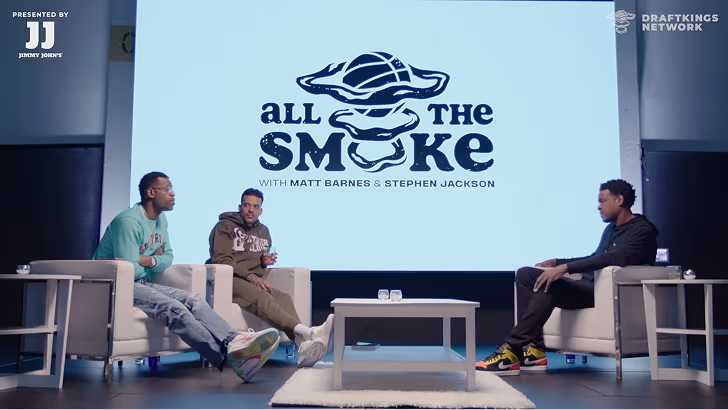
How All the Smoke makes hit compilations faster with OpusSearch

How All the Smoke makes hit compilations faster with OpusSearch

Growing a new channel to 1.5M views in 90 days without creating new videos

Growing a new channel to 1.5M views in 90 days without creating new videos

Turning old videos into new hits: How KFC Radio drives 43% more views with a new YouTube strategy

Turning old videos into new hits: How KFC Radio drives 43% more views with a new YouTube strategy

Canva's Magic Layers Shows Why AI-Native Video Tools Are Winning

Canva's Magic Layers Shows Why AI-Native Video Tools Are Winning
No items found.
No items found.

Boost your social media growth with OpusClip

Create and post one short video every day for your social media and grow faster.

Canva's Magic Layers Shows Why AI-Native Video Tools Are Winning

Canva's Magic Layers Shows Why AI-Native Video Tools Are Winning

Canva's Magic Layers Shows Why AI-Native Video Tools Are Winning

Canva just dropped a feature that should make every content creator pay attention. Magic Layers, now in public beta across the US, UK, Canada, and Australia, transforms flat images and AI-generated visuals into fully editable, layered designs. Objects, text boxes, and graphics become individually selectable while preserving the original layout.

This is not just a cool feature update. It signals something bigger: the entire creative software industry is racing toward AI-native architecture. And for video creators, this shift explains exactly why AI-native video tools are winning the battle for attention, efficiency, and output quality in 2026.

The question is no longer whether AI will transform creative workflows. The question is whether you are using tools built from the ground up for this new reality.

What Canva's Magic Layers Actually Does

Before diving into the broader implications, let us understand what Canva shipped. Magic Layers uses AI to analyze any flat image file or AI-generated visual and automatically separates it into distinct, editable components.

The Technical Breakdown

Traditional image editing requires manual layer creation. You import a flat PNG or JPEG, and everything sits on one layer. Want to move that text? You need to recreate it. Want to adjust that background element? Time to mask and cut.

Magic Layers eliminates this friction entirely:

  • Automatic object detection identifies distinct visual elements
  • Layer separation preserves spatial relationships and original positioning
  • Non-destructive editing lets you modify individual components without affecting others
  • AI-powered reconstruction fills gaps when you move or remove elements

This means a social media graphic you downloaded, an AI-generated image from any tool, or even a screenshot can become a fully editable design in seconds.

Why This Matters for the Industry

Canva is not a small player experimenting with AI. They serve over 170 million monthly active users. When they ship AI-native features to their core product, it validates a fundamental shift in how creative software must work.

The message is clear: tools that treat AI as an add-on will lose to tools built with AI at their foundation.

The Rise of AI-Native Creative Tools

What does "AI-native" actually mean? It is not just slapping an AI feature onto existing software. AI-native tools are architected from the ground up to leverage machine learning at every step of the creative process.

AI-Native vs. AI-Enhanced: The Critical Difference

CharacteristicAI-Enhanced ToolsAI-Native Tools
ArchitectureAI bolted onto legacy codebaseAI integrated at core level
User ExperienceAI features feel separateAI invisible, results feel magical
SpeedIncremental improvements10x faster workflows
Learning CurveStill requires expertiseAccessible to beginners
Output QualityDepends on user skillConsistently professional

Think about the difference between a car with lane assist added as an afterthought versus a Tesla designed from scratch around autonomous driving. Both have AI, but the experience and capability gap is enormous.

Video Creation: Where AI-Native Wins Biggest

Nowhere is this distinction more important than in video creation. Video has always been the most time-intensive content format. A single polished video could take hours or days to produce.

AI-native video tools flip this equation entirely. Instead of starting with a blank timeline and manually assembling every element, you start with content and let AI handle the heavy lifting.

OpusClip exemplifies this approach. Rather than adding AI features to a traditional video editor, OpusClip was built from day one to use AI for the most tedious parts of video production:

  • Intelligent clipping identifies the most engaging moments from long-form content
  • Automatic captions generate accurate, styled subtitles without manual transcription
  • Smart reframing adapts horizontal video to vertical formats for social platforms
  • Brand kit integration applies consistent visual identity across all outputs

The result? What used to take a video editor hours now happens in minutes.

Why Traditional Video Editing Cannot Keep Up

Legacy video editing software was designed for a different era. Adobe Premiere, Final Cut Pro, and DaVinci Resolve are powerful tools, but they were built around manual, frame-by-frame editing workflows.

The Content Volume Problem

In 2026, content demands have exploded. A single podcast episode needs to become:

  • 10-15 short clips for TikTok and Reels
  • Quote graphics for Instagram and LinkedIn
  • Audiograms for Twitter/X
  • Highlight reels for YouTube Shorts
  • Promotional teasers for email and ads

Doing this manually in traditional software is not just slow. It is unsustainable. Creators and marketing teams face an impossible choice: spend all their time editing or sacrifice content output.

The Skill Gap Challenge

Traditional video editing requires significant expertise. Color correction, audio mixing, motion graphics, and pacing all demand years of practice to master.

AI-native tools democratize these skills. When AI handles technical execution, creators can focus on what humans do best: storytelling, strategy, and creative direction.

The Platform Fragmentation Reality

Every social platform has different requirements:

  • TikTok favors 9:16 vertical video under 60 seconds
  • YouTube Shorts wants vertical but allows up to 3 minutes
  • Instagram Reels performs best at 15-30 seconds
  • LinkedIn prefers square or horizontal with captions

Manually reformatting content for each platform multiplies editing time. AI-native tools handle this automatically, producing platform-optimized outputs from a single source.

How OpusClip Embodies the AI-Native Approach

OpusClip was designed specifically to solve the video repurposing challenge using AI-native architecture. Here is how it works in practice.

Intelligent Content Analysis

When you upload a long-form video to OpusClip, AI analyzes the entire piece to identify:

  • Engagement peaks where viewers are most likely to stay hooked
  • Complete thought segments that work as standalone clips
  • Emotional moments that drive shares and comments
  • Key quotes that capture the essence of your message

This is not random cutting. The AI understands context, pacing, and what makes content perform on short-form platforms.

Automatic Caption Generation

Captions are no longer optional. Over 85% of social video is watched without sound. OpusClip generates accurate captions automatically, with multiple style options that match your brand.

The AI handles speaker identification, punctuation, and timing. You review and publish rather than transcribe and sync.

Smart Reframing for Any Platform

Horizontal video does not work on vertical platforms. Traditional reframing requires manually keyframing the crop position throughout the video.

OpusClip's AI tracks speakers and important visual elements, automatically adjusting the frame to keep the action centered. A 16:9 podcast becomes a 9:16 TikTok without losing the conversation.

Brand Kit Consistency

Every clip needs to look like it came from your brand. OpusClip's brand kit feature applies your colors, fonts, logos, and caption styles automatically across all outputs.

No more recreating lower thirds or hunting for the right hex code. Set it once, apply it everywhere.

Practical Steps to Adopt AI-Native Video Workflows

Ready to make the shift? Here is how to transition from traditional editing to AI-native video production.

Step 1: Audit Your Current Workflow

Document how long each video task takes. Track time spent on:

  • Reviewing footage and identifying clips
  • Cutting and trimming segments
  • Adding captions and subtitles
  • Reformatting for different platforms
  • Applying brand elements

This baseline shows where AI can save the most time.

Step 2: Identify Your Repurposing Opportunities

Look at your existing long-form content. Podcasts, webinars, interviews, and live streams are goldmines for short-form clips. Most creators have hours of untapped content sitting in their archives.

Step 3: Start with One Content Type

Do not try to transform everything at once. Pick your highest-volume content type and run it through OpusClip. See how the AI-generated clips compare to what you would create manually.

Step 4: Refine Your Brand Kit

Upload your brand assets to OpusClip. Configure caption styles, colors, and logo placement. This upfront investment pays off across every future clip.

Step 5: Establish a Review Process

AI-native does not mean fully automated. Build a quick review step where you approve clips before publishing. This maintains quality while capturing the speed benefits.

Step 6: Scale Your Output

Once your workflow is dialed in, increase volume. A single hour-long video can yield 10-20 clips. Publish consistently across platforms without proportionally increasing your time investment.

Common Mistakes When Adopting AI Video Tools

The transition to AI-native workflows is not automatic. Avoid these pitfalls:

  • Treating AI as a replacement for strategy: AI handles execution, but you still need to know your audience and message
  • Skipping the review step: AI is good, not perfect. Always watch clips before publishing
  • Ignoring brand consistency: Take time to configure your brand kit properly
  • Publishing without optimization: Add hooks, CTAs, and platform-specific tweaks to AI outputs
  • Forgetting about audio quality: AI cannot fix bad source audio. Invest in decent recording
  • Over-relying on a single platform: Diversify where you publish to reduce algorithm dependency

Pro Tips for Maximizing AI-Native Video Tools

Get more from your AI-native workflow with these advanced strategies:

  • Batch process content: Upload multiple videos at once and review clips in batches for efficiency
  • Create clip templates: Save your best-performing caption styles and reuse them
  • Use AI suggestions as starting points: The best clips often come from AI picks you slightly modify
  • Track performance by source: Note which long-form videos produce the best short clips
  • Repurpose repurposed content: Top-performing clips can become ads, email content, or website assets
  • Schedule strategically: Use AI time savings to post more consistently rather than just faster

What This Means for the Future of Video Creation

Canva's Magic Layers is one data point in a larger trend. Every major creative tool is racing to become AI-native. The companies that started with AI at their core have a structural advantage.

For video creators, this means:

  • Output expectations will rise: When everyone can produce more, you need to produce more to stay visible
  • Quality floors will increase: AI-native tools make professional results accessible to everyone
  • Speed becomes a competitive advantage: First-mover advantage on trends matters more than ever
  • Human creativity becomes the differentiator: When AI handles execution, your ideas and perspective stand out

The creators who thrive will be those who embrace AI-native tools while doubling down on what makes their content unique.

Key Takeaways

  • Canva's Magic Layers signals the industry-wide shift toward AI-native creative tools
  • AI-native means built from the ground up with AI, not AI features added to legacy software
  • Video creation benefits most from AI-native approaches due to high time investment and platform fragmentation
  • OpusClip exemplifies AI-native video production through intelligent clipping, automatic captions, smart reframing, and brand kit integration
  • Transitioning to AI-native workflows requires auditing current processes and starting with high-volume content types
  • Human creativity and strategy remain essential even as AI handles technical execution

Frequently Asked Questions

How does Canva's Magic Layers compare to AI-native video tools like OpusClip?

Canva's Magic Layers focuses on static image editing, transforming flat files into layered, editable designs. OpusClip operates in a different domain entirely, using AI to analyze long-form video content and automatically generate optimized short-form clips. While both represent the AI-native approach, OpusClip specifically solves the video repurposing challenge by handling clipping, captioning, reframing, and brand application in one workflow. The tools complement each other if you create both static graphics and video content.

What makes a video tool truly AI-native versus just having AI features?

An AI-native video tool is architected from its foundation to leverage machine learning at every step. This means AI is not a separate feature you activate but is embedded in the core workflow. In OpusClip, for example, AI analyzes your content the moment you upload, identifies engaging segments, generates captions, and handles reframing automatically. Traditional editors with AI features still require you to manually initiate each AI function, creating a fragmented experience that slows down production.

Can AI-native video tools like OpusClip replace professional video editors?

AI-native tools excel at high-volume, repetitive tasks like repurposing long-form content into short clips. They handle the 80% of editing work that follows predictable patterns. Professional editors remain valuable for complex projects requiring custom motion graphics, narrative storytelling, or highly stylized productions. The smart approach is using OpusClip for content repurposing and volume production while reserving professional editing resources for flagship content that demands a human touch.

How do I maintain brand consistency when using AI to generate video clips?

OpusClip's brand kit feature solves this challenge directly. You upload your brand assets including logos, color palettes, fonts, and preferred caption styles once. The AI then applies these elements consistently across every clip it generates. This ensures that whether you produce 5 clips or 50 from a single video, each one looks unmistakably like your brand. You can also save multiple brand kits if you manage content for different clients or product lines.

What types of long-form content work best for AI-powered video repurposing?

Content with clear spoken segments performs exceptionally well with OpusClip. Podcasts, interviews, webinars, live streams, and talking-head videos all contain natural breakpoints the AI can identify. Educational content and how-to videos also repurpose effectively because they contain discrete tips or steps that work as standalone clips. Content that relies heavily on visual demonstrations without narration may require more manual review, though OpusClip's speaker tracking still handles the reframing automatically.

How long does it take to see ROI from switching to AI-native video workflows?

Most creators see immediate time savings on their first batch of content. If you currently spend 2-3 hours manually creating clips from a podcast episode, OpusClip can reduce that to 15-20 minutes of review time. The ROI compounds as you increase output volume. Within the first month, many users report producing 3-5x more content without adding production hours. The key is establishing your brand kit and review process upfront so subsequent batches flow smoothly through your workflow.

What to Do Next

The shift to AI-native creative tools is not coming. It is here. Canva's Magic Layers is just the latest confirmation that the industry has moved past the question of whether AI belongs in creative workflows.

For video creators, the opportunity is clear. Tools like OpusClip let you produce more content, reach more platforms, and maintain quality without burning out. Start by uploading one long-form video to OpusClip at opus.pro and see how many clips the AI identifies. You might be surprised how much content you have been leaving on the table.

Ready to start streaming differently?

Opus is completely FREE for one year for all private beta users. You can get access to all our premium features during this period. We also offer free support for production, studio design, and content repurposing to help you grow.
Join the beta
Limited spots remaining

Try OPUS today

Try Opus Studio

Make your live stream your Magnum Opus