No items found.
How to Make Italian Brainrot Videos: The 2026 AI Trend Eating TikTok
May 6, 2026

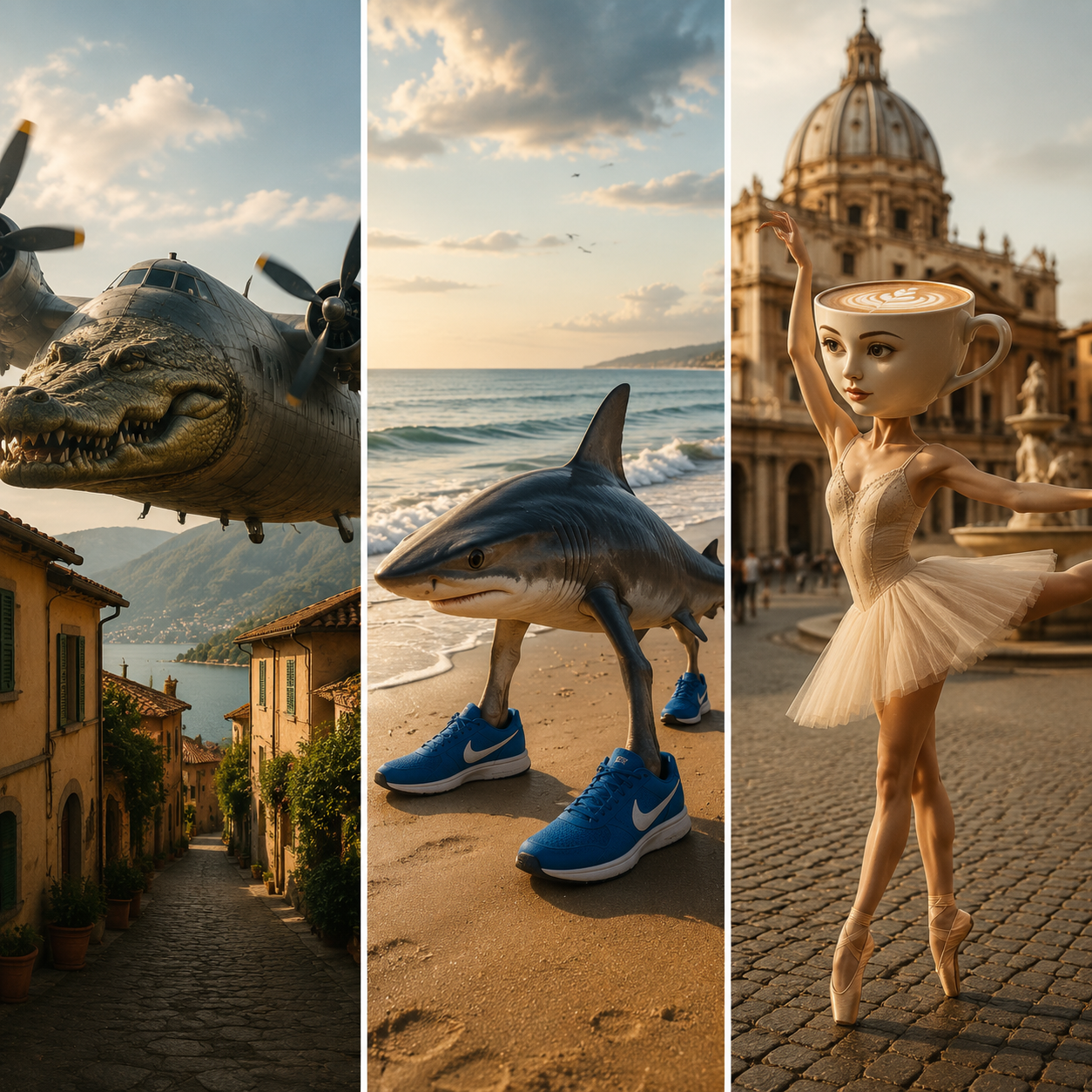
If you've spent more than ten minutes on TikTok in 2026, you've already seen one. A shark wearing Nikes named "Tralalero Tralala." A coffee-cup-headed crocodile in a tracksuit. A flying cappuccino with a mustache shouting in fake Italian. These are Italian brainrot videos — and they're one of the fastest-growing viral formats of the year.
This guide breaks down what Italian brainrot is, why it works, and how to make your own using free AI tools — plus how to clip and caption the long generations into short-form content that actually pulls views.
Key takeaways
• Italian brainrot is a surrealist meme genre that pairs AI-generated absurd creatures with synthesized pseudo-Italian voiceovers and nonsensical narratives.
• The trend exploded in early 2025 and has only grown in 2026, with major characters like Tralalero Tralala, Bombardino Crocodilo, and Ballerina Cappuccina racking up billions of cumulative views.
• The format relies on three ingredients: a weird AI-generated character, a sing-songy "Italian-sounding" voiceover, and tight 8–15 second pacing.
• You can produce one in under 20 minutes using a text-to-image model, a text-to-video model, an AI voice generator, and a short-form editor like OpusClip.
• Engagement comes from the absurdity loop — viewers rewatch trying to "get" the joke, which boosts your completion rate above the 70% TikTok virality threshold.
What is Italian brainrot?
Italian brainrot is a category of AI-generated meme videos featuring grotesque, hybrid, surreal creatures with pseudo-Italian names and voiceovers. The genre sits inside the broader brainrot meme universe but earned its own subcategory because of the consistent visual and audio language: AI slop aesthetics, mock-Italian narration, and absurd character lore.
The breakout characters became cultural references almost overnight:
• Tralalero Tralala — a three-legged shark wearing blue Nike sneakers, the unofficial mascot of the genre
• Bombardino Crocodilo — a hybrid crocodile-bomber-plane creature that "bombs" Italian villages
• Ballerina Cappuccina — a ballerina with a coffee cup for a head
• Tung Tung Tung Sahur — a wooden log creature with a baseball bat (originating from Indonesian brainrot before crossing over)
• Lirilì Larilà — a sandal-wearing elephant with a pocket watch
Each character has its own theme song, voice, and "lore" — usually invented post-hoc by fans in the comments. The result is a self-perpetuating meme economy where every new creature gets named, ranked, and slotted into an evolving fictional universe.
Why Italian brainrot videos go viral
Three structural reasons, and one cultural one.
1. The "what did I just watch?" rewatch. Italian brainrot videos are deliberately confusing. The viewer's instinct is to rewatch trying to understand the joke. That pushes completion rate above 70% — the 2026 TikTok algorithm threshold for viral distribution.
2. Built-in shareability. The videos function as inside jokes. Sharing one to a friend with no caption is itself the punchline. TikTok's 2026 algorithm weights DM shares heavily — Italian brainrot videos are share-bait by design.
3. AI tooling unlocked production speed. A creator can produce 5–10 brainrot videos a day. The format rewards volume because each new creature is a new shot at virality, and the marginal cost of production is near zero with AI.
4. Generational signaling. For Gen Alpha and younger Gen Z, recognizing the characters is a form of cultural fluency. The genre signals belonging the same way obscure music references did for previous generations.
How to make Italian brainrot videos: step-by-step
Here's the production pipeline used by most top creators in the niche.
Step 1 — Invent the creature
Brainstorm an absurd hybrid: an animal + an object + a piece of Italian culture. Some prompt scaffolds that work:
• [Animal] with [household object] for a head wearing [iconic Italian item]
• [Animal] crossed with a [vehicle/weapon] standing in [Italian location]
• Anthropomorphic [Italian food] holding a [random object]
Examples that have worked: a hot-dog-bodied flamingo wearing aviators, a Vespa with the head of an angry tomato, a parmigiana-headed gondolier paddling a coffee table.
Step 2 — Generate the character image
Use any text-to-image model — Midjourney, DALL-E, Flux, or Imagen 3. The prompt formula:
Hyperrealistic photo of a [your creature description], standing in [Italian setting — piazza, beach, Vatican steps, gelateria]. Cinematic lighting, AI slop aesthetic, sharp details, absurd composition, slightly surreal, golden hour.
Lean into the photorealism mismatched with absurd subject — that contrast is what makes the visual hit.
Step 3 — Animate the still image
Feed the image into a text-to-video model. Sora 2, Veo 3, Kling, and Seedance 2.0 all handle this format well. A typical animation prompt:
The [creature] walks toward camera through [setting], slight wobble in its gait, dramatic cinematic camera movement, 5 seconds, 9:16 aspect ratio.
If you want to skip the multi-tool workflow, you can spin up the full image-to-video generation directly in Agent Opus, which gives you access to Seedance 2.0, Veo 3, and other top video models in a single interface.
Step 4 — Generate the voiceover
The Italian brainrot voiceover is half the magic. Use ElevenLabs, OpenAI TTS, or a similar voice model with an Italian voice preset. The script is always nonsense — strings of fake-Italian words that sound real but mean nothing. Examples:
• "Tralalero tralala, mi sono mangiato la cappuccino con tre piedi e una scarpa Nike, oh porco Dio."
• "Bombardino crocodilo, vola vola sopra il piazza e fa BOOM sui turisti, tipico martedì."
The cadence is sing-songy, often rhyming, with absurd breaks for fake outrage or laughter.
Step 5 — Edit, caption, and export for TikTok
This is where the post becomes a viral clip rather than just a generation. Drop the video into a short-form editor and:
• Add dynamic captions that match the spoken nonsense — caption rendering boosts watch time by 40%+ on muted plays
• Trim aggressively — Italian brainrot videos work best at 8–15 seconds
• Add a hook frame in the first 0.5 seconds — the creature's face filling the screen
• Export at 9:16 vertical, 30fps
OpusClip handles all of this in one pass — auto-captioning, smart reframing to vertical, and AI-driven hook detection. If you're producing brainrot videos at volume, the manual caption step alone will eat your day. Automate it.

Italian brainrot prompt examples that actually work
Copy-paste these into your image generator to start fast:
Bombardino Crocodilo style:
A photorealistic hybrid crocodile-bomber-plane creature with metal wings and crocodile head, standing on the cobblestones of a small Italian village at sunrise, dramatic golden lighting, absurd surreal composition, cinematic photo
Tralalero Tralala style:
A three-legged great white shark wearing blue Nike Air Force sneakers, walking across a sunny Italian beach, hyperrealistic photo, surreal composition, cinematic shallow depth of field
Ballerina Cappuccina style:
A ballerina in a pink tutu with a giant cappuccino cup as her head, foam art shaped like a heart, dancing on a Roman piazza, photorealistic, golden hour lighting, surreal absurd composition
Original creation:
An anthropomorphic anchovy wearing a tracksuit and aviator sunglasses, riding a tiny Vespa through Naples, photorealistic, dramatic lighting, surreal absurd composition, cinematic shallow depth of field
How to caption Italian brainrot videos for TikTok
The caption is part of the joke. A few patterns that perform:
• The creature's "lore" stated as fact: "Bombardino Crocodilo terrorizing the village again 😔🇮🇹"
• A fake plea: "why is no one talking about Tralalero Tralala's third leg"
• A ranking: "ranking the Italian brainrot characters from least to most cursed"
• An unhinged reaction: "this changed me as a person"
Stack 8–12 hashtags including #italianbrainrot, #brainrot, #tralalerotralala, and #fyp. Posts with #fyp see 2.2x median views compared to those without.
What to do after your first hit
If one of your brainrot creatures lands, don't move on — expand the lore.
• Make a sequel where two of your characters meet
• Build a "ranking" video covering all your creations
• Drop a "behind the scenes" showing how you generated the creature (meta content always pulls views)
• Launch a series where the same creature appears in different absurd scenarios
Top brainrot creators ride a single character for weeks. The audience invests in recurring lore — give them more.
The bottom line
Italian brainrot is the rare format where AI tooling, algorithm rewards, and absurdist humor align perfectly. Production cost is near zero, the algorithm rewards completion-rate-bait, and the genre is still expanding as new characters enter the canon.
The bottleneck isn't ideas or generation — it's the editing and captioning step that turns a raw AI clip into a tight, captioned, vertical short. Drop your AI generations into OpusClip and let it handle the captions, hooks, and reframing while you focus on inventing the next Tralalero Tralala.
The internet's most absurd corner is yours to colonize. Start generating.