What Is Whop Content Rewards? Everything You Need to Know About the Leading Clipping Marketplace

August 12, 2026

Whop Content Rewards is a view-based campaign marketplace where brands (and agencies), creators, and streamers fund bounties, and literally anyone (no audience, no application, no portfolio) can join, post content, and get paid per 1,000 views.

It's quickly become one of the most talked-about ways to make money as a clipper in 2026, and also one of the most misunderstood. In this article, we'll break it all down: what Content Rewards actually is, how it works for both brands and clippers, what campaigns are paying right now, what to watch out for before you commit hours to one, and how OpusClip fits into the workflow to help clippers running Content Rewards campaigns produce more, better clips in a fraction of the time.

What is Whop?

Before getting into Content Rewards specifically, it's worth knowing what Whop is, because Content Rewards isn't a standalone app. It's a feature living inside a much bigger platform.

Whop is a Brooklyn-based creator commerce platform founded in 2021 by Steven Schwartz, Cameron Zoub, and Jack Sharkey. At its core, it's infrastructure for selling digital products, memberships, and communities: courses, trading groups, Discord-style communities, SaaS tools, and more, all with built-in payments, access control, and storefronts. The company has raised over $200M in funding and now processes close to $1B a year in payments across thousands of merchants.

Content Rewards is one app inside that ecosystem, but in 2026, it's become the thing most people mean when they say "Whop."

What is Whop Content Rewards?
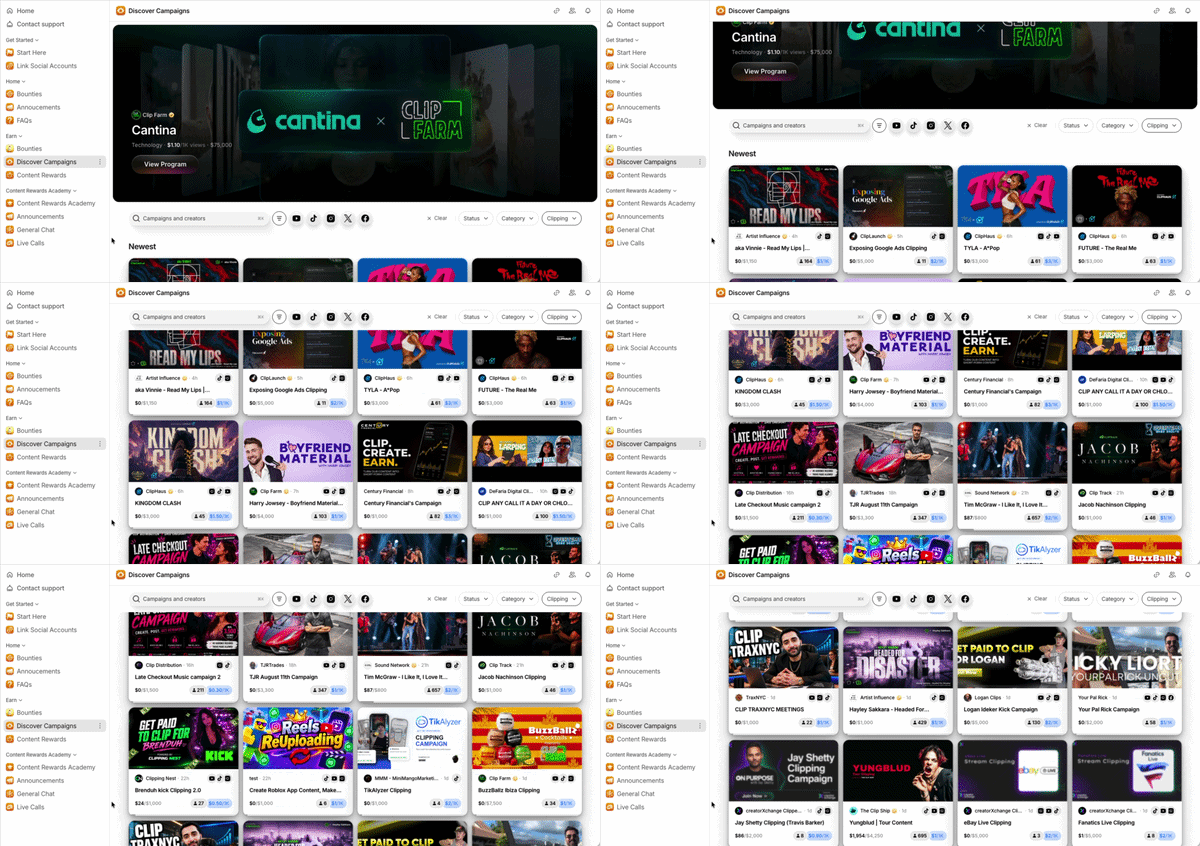
Content Rewards is Whop's open campaign marketplace connecting two groups: brands (and agencies), creators, and streamers who want more reach, and clippers who want to get paid for making short-form content. A brand sets a budget and a reward rate (say, $2 per 1,000 views), and from that moment, any clipper on Whop can join the campaign, post content that meets the requirements, and start earning based on the views they generate.

There's no upfront cost to launch a campaign, and no upfront cost to join one as a clipper. Brands only pay for verified, approved views. Clippers only get paid once their content clears review and hits the platform's minimum view threshold.

How Content Rewards differs from a normal creator or influencer deal

  • No audience required. You don't need followers to join a campaign: you're paid on the performance of the specific clip, not your existing reach.
  • No application in most cases. Many campaigns let you join instantly and start submitting; some use a waitlist, but it's the exception, not the rule.
  • It's a marketplace, not a roster. Unlike a typical influencer program that hand-picks a small group of creators, Content Rewards is open: literally anyone with a Whop account can browse active campaigns and enter.
  • Pay is per-clip, per-view, not per-relationship. There's no retainer or flat sponsorship fee in most campaigns; your earnings are tied directly to how well each individual clip performs.

The different types of Content Rewards campaigns
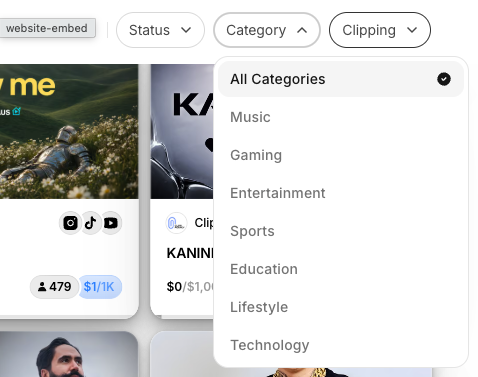
One thing that separates Whop from more narrowly-scoped clipping platforms is how many flavors of campaign exist inside Content Rewards. Broadly, they fall into two categories (clipping and UGC), but in practice they show up as several distinct niches:

  • Clipping campaigns. The classic model: take a brand or creator's long-form content (a podcast, a livestream VOD, a webinar) and cut it into short-form clips for TikTok, Reels, or Shorts.
  • UGC campaigns. Original, face-to-camera content: think TikTok Shop-style videos where you're talking about a product or service rather than repurposing existing footage.
  • Music campaigns. Add a specific song to content you were likely already posting. Payouts here tend to be smaller than other campaign types, but also require far less work.
  • Podcast-specific and streamer campaigns. Niche clipping campaigns scoped to a specific show or streamer's VOD library, often run directly by the podcast or streamer's own team.

The rates vary enormously by type and difficulty. A "just add this song" campaign might pay $1 per 1,000 views; a "make an original talking-head video about our product" campaign might pay $3 per 1,000 views. As a rule of thumb, the more original effort a campaign requires, the higher the reward rate, and the stricter the requirements.

How Whop Content Rewards works

For brands and creators launching a campaign

  1. Add the Content Rewards app to your Whop from the App Store.
  2. Choose a campaign type (clipping or UGC) and a category.
  3. Set the economics: total budget, reward rate per 1,000 views, minimum and maximum payout per submission, and an optional flat bonus paid just for submitting (regardless of views).
  4. Choose eligible platforms: TikTok, Instagram Reels, YouTube Shorts, and X are all supported, and campaigns that allow more platforms tend to attract more clippers, since one clip can be cross-posted for multiple payouts.
  5. Set content requirements: tags, hashtags, affiliate links, minimum clip length, language, whether a dedicated fan page is required, and so on.
  6. Fund and launch. Once the budget is deposited, the campaign goes live in the public marketplace immediately.

Running your campaign through an agency

Not every brand wants to set up and manage a Content Rewards campaign itself, and that's the gap clipping agencies fill. Instead of a brand writing its own brief, sourcing footage, and manually reviewing every submission, an agency (like several of the ones we cover in our rundown of the top clipping agencies of 2026) will often run the campaign on a brand's behalf, either through Whop directly or through its own private network of vetted clippers: writing the requirements, managing quality control, chasing down underperforming submissions, and handling reporting, all rolled into one managed engagement instead of a self-serve marketplace listing.

The tradeoff is straightforward. Running your own campaign on Whop keeps costs lowest, since you're paying clippers directly with no management layer on top, but it also means you're doing all the sourcing, vetting, and review work yourself. Going through an agency costs more, but you're handing off that operational burden, and you're often tapping into a curated pool of clippers with a track record rather than whoever happens to be browsing the open marketplace that day.

Lastly, working with an agency comes with one more advantage: you're also tapping into their expertise about what actually works. Grayson Peil, the founder of popular clipping agency Clipping Culture, knows what works - he has grown over 3.5 million followers across music, memes, tech, fashion, news and sports, giving him firsthand experience in what makes content travel across different audiences. That expertise is part of what you're paying for when you work with an agency like Clipping Culture, not just the labor.

"You can’t force virality, but you can orchestrate it. Our clipping agency does not just distribute content. We shape the strategy, content and distribution around what is actually likely to spread."

- Grayson Peil, Founder / COO at Clipping Culture

For clippers joining a campaign

  1. Sign up at whop.com (free, and takes about a minute with a Google login).
  2. Browse the Content Rewards marketplace, filtering by category: clipping, UGC, music, logo, podcast, and more.
  3. Vet the campaign before joining. Experienced clippers check four things: the reward rate per 1,000 views, which platforms are eligible (more platforms = one clip earning multiple payouts), how much of the total budget is already spent (partially-spent budgets with a track record of payouts are generally safer than brand-new campaigns), and whether the campaign requires a waitlist or allows instant joining.
  4. Check reviews and campaign chat. Every campaign has a rating and a chat where clippers discuss whether submissions are actually getting approved and paid: this is the fastest way to avoid wasting hours clipping for a campaign manager who doesn't pay out.
  5. Pull the source assets. Most campaigns link a shared drive of raw footage (podcasts, stream VODs, or brand assets) that clippers use to make their clips.
  6. Create and post the clip to your own personal account on an eligible platform, following the campaign's exact requirements (tags, captions, minimum length, etc.). A tool like OpusClip is worth using here: it handles AI-powered clipping, gives you a full video editing UI to fine-tune the result, and includes a built-in post-scheduling feature, so you can go from raw footage to a scheduled, published post without leaving one app.
  7. Submit the link and raw file back through Whop and wait for review.
  8. Get paid once your submission is approved and clears the campaign's minimum view threshold: payouts scale with views up to the campaign's max-payout cap.

How much money can you actually make?

Reported payout rates vary a lot by campaign type and difficulty:

  • Music / logo campaigns: $1 per 1,000 views. Minimal extra effort; often stacked on content you're already posting
  • Standard clipping campaigns: $1–$3 per 1,000 views. The most common category; rates above $3 usually come with stricter requirements
  • UGC / talking-head campaigns: $2–$50 per 1,000 views. Highest ceiling, but requires original, on-camera content
  • Typical live campaigns (mid-2026 snapshot): $0.50–$1.50 per 1,000 views. Larger, well-funded campaigns tend to sit in this range, with rare outliers reported as high as $15/1,000 on small, low-budget campaigns

Individual clippers have reported earning anywhere from a few hundred dollars in their first couple of days on the platform to several thousand dollars in a single week, largely by working across multiple campaign types at once: a low-effort music or logo campaign stacked on top of content they're already posting, plus higher-effort clipping or UGC campaigns for the bulk of their earnings. As with any view-based model, results depend heavily on how many campaigns you enter, how good your clips are, and how consistently you post.

Payout mechanics

  • Submissions typically move through a review window (often around 72 hours) before views count toward payout.
  • Most campaigns have both a minimum payout threshold (you need a certain number of views before you're paid anything) and a maximum payout cap (there's a ceiling on what a single clip can earn, so budget gets spread across more clippers).
  • Withdrawals generally go out via a connected Stripe account or bank transfer; some reports also describe crypto payout options, and Whop has reportedly charged a processing fee in the high single digits on withdrawals.
  • Clippers in countries where Stripe isn't supported have historically had a harder time cashing out, a real limitation worth knowing about before you invest a lot of time.

Is Whop Content Rewards legit?

Mostly, yes, but it's worth going in with clear eyes about a few things independent reviewers and clippers themselves have flagged:

  • Bot and fraud detection is imperfect. Whop uses AI to flag suspicious submissions, but reports exist of view patterns that "cap out" suspiciously close to a campaign's max-payout threshold: the kind of pattern associated with view botting rather than organic growth. Brands that have lowered payout caps have reported view counts snapping down to match, which is not something organic traffic normally does.
  • Geo-targeting is easy to route around. Some brands try to restrict campaigns to specific countries, but that's reportedly simple to bypass with a VPN, since Whop's creator pool is global by default.
  • Not every campaign manager pays reliably. Multiple clippers describe submitting content, hitting the view threshold, and then not getting paid, which is exactly why checking a campaign's reviews and chat activity before joining is treated as a non-negotiable step by experienced clippers, not an optional one.
  • Content doesn't always stick around. Some brands have reported that clips get deleted from creators' accounts after a campaign ends, which limits the long-term organic value brands often expect from this kind of distribution.

None of this makes Content Rewards a scam: it's simply an open marketplace, and open marketplaces have more variance in quality than a curated agency roster (see our breakdown of some of the top clipping agencies of 2026 for a more managed alternative). If you're a brand, that means budgeting time for manual review. If you're a clipper, it means treating campaign vetting as seriously as the clipping itself.

It's also worth comparing this model to platforms like MrBeast's Vyro, which takes a narrower approach: a curated roster of major creators running structured campaign "drops," rather than Whop's fully open, anyone-can-join marketplace spanning dozens of brands and campaign types at once. Vyro trades breadth for more curation; Whop trades curation for volume and variety.

Using OpusClip with Whop Content Rewards campaigns

The single biggest bottleneck for clippers on Whop isn't finding campaigns: it's producing enough clips to actually make money. Manually scrubbing through a 90-minute podcast to find the handful of clip-worthy moments, then cutting, captioning, and reframing each one in an editor like CapCut, can easily eat several hours for just a handful of finished clips. And on a per-view payout model, output volume is directly tied to income.

This is exactly the gap OpusClip is built to close.

Why OpusClip works well for Content Rewards campaigns

  • Speed. Instead of manually scrubbing a full-length source video, OpusClip's AI surfaces the most clip-worthy moments automatically, turning a process that used to take hours into one that takes minutes.
  • Volume. Clippers using AI-assisted editing have reported generating 40+ finished clips from a single long-form video in under 15 minutes, versus one or two clips manually in the same window, and on a per-view model, more published clips means more shots at a submission going viral.
  • Built-in formatting. Auto-captioning, 9:16 reframing, and active-speaker tracking are handled automatically, matching the technical requirements most Content Rewards campaigns specify.
  • Quality filtering, not just quantity. Not every AI-generated clip is publish-ready, but the tool ranks and scores clips so you can quickly identify which ones are actually worth submitting, rather than reviewing everything manually.

A typical OpusClip + Content Rewards workflow

  1. Find your source video: a podcast, stream VOD, or webinar, often already linked directly in the campaign's shared drive.
  2. Import it into OpusClip by pasting a link or connecting the source drive.
  3. Let the AI find and rank the best moments based on virality potential, rather than watching the full source yourself.
  4. Auto-generate captions and reframe to whatever aspect ratio the campaign platform requires.
  5. Review the ranked clips and select the ones that best match the campaign's specific requirements (length, tags, platform).
  6. Publish to your own TikTok, Reels, or Shorts account.
  7. Submit the link back to the Whop campaign and track approval status and payout in one place.

The clippers earning the most on Whop aren't necessarily the best editors: they're the ones who can consistently produce enough high-quality clips to have several shots at going viral across multiple campaigns at once. That's a volume game, and volume is where AI-assisted clipping has the clearest edge over doing it by hand.

Final thoughts: is Whop Content Rewards worth it?

What we know for certain:

  • Content Rewards is a real, functioning marketplace with active campaigns, real payouts, and no cost to join as a clipper.
  • Rates vary widely by campaign type, from fractions of a cent to $50+ per 1,000 views.
  • The platform rewards volume and consistency more than any single viral hit.

What to watch out for:

  • Bot detection and payout reliability aren't uniform across every campaign: vetting individual campaigns matters more than trusting the platform as a whole.
  • Payout mechanics (review windows, fees, country restrictions) can meaningfully affect how much you actually take home.
  • Content persistence and campaign manager reliability vary brand to brand.

Content Rewards is worth exploring if:

  • You're already posting short-form content and want a low-effort way to monetize existing output (music and logo campaigns are the easiest entry point).
  • You're comfortable treating clip production as a volume game rather than a one-hit strategy.
  • You're willing to spend a few minutes vetting a campaign's reviews and payout history before investing hours into it.
  • You have (or are willing to build) a fast clipping workflow, because on a per-view marketplace, the clippers producing the most publishable clips are the ones earning the most.

If that last point is your bottleneck, that's exactly where OpusClip comes in: turning long-form source footage into a batch of ranked, ready-to-post clips in minutes, so you can spend your time finding the next campaign instead of scrubbing through hours of raw video.
On this page

Use our Free Forever Plan

Find the moment. Skip the scrubbing.

From script to polished video — in one click.

Create and post one short video every day for free, and grow faster.

OpusSearch uses AI to surface the exact clip you need from hours of footage — in seconds, not afternoons.

Agent Opus runs the entire video pipeline for you: research, scriptwriting, storyboarding, motion, voice, and edit. Upload the idea, post the result.

What Is Whop Content Rewards? Everything You Need to Know About the Leading Clipping Marketplace

Whop Content Rewards is a view-based campaign marketplace where brands (and agencies), creators, and streamers fund bounties, and literally anyone (no audience, no application, no portfolio) can join, post content, and get paid per 1,000 views.

It's quickly become one of the most talked-about ways to make money as a clipper in 2026, and also one of the most misunderstood. In this article, we'll break it all down: what Content Rewards actually is, how it works for both brands and clippers, what campaigns are paying right now, what to watch out for before you commit hours to one, and how OpusClip fits into the workflow to help clippers running Content Rewards campaigns produce more, better clips in a fraction of the time.

What is Whop?

Before getting into Content Rewards specifically, it's worth knowing what Whop is, because Content Rewards isn't a standalone app. It's a feature living inside a much bigger platform.

Whop is a Brooklyn-based creator commerce platform founded in 2021 by Steven Schwartz, Cameron Zoub, and Jack Sharkey. At its core, it's infrastructure for selling digital products, memberships, and communities: courses, trading groups, Discord-style communities, SaaS tools, and more, all with built-in payments, access control, and storefronts. The company has raised over $200M in funding and now processes close to $1B a year in payments across thousands of merchants.

Content Rewards is one app inside that ecosystem, but in 2026, it's become the thing most people mean when they say "Whop."

What is Whop Content Rewards?

Content Rewards is Whop's open campaign marketplace connecting two groups: brands (and agencies), creators, and streamers who want more reach, and clippers who want to get paid for making short-form content. A brand sets a budget and a reward rate (say, $2 per 1,000 views), and from that moment, any clipper on Whop can join the campaign, post content that meets the requirements, and start earning based on the views they generate.

There's no upfront cost to launch a campaign, and no upfront cost to join one as a clipper. Brands only pay for verified, approved views. Clippers only get paid once their content clears review and hits the platform's minimum view threshold.

How Content Rewards differs from a normal creator or influencer deal

  • No audience required. You don't need followers to join a campaign: you're paid on the performance of the specific clip, not your existing reach.
  • No application in most cases. Many campaigns let you join instantly and start submitting; some use a waitlist, but it's the exception, not the rule.
  • It's a marketplace, not a roster. Unlike a typical influencer program that hand-picks a small group of creators, Content Rewards is open: literally anyone with a Whop account can browse active campaigns and enter.
  • Pay is per-clip, per-view, not per-relationship. There's no retainer or flat sponsorship fee in most campaigns; your earnings are tied directly to how well each individual clip performs.

The different types of Content Rewards campaigns

One thing that separates Whop from more narrowly-scoped clipping platforms is how many flavors of campaign exist inside Content Rewards. Broadly, they fall into two categories (clipping and UGC), but in practice they show up as several distinct niches:

  • Clipping campaigns. The classic model: take a brand or creator's long-form content (a podcast, a livestream VOD, a webinar) and cut it into short-form clips for TikTok, Reels, or Shorts.
  • UGC campaigns. Original, face-to-camera content: think TikTok Shop-style videos where you're talking about a product or service rather than repurposing existing footage.
  • Music campaigns. Add a specific song to content you were likely already posting. Payouts here tend to be smaller than other campaign types, but also require far less work.
  • Podcast-specific and streamer campaigns. Niche clipping campaigns scoped to a specific show or streamer's VOD library, often run directly by the podcast or streamer's own team.

The rates vary enormously by type and difficulty. A "just add this song" campaign might pay $1 per 1,000 views; a "make an original talking-head video about our product" campaign might pay $3 per 1,000 views. As a rule of thumb, the more original effort a campaign requires, the higher the reward rate, and the stricter the requirements.

How Whop Content Rewards works

For brands and creators launching a campaign

  1. Add the Content Rewards app to your Whop from the App Store.
  2. Choose a campaign type (clipping or UGC) and a category.
  3. Set the economics: total budget, reward rate per 1,000 views, minimum and maximum payout per submission, and an optional flat bonus paid just for submitting (regardless of views).
  4. Choose eligible platforms: TikTok, Instagram Reels, YouTube Shorts, and X are all supported, and campaigns that allow more platforms tend to attract more clippers, since one clip can be cross-posted for multiple payouts.
  5. Set content requirements: tags, hashtags, affiliate links, minimum clip length, language, whether a dedicated fan page is required, and so on.
  6. Fund and launch. Once the budget is deposited, the campaign goes live in the public marketplace immediately.

Running your campaign through an agency

Not every brand wants to set up and manage a Content Rewards campaign itself, and that's the gap clipping agencies fill. Instead of a brand writing its own brief, sourcing footage, and manually reviewing every submission, an agency (like several of the ones we cover in our rundown of the top clipping agencies of 2026) will often run the campaign on a brand's behalf, either through Whop directly or through its own private network of vetted clippers: writing the requirements, managing quality control, chasing down underperforming submissions, and handling reporting, all rolled into one managed engagement instead of a self-serve marketplace listing.

The tradeoff is straightforward. Running your own campaign on Whop keeps costs lowest, since you're paying clippers directly with no management layer on top, but it also means you're doing all the sourcing, vetting, and review work yourself. Going through an agency costs more, but you're handing off that operational burden, and you're often tapping into a curated pool of clippers with a track record rather than whoever happens to be browsing the open marketplace that day.

Lastly, working with an agency comes with one more advantage: you're also tapping into their expertise about what actually works. Grayson Peil, the founder of popular clipping agency Clipping Culture, knows what works - he has grown over 3.5 million followers across music, memes, tech, fashion, news and sports, giving him firsthand experience in what makes content travel across different audiences. That expertise is part of what you're paying for when you work with an agency like Clipping Culture, not just the labor.

"You can’t force virality, but you can orchestrate it. Our clipping agency does not just distribute content. We shape the strategy, content and distribution around what is actually likely to spread."

- Grayson Peil, Founder / COO at Clipping Culture

For clippers joining a campaign

  1. Sign up at whop.com (free, and takes about a minute with a Google login).
  2. Browse the Content Rewards marketplace, filtering by category: clipping, UGC, music, logo, podcast, and more.
  3. Vet the campaign before joining. Experienced clippers check four things: the reward rate per 1,000 views, which platforms are eligible (more platforms = one clip earning multiple payouts), how much of the total budget is already spent (partially-spent budgets with a track record of payouts are generally safer than brand-new campaigns), and whether the campaign requires a waitlist or allows instant joining.
  4. Check reviews and campaign chat. Every campaign has a rating and a chat where clippers discuss whether submissions are actually getting approved and paid: this is the fastest way to avoid wasting hours clipping for a campaign manager who doesn't pay out.
  5. Pull the source assets. Most campaigns link a shared drive of raw footage (podcasts, stream VODs, or brand assets) that clippers use to make their clips.
  6. Create and post the clip to your own personal account on an eligible platform, following the campaign's exact requirements (tags, captions, minimum length, etc.). A tool like OpusClip is worth using here: it handles AI-powered clipping, gives you a full video editing UI to fine-tune the result, and includes a built-in post-scheduling feature, so you can go from raw footage to a scheduled, published post without leaving one app.
  7. Submit the link and raw file back through Whop and wait for review.
  8. Get paid once your submission is approved and clears the campaign's minimum view threshold: payouts scale with views up to the campaign's max-payout cap.

How much money can you actually make?

Reported payout rates vary a lot by campaign type and difficulty:

  • Music / logo campaigns: $1 per 1,000 views. Minimal extra effort; often stacked on content you're already posting
  • Standard clipping campaigns: $1–$3 per 1,000 views. The most common category; rates above $3 usually come with stricter requirements
  • UGC / talking-head campaigns: $2–$50 per 1,000 views. Highest ceiling, but requires original, on-camera content
  • Typical live campaigns (mid-2026 snapshot): $0.50–$1.50 per 1,000 views. Larger, well-funded campaigns tend to sit in this range, with rare outliers reported as high as $15/1,000 on small, low-budget campaigns

Individual clippers have reported earning anywhere from a few hundred dollars in their first couple of days on the platform to several thousand dollars in a single week, largely by working across multiple campaign types at once: a low-effort music or logo campaign stacked on top of content they're already posting, plus higher-effort clipping or UGC campaigns for the bulk of their earnings. As with any view-based model, results depend heavily on how many campaigns you enter, how good your clips are, and how consistently you post.

Payout mechanics

  • Submissions typically move through a review window (often around 72 hours) before views count toward payout.
  • Most campaigns have both a minimum payout threshold (you need a certain number of views before you're paid anything) and a maximum payout cap (there's a ceiling on what a single clip can earn, so budget gets spread across more clippers).
  • Withdrawals generally go out via a connected Stripe account or bank transfer; some reports also describe crypto payout options, and Whop has reportedly charged a processing fee in the high single digits on withdrawals.
  • Clippers in countries where Stripe isn't supported have historically had a harder time cashing out, a real limitation worth knowing about before you invest a lot of time.

Is Whop Content Rewards legit?

Mostly, yes, but it's worth going in with clear eyes about a few things independent reviewers and clippers themselves have flagged:

  • Bot and fraud detection is imperfect. Whop uses AI to flag suspicious submissions, but reports exist of view patterns that "cap out" suspiciously close to a campaign's max-payout threshold: the kind of pattern associated with view botting rather than organic growth. Brands that have lowered payout caps have reported view counts snapping down to match, which is not something organic traffic normally does.
  • Geo-targeting is easy to route around. Some brands try to restrict campaigns to specific countries, but that's reportedly simple to bypass with a VPN, since Whop's creator pool is global by default.
  • Not every campaign manager pays reliably. Multiple clippers describe submitting content, hitting the view threshold, and then not getting paid, which is exactly why checking a campaign's reviews and chat activity before joining is treated as a non-negotiable step by experienced clippers, not an optional one.
  • Content doesn't always stick around. Some brands have reported that clips get deleted from creators' accounts after a campaign ends, which limits the long-term organic value brands often expect from this kind of distribution.

None of this makes Content Rewards a scam: it's simply an open marketplace, and open marketplaces have more variance in quality than a curated agency roster (see our breakdown of some of the top clipping agencies of 2026 for a more managed alternative). If you're a brand, that means budgeting time for manual review. If you're a clipper, it means treating campaign vetting as seriously as the clipping itself.

It's also worth comparing this model to platforms like MrBeast's Vyro, which takes a narrower approach: a curated roster of major creators running structured campaign "drops," rather than Whop's fully open, anyone-can-join marketplace spanning dozens of brands and campaign types at once. Vyro trades breadth for more curation; Whop trades curation for volume and variety.

Using OpusClip with Whop Content Rewards campaigns

The single biggest bottleneck for clippers on Whop isn't finding campaigns: it's producing enough clips to actually make money. Manually scrubbing through a 90-minute podcast to find the handful of clip-worthy moments, then cutting, captioning, and reframing each one in an editor like CapCut, can easily eat several hours for just a handful of finished clips. And on a per-view payout model, output volume is directly tied to income.

This is exactly the gap OpusClip is built to close.

Why OpusClip works well for Content Rewards campaigns

  • Speed. Instead of manually scrubbing a full-length source video, OpusClip's AI surfaces the most clip-worthy moments automatically, turning a process that used to take hours into one that takes minutes.
  • Volume. Clippers using AI-assisted editing have reported generating 40+ finished clips from a single long-form video in under 15 minutes, versus one or two clips manually in the same window, and on a per-view model, more published clips means more shots at a submission going viral.
  • Built-in formatting. Auto-captioning, 9:16 reframing, and active-speaker tracking are handled automatically, matching the technical requirements most Content Rewards campaigns specify.
  • Quality filtering, not just quantity. Not every AI-generated clip is publish-ready, but the tool ranks and scores clips so you can quickly identify which ones are actually worth submitting, rather than reviewing everything manually.

A typical OpusClip + Content Rewards workflow

  1. Find your source video: a podcast, stream VOD, or webinar, often already linked directly in the campaign's shared drive.
  2. Import it into OpusClip by pasting a link or connecting the source drive.
  3. Let the AI find and rank the best moments based on virality potential, rather than watching the full source yourself.
  4. Auto-generate captions and reframe to whatever aspect ratio the campaign platform requires.
  5. Review the ranked clips and select the ones that best match the campaign's specific requirements (length, tags, platform).
  6. Publish to your own TikTok, Reels, or Shorts account.
  7. Submit the link back to the Whop campaign and track approval status and payout in one place.

The clippers earning the most on Whop aren't necessarily the best editors: they're the ones who can consistently produce enough high-quality clips to have several shots at going viral across multiple campaigns at once. That's a volume game, and volume is where AI-assisted clipping has the clearest edge over doing it by hand.

Final thoughts: is Whop Content Rewards worth it?

What we know for certain:

  • Content Rewards is a real, functioning marketplace with active campaigns, real payouts, and no cost to join as a clipper.
  • Rates vary widely by campaign type, from fractions of a cent to $50+ per 1,000 views.
  • The platform rewards volume and consistency more than any single viral hit.

What to watch out for:

  • Bot detection and payout reliability aren't uniform across every campaign: vetting individual campaigns matters more than trusting the platform as a whole.
  • Payout mechanics (review windows, fees, country restrictions) can meaningfully affect how much you actually take home.
  • Content persistence and campaign manager reliability vary brand to brand.

Content Rewards is worth exploring if:

  • You're already posting short-form content and want a low-effort way to monetize existing output (music and logo campaigns are the easiest entry point).
  • You're comfortable treating clip production as a volume game rather than a one-hit strategy.
  • You're willing to spend a few minutes vetting a campaign's reviews and payout history before investing hours into it.
  • You have (or are willing to build) a fast clipping workflow, because on a per-view marketplace, the clippers producing the most publishable clips are the ones earning the most.

If that last point is your bottleneck, that's exactly where OpusClip comes in: turning long-form source footage into a batch of ranked, ready-to-post clips in minutes, so you can spend your time finding the next campaign instead of scrubbing through hours of raw video.

Creator name

Creator type

Team size

Channels

linkYouTubefacebookXTikTok

Pain point

Time to see positive ROI

About the creator

Don't miss these

How Audacy Drove 1B+ Views by Taking a Tech-Forward Approach to Radio with OpusClip
No items found.

How Audacy Drove 1B+ Views by Taking a Tech-Forward Approach to Radio with OpusClip

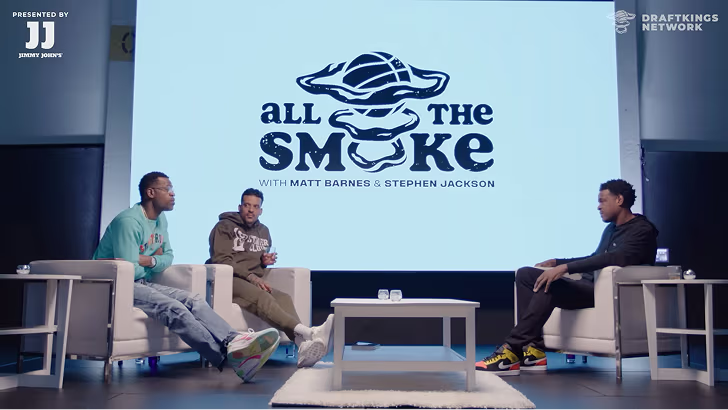
How All the Smoke makes hit compilations faster with OpusSearch

How All the Smoke makes hit compilations faster with OpusSearch

Growing a new channel to 1.5M views in 90 days without creating new videos

Growing a new channel to 1.5M views in 90 days without creating new videos

What Is Whop Content Rewards? Everything You Need to Know About the Leading Clipping Marketplace

No items found.
No items found.

Boost your social media growth with OpusClip

Create and post one short video every day for your social media and grow faster.

What Is Whop Content Rewards? Everything You Need to Know About the Leading Clipping Marketplace

Whop Content Rewards is a view-based campaign marketplace where brands (and agencies), creators, and streamers fund bounties, and literally anyone (no audience, no application, no portfolio) can join, post content, and get paid per 1,000 views.

It's quickly become one of the most talked-about ways to make money as a clipper in 2026, and also one of the most misunderstood. In this article, we'll break it all down: what Content Rewards actually is, how it works for both brands and clippers, what campaigns are paying right now, what to watch out for before you commit hours to one, and how OpusClip fits into the workflow to help clippers running Content Rewards campaigns produce more, better clips in a fraction of the time.

What is Whop?

Before getting into Content Rewards specifically, it's worth knowing what Whop is, because Content Rewards isn't a standalone app. It's a feature living inside a much bigger platform.

Whop is a Brooklyn-based creator commerce platform founded in 2021 by Steven Schwartz, Cameron Zoub, and Jack Sharkey. At its core, it's infrastructure for selling digital products, memberships, and communities: courses, trading groups, Discord-style communities, SaaS tools, and more, all with built-in payments, access control, and storefronts. The company has raised over $200M in funding and now processes close to $1B a year in payments across thousands of merchants.

Content Rewards is one app inside that ecosystem, but in 2026, it's become the thing most people mean when they say "Whop."

What is Whop Content Rewards?

Content Rewards is Whop's open campaign marketplace connecting two groups: brands (and agencies), creators, and streamers who want more reach, and clippers who want to get paid for making short-form content. A brand sets a budget and a reward rate (say, $2 per 1,000 views), and from that moment, any clipper on Whop can join the campaign, post content that meets the requirements, and start earning based on the views they generate.

There's no upfront cost to launch a campaign, and no upfront cost to join one as a clipper. Brands only pay for verified, approved views. Clippers only get paid once their content clears review and hits the platform's minimum view threshold.

How Content Rewards differs from a normal creator or influencer deal

  • No audience required. You don't need followers to join a campaign: you're paid on the performance of the specific clip, not your existing reach.
  • No application in most cases. Many campaigns let you join instantly and start submitting; some use a waitlist, but it's the exception, not the rule.
  • It's a marketplace, not a roster. Unlike a typical influencer program that hand-picks a small group of creators, Content Rewards is open: literally anyone with a Whop account can browse active campaigns and enter.
  • Pay is per-clip, per-view, not per-relationship. There's no retainer or flat sponsorship fee in most campaigns; your earnings are tied directly to how well each individual clip performs.

The different types of Content Rewards campaigns

One thing that separates Whop from more narrowly-scoped clipping platforms is how many flavors of campaign exist inside Content Rewards. Broadly, they fall into two categories (clipping and UGC), but in practice they show up as several distinct niches:

  • Clipping campaigns. The classic model: take a brand or creator's long-form content (a podcast, a livestream VOD, a webinar) and cut it into short-form clips for TikTok, Reels, or Shorts.
  • UGC campaigns. Original, face-to-camera content: think TikTok Shop-style videos where you're talking about a product or service rather than repurposing existing footage.
  • Music campaigns. Add a specific song to content you were likely already posting. Payouts here tend to be smaller than other campaign types, but also require far less work.
  • Podcast-specific and streamer campaigns. Niche clipping campaigns scoped to a specific show or streamer's VOD library, often run directly by the podcast or streamer's own team.

The rates vary enormously by type and difficulty. A "just add this song" campaign might pay $1 per 1,000 views; a "make an original talking-head video about our product" campaign might pay $3 per 1,000 views. As a rule of thumb, the more original effort a campaign requires, the higher the reward rate, and the stricter the requirements.

How Whop Content Rewards works

For brands and creators launching a campaign

  1. Add the Content Rewards app to your Whop from the App Store.
  2. Choose a campaign type (clipping or UGC) and a category.
  3. Set the economics: total budget, reward rate per 1,000 views, minimum and maximum payout per submission, and an optional flat bonus paid just for submitting (regardless of views).
  4. Choose eligible platforms: TikTok, Instagram Reels, YouTube Shorts, and X are all supported, and campaigns that allow more platforms tend to attract more clippers, since one clip can be cross-posted for multiple payouts.
  5. Set content requirements: tags, hashtags, affiliate links, minimum clip length, language, whether a dedicated fan page is required, and so on.
  6. Fund and launch. Once the budget is deposited, the campaign goes live in the public marketplace immediately.

Running your campaign through an agency

Not every brand wants to set up and manage a Content Rewards campaign itself, and that's the gap clipping agencies fill. Instead of a brand writing its own brief, sourcing footage, and manually reviewing every submission, an agency (like several of the ones we cover in our rundown of the top clipping agencies of 2026) will often run the campaign on a brand's behalf, either through Whop directly or through its own private network of vetted clippers: writing the requirements, managing quality control, chasing down underperforming submissions, and handling reporting, all rolled into one managed engagement instead of a self-serve marketplace listing.

The tradeoff is straightforward. Running your own campaign on Whop keeps costs lowest, since you're paying clippers directly with no management layer on top, but it also means you're doing all the sourcing, vetting, and review work yourself. Going through an agency costs more, but you're handing off that operational burden, and you're often tapping into a curated pool of clippers with a track record rather than whoever happens to be browsing the open marketplace that day.

Lastly, working with an agency comes with one more advantage: you're also tapping into their expertise about what actually works. Grayson Peil, the founder of popular clipping agency Clipping Culture, knows what works - he has grown over 3.5 million followers across music, memes, tech, fashion, news and sports, giving him firsthand experience in what makes content travel across different audiences. That expertise is part of what you're paying for when you work with an agency like Clipping Culture, not just the labor.

"You can’t force virality, but you can orchestrate it. Our clipping agency does not just distribute content. We shape the strategy, content and distribution around what is actually likely to spread."

- Grayson Peil, Founder / COO at Clipping Culture

For clippers joining a campaign

  1. Sign up at whop.com (free, and takes about a minute with a Google login).
  2. Browse the Content Rewards marketplace, filtering by category: clipping, UGC, music, logo, podcast, and more.
  3. Vet the campaign before joining. Experienced clippers check four things: the reward rate per 1,000 views, which platforms are eligible (more platforms = one clip earning multiple payouts), how much of the total budget is already spent (partially-spent budgets with a track record of payouts are generally safer than brand-new campaigns), and whether the campaign requires a waitlist or allows instant joining.
  4. Check reviews and campaign chat. Every campaign has a rating and a chat where clippers discuss whether submissions are actually getting approved and paid: this is the fastest way to avoid wasting hours clipping for a campaign manager who doesn't pay out.
  5. Pull the source assets. Most campaigns link a shared drive of raw footage (podcasts, stream VODs, or brand assets) that clippers use to make their clips.
  6. Create and post the clip to your own personal account on an eligible platform, following the campaign's exact requirements (tags, captions, minimum length, etc.). A tool like OpusClip is worth using here: it handles AI-powered clipping, gives you a full video editing UI to fine-tune the result, and includes a built-in post-scheduling feature, so you can go from raw footage to a scheduled, published post without leaving one app.
  7. Submit the link and raw file back through Whop and wait for review.
  8. Get paid once your submission is approved and clears the campaign's minimum view threshold: payouts scale with views up to the campaign's max-payout cap.

How much money can you actually make?

Reported payout rates vary a lot by campaign type and difficulty:

  • Music / logo campaigns: $1 per 1,000 views. Minimal extra effort; often stacked on content you're already posting
  • Standard clipping campaigns: $1–$3 per 1,000 views. The most common category; rates above $3 usually come with stricter requirements
  • UGC / talking-head campaigns: $2–$50 per 1,000 views. Highest ceiling, but requires original, on-camera content
  • Typical live campaigns (mid-2026 snapshot): $0.50–$1.50 per 1,000 views. Larger, well-funded campaigns tend to sit in this range, with rare outliers reported as high as $15/1,000 on small, low-budget campaigns

Individual clippers have reported earning anywhere from a few hundred dollars in their first couple of days on the platform to several thousand dollars in a single week, largely by working across multiple campaign types at once: a low-effort music or logo campaign stacked on top of content they're already posting, plus higher-effort clipping or UGC campaigns for the bulk of their earnings. As with any view-based model, results depend heavily on how many campaigns you enter, how good your clips are, and how consistently you post.

Payout mechanics

  • Submissions typically move through a review window (often around 72 hours) before views count toward payout.
  • Most campaigns have both a minimum payout threshold (you need a certain number of views before you're paid anything) and a maximum payout cap (there's a ceiling on what a single clip can earn, so budget gets spread across more clippers).
  • Withdrawals generally go out via a connected Stripe account or bank transfer; some reports also describe crypto payout options, and Whop has reportedly charged a processing fee in the high single digits on withdrawals.
  • Clippers in countries where Stripe isn't supported have historically had a harder time cashing out, a real limitation worth knowing about before you invest a lot of time.

Is Whop Content Rewards legit?

Mostly, yes, but it's worth going in with clear eyes about a few things independent reviewers and clippers themselves have flagged:

  • Bot and fraud detection is imperfect. Whop uses AI to flag suspicious submissions, but reports exist of view patterns that "cap out" suspiciously close to a campaign's max-payout threshold: the kind of pattern associated with view botting rather than organic growth. Brands that have lowered payout caps have reported view counts snapping down to match, which is not something organic traffic normally does.
  • Geo-targeting is easy to route around. Some brands try to restrict campaigns to specific countries, but that's reportedly simple to bypass with a VPN, since Whop's creator pool is global by default.
  • Not every campaign manager pays reliably. Multiple clippers describe submitting content, hitting the view threshold, and then not getting paid, which is exactly why checking a campaign's reviews and chat activity before joining is treated as a non-negotiable step by experienced clippers, not an optional one.
  • Content doesn't always stick around. Some brands have reported that clips get deleted from creators' accounts after a campaign ends, which limits the long-term organic value brands often expect from this kind of distribution.

None of this makes Content Rewards a scam: it's simply an open marketplace, and open marketplaces have more variance in quality than a curated agency roster (see our breakdown of some of the top clipping agencies of 2026 for a more managed alternative). If you're a brand, that means budgeting time for manual review. If you're a clipper, it means treating campaign vetting as seriously as the clipping itself.

It's also worth comparing this model to platforms like MrBeast's Vyro, which takes a narrower approach: a curated roster of major creators running structured campaign "drops," rather than Whop's fully open, anyone-can-join marketplace spanning dozens of brands and campaign types at once. Vyro trades breadth for more curation; Whop trades curation for volume and variety.

Using OpusClip with Whop Content Rewards campaigns

The single biggest bottleneck for clippers on Whop isn't finding campaigns: it's producing enough clips to actually make money. Manually scrubbing through a 90-minute podcast to find the handful of clip-worthy moments, then cutting, captioning, and reframing each one in an editor like CapCut, can easily eat several hours for just a handful of finished clips. And on a per-view payout model, output volume is directly tied to income.

This is exactly the gap OpusClip is built to close.

Why OpusClip works well for Content Rewards campaigns

  • Speed. Instead of manually scrubbing a full-length source video, OpusClip's AI surfaces the most clip-worthy moments automatically, turning a process that used to take hours into one that takes minutes.
  • Volume. Clippers using AI-assisted editing have reported generating 40+ finished clips from a single long-form video in under 15 minutes, versus one or two clips manually in the same window, and on a per-view model, more published clips means more shots at a submission going viral.
  • Built-in formatting. Auto-captioning, 9:16 reframing, and active-speaker tracking are handled automatically, matching the technical requirements most Content Rewards campaigns specify.
  • Quality filtering, not just quantity. Not every AI-generated clip is publish-ready, but the tool ranks and scores clips so you can quickly identify which ones are actually worth submitting, rather than reviewing everything manually.

A typical OpusClip + Content Rewards workflow

  1. Find your source video: a podcast, stream VOD, or webinar, often already linked directly in the campaign's shared drive.
  2. Import it into OpusClip by pasting a link or connecting the source drive.
  3. Let the AI find and rank the best moments based on virality potential, rather than watching the full source yourself.
  4. Auto-generate captions and reframe to whatever aspect ratio the campaign platform requires.
  5. Review the ranked clips and select the ones that best match the campaign's specific requirements (length, tags, platform).
  6. Publish to your own TikTok, Reels, or Shorts account.
  7. Submit the link back to the Whop campaign and track approval status and payout in one place.

The clippers earning the most on Whop aren't necessarily the best editors: they're the ones who can consistently produce enough high-quality clips to have several shots at going viral across multiple campaigns at once. That's a volume game, and volume is where AI-assisted clipping has the clearest edge over doing it by hand.

Final thoughts: is Whop Content Rewards worth it?

What we know for certain:

  • Content Rewards is a real, functioning marketplace with active campaigns, real payouts, and no cost to join as a clipper.
  • Rates vary widely by campaign type, from fractions of a cent to $50+ per 1,000 views.
  • The platform rewards volume and consistency more than any single viral hit.

What to watch out for:

  • Bot detection and payout reliability aren't uniform across every campaign: vetting individual campaigns matters more than trusting the platform as a whole.
  • Payout mechanics (review windows, fees, country restrictions) can meaningfully affect how much you actually take home.
  • Content persistence and campaign manager reliability vary brand to brand.

Content Rewards is worth exploring if:

  • You're already posting short-form content and want a low-effort way to monetize existing output (music and logo campaigns are the easiest entry point).
  • You're comfortable treating clip production as a volume game rather than a one-hit strategy.
  • You're willing to spend a few minutes vetting a campaign's reviews and payout history before investing hours into it.
  • You have (or are willing to build) a fast clipping workflow, because on a per-view marketplace, the clippers producing the most publishable clips are the ones earning the most.

If that last point is your bottleneck, that's exactly where OpusClip comes in: turning long-form source footage into a batch of ranked, ready-to-post clips in minutes, so you can spend your time finding the next campaign instead of scrubbing through hours of raw video.

Ready to start streaming differently?

Opus is completely FREE for one year for all private beta users. You can get access to all our premium features during this period. We also offer free support for production, studio design, and content repurposing to help you grow.
Join the beta
Limited spots remaining

Try OPUS today

Try Opus Studio

Make your live stream your Magnum Opus