No items found.
The 10 Best Clipping Agencies in 2026
August 12, 2026

A clipping agency sources and manages a network of short-form editors, called clippers, who cut a brand's long-form content into dozens or hundreds of native TikTok, Reels, and Shorts posts. Most price against verified views rather than a flat retainer, which makes a clipping agency closer to a media buy than a traditional creative shop.
Short-form video didn't just change how people watch. It changed how brands, artists, and creators get discovered. And behind almost every viral moment you've scrolled past on TikTok, Reels, or Shorts that wasn't posted by the original creator, there's a clipping agency running the machine: sourcing clippers, managing distribution, and turning one piece of long-form content into hundreds of native, algorithm-friendly posts.
Clipping agencies have matured fast. What started as scrappy Discord servers paying creators pennies per view has turned into a real industry with CPM benchmarking, verified-view reporting, and campaigns for labels like Universal Music Group and platforms like Netflix. But the agencies aren't interchangeable: they differ a lot in who they serve, how they price, which platforms they prioritize, and how "managed" the experience actually is.
We looked at ten of the clipping agencies creators, brands, and labels are talking about in 2026 to break down what actually makes each one different. Here's what we found.
How we put this list together
Every agency below is included because it publishes enough about pricing, network size, platform coverage, and past work to be evaluated. We've noted where figures are self-reported by the agency rather than independently verified. The list is not ranked best to worst: the right agency depends almost entirely on your budget tier and content type, so we've ordered it roughly from most managed and highest minimum to most self-serve, and flagged the specific use case each one fits.
The 10 clipping agencies at a glance
- Clipping Culture: fully managed campaigns, $15,000+ minimum, 300,000+ clippers. Best for major labels and established artists.
- Clip Farm: pay-per-view, you set your own rate, no upfront fee or retainer. Best for testing clipping cheaply.
- Zula.chat: marketplace of named creators, roughly $100 per 100K views, TikTok and Instagram only. Best for tapping recognizable accounts.
- Clip Central: CPM-based with a published $0.001–$0.004 CPV benchmark. Best for performance marketers reallocating paid social budget.
- The Clip Ship: managed, CPM-transparent, 150,000+ creators, deep entertainment case studies. Best for music, film, and TV rollouts.
- cliphaus: managed, five platforms, 24–48 hour launch, $5K to $250K+ budgets. Best for the broadest simultaneous platform coverage.
- Clipping Agency: four productized services including a dedicated podcast clipping product. Best for podcasters.
- Bounty Network: bounty board, 10,000+ creators, brief live in under an hour. Best for the lowest-commitment test.
- Clip.tech: Discord-first clipper community rather than a managed network. Best for web3, gaming, and fandom brands.
- CLPR Media: boutique and founder-led, 8,000+ clippers, four platforms simultaneously. Best for DTC brands, musicians, and podcasters.
1. Clipping Culture: best clipping agency for major labels and artists
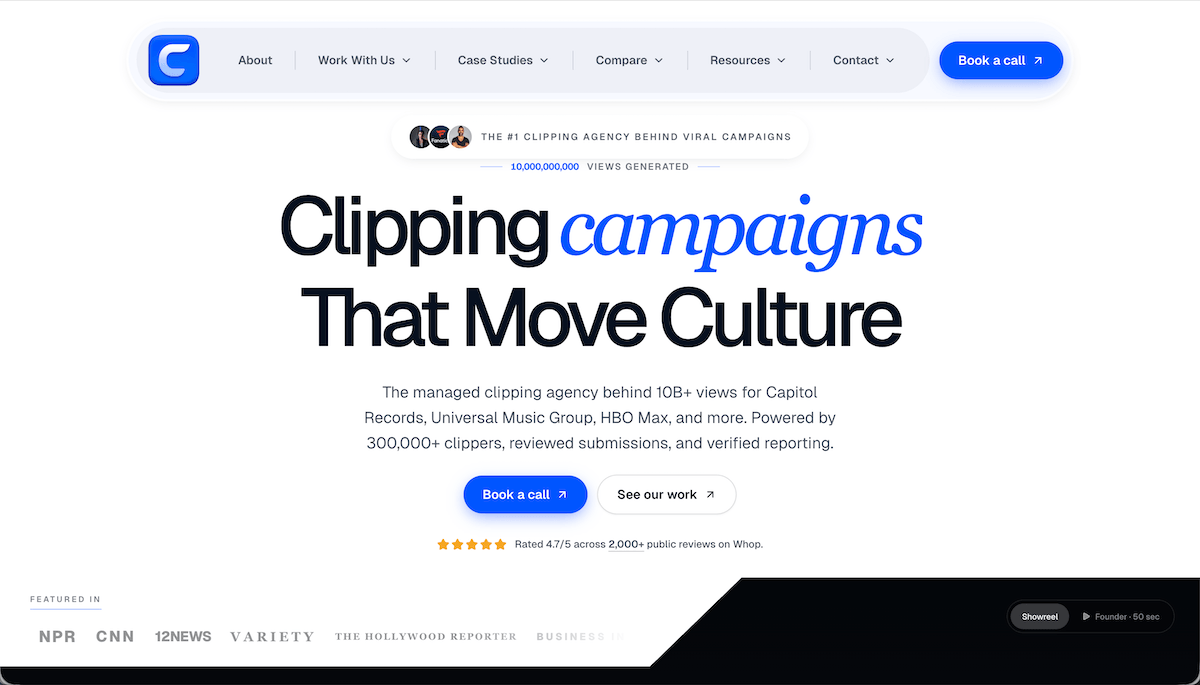
Clipping Culture, founded by Evan Stanfield and Grayson Peil, runs at the high end of the market. Managed clipping campaigns start at $15,000+, priced against a target volume of verified views rather than a flat retainer. Every clip submitted against a campaign is checked against brand guidelines before it counts. That rigor is matched by its client roster: Capitol Records, Universal Music Group, HBO Max, Selena Gomez, Zedd, and bbno$ have all run campaigns through its network of 300,000+ active clippers.
Best for: major labels, established artists, and brand launches that want enterprise-scale distribution and are less price-sensitive than they are results-sensitive. Campaigns reportedly launch within 1–2 days of an intro call.
2. The Clip Ship: best clipping agency for music, film, and TV releases
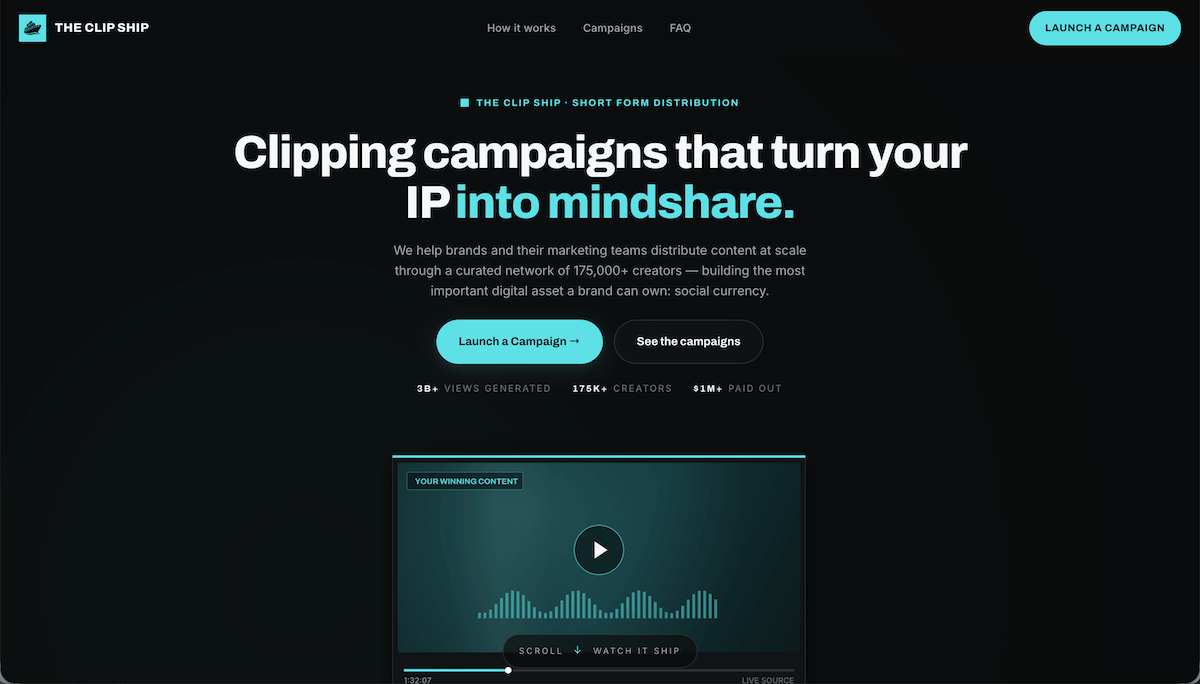
The Clip Ship is squarely built for entertainment IP: music releases, film, and television. Its published case studies are some of the most detailed in the space: Logic's Paradise Records rollout generated 125M+ views across 4,000+ clips, The Chainsmokers' Breathe EP hit 108M+ views from 1,100+ clips, and a Netflix campaign for Owning Manhattan drove 25M+ views from 2,400 clips. The agency leans into "growth partner" positioning, transparency on CPM, no arbitrage, and operates a network of 150,000+ creators and clippers.
Best for: labels, film/TV studios, and artist teams that want to see documented, platform-scale case studies before committing budget.
3. Clip Farm: best clipping agency for low-commitment, pay-per-view tests
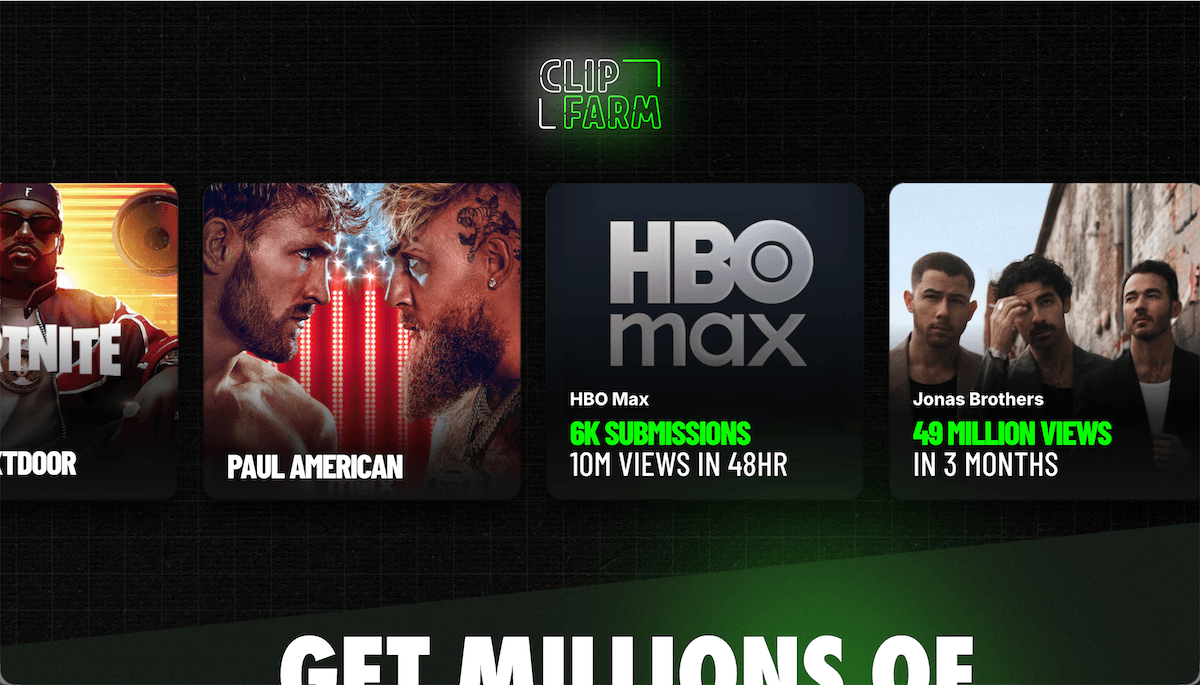
Clip Farm strips clipping down to its purest performance model: you set your own reward rate per 1,000 views, and you only pay for approved, viewed content: no upfront fees, no retainer. That structure makes it one of the more accessible entry points into paid clipping, and the site pitches itself to everyone from startups to global brands.
What makes Clip Farm particularly interesting is who's behind it: it was founded by Airrack (Eric Decker), the ~14M-subscriber YouTuber known for MrBeast-style challenge videos and viral stunts, launched in partnership with Whop. That's a meaningfully different starting point than most agencies on this list: Clip Farm wasn't built by a marketing or ad-tech team looking to sell brands on a new channel, it was built by a creator who came up on the exact kind of high-volume, algorithm-chasing content this whole industry repackages. That pedigree gives Clip Farm built-in credibility with the clipper side of the marketplace, not just the brand side, which matters in a two-sided platform where you need enough clippers showing up to make any bounty worth posting.
Because Clip Farm runs on Whop, it's worth understanding how that underlying marketplace works before you launch: we break it down in our guide to Whop Content Rewards.
Best for: teams that want to test clipping as a channel without committing to a large clipping campaign minimum, and that are comfortable managing more of the strategy themselves in exchange for lower cost.
4. Zulachat: best clipping marketplace for named-creator reach
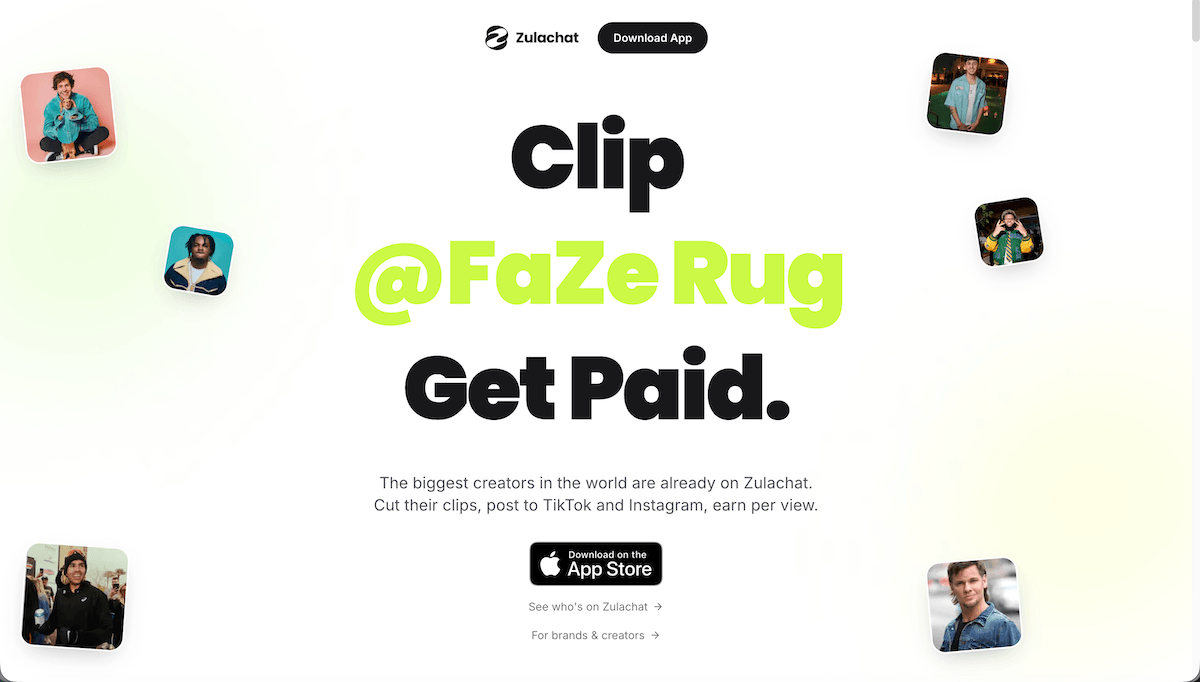
Zulachat is less an agency in the traditional sense and more a marketplace connecting brands directly with individual clippers, including some genuinely large ones. The platform highlights creators like David Dobrik and FaZe Rug in its network, with a combined reach north of 158 million followers, and pays out at roughly $100 per 100K views. It's also one of the more transparent platforms on payout mechanics: weekly payouts, PayPal or bank transfer, and top performers reportedly clearing $10K+ a month.
Best for: brands and creators who specifically want TikTok- and Instagram-native distribution (Zula.chat doesn't extend to YouTube Shorts) and like the idea of tapping into named creator accounts rather than an anonymous network.
5. Clip Central: best clipping agency for CPM-driven performance marketers
Clip Central pitches itself with a media-buyer's argument: a direct cost comparison against paid social. Its published numbers put Clip Central at $0.001–$0.004 CPV, versus $0.005–$0.05 for TikTok, Meta, and YouTube ads. That means a 25M-view campaign that might cost $125K–$1.25M in paid media could run $25K–$100K through their network. Pricing itself is CPM-based, with a separate flat rate for their creative studio if you need clips produced, not just distributed. Because no paid spend sits behind the clips, content runs as organic rather than sponsored, and doesn't require #ad disclosure by default (though brands can opt into disclosure language).
Best for: performance marketers who think in CPM/CPV and want a numbers-first pitch for reallocating ad budget toward organic-feeling distribution.
6. cliphaus: best clipping agency for multi-platform coverage
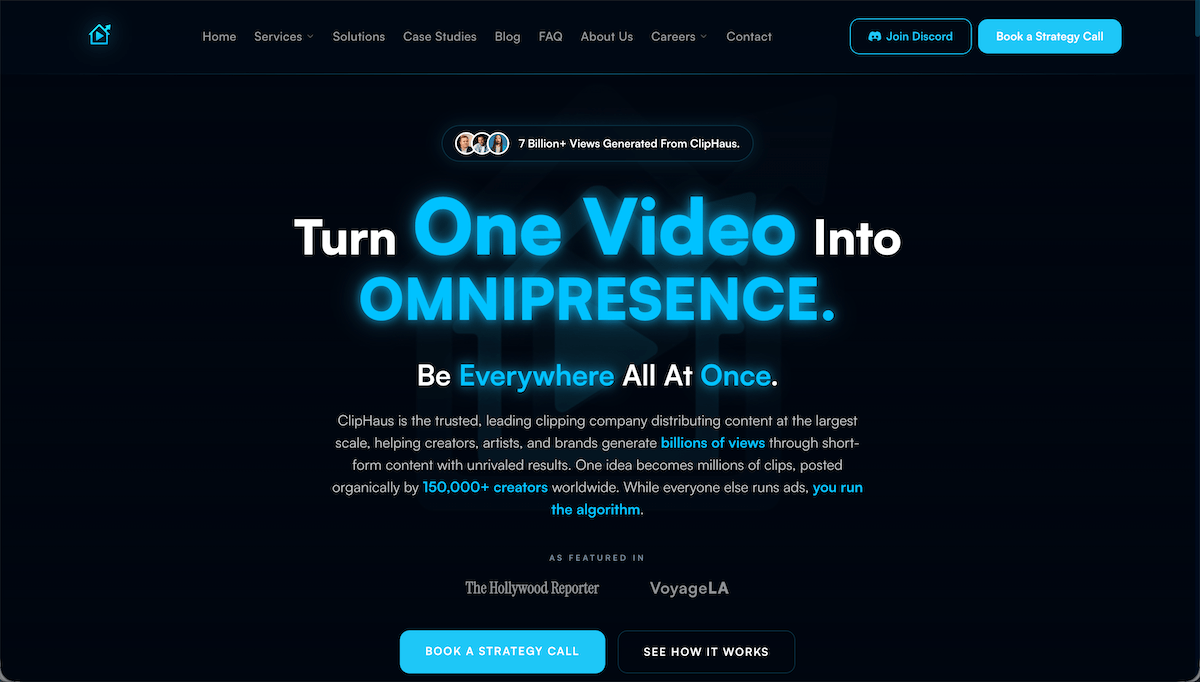
cliphaus has the widest platform footprint on this list, distributing to TikTok, Instagram Reels, YouTube Shorts, X, and Facebook, and claims the fastest turnaround, a 24–48 hour clipping campaign launch versus what it frames as a 5–7 day industry norm. Its client list spans music (Atlantic Records, Universal Music Group) and consumer brands (Gymshark, Coinbase, Crocs), plus political campaigns, run through a 150,000+ creator network of "handpicked editors." The agency also makes a specific claim worth noting: 100% verified human engagement, zero bots. Budgets on the contact form range from $5K to $250K+.
Best for: brands that want the broadest simultaneous platform coverage and are willing to work at enterprise budget tiers.
7. Clipping Agency: best clipping agency for podcasts
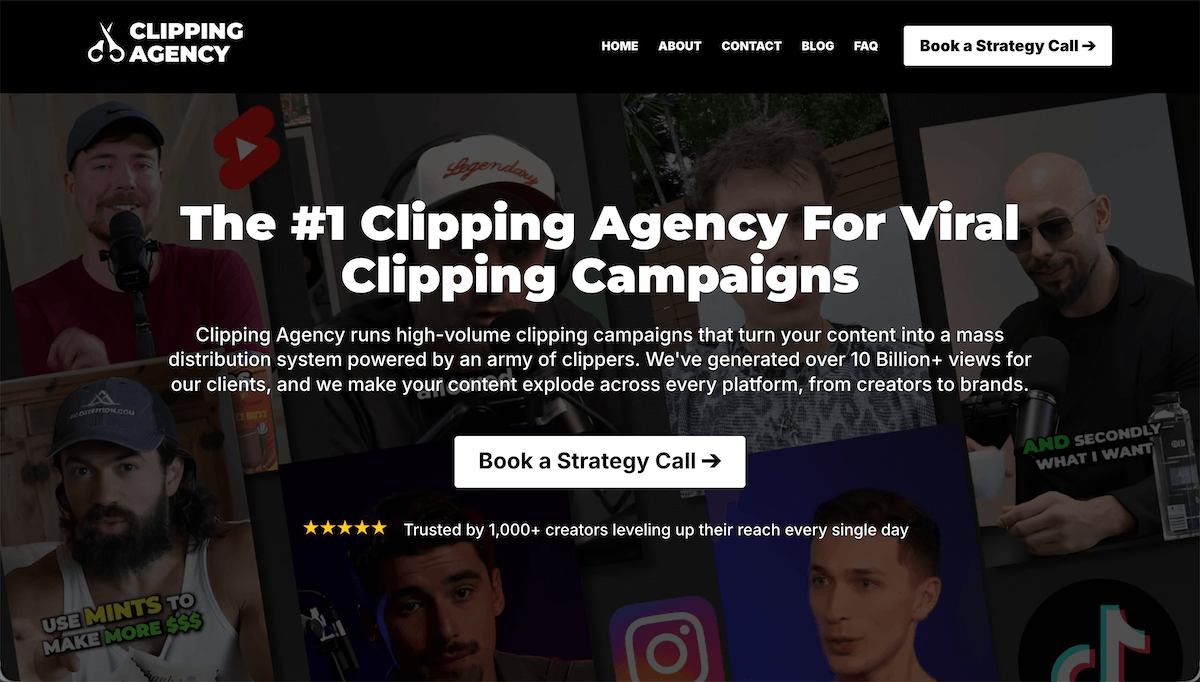
True to its name, Clipping Agency is one of the more categorized offerings here, splitting its service into four distinct products: general clipping services, performance-tracked clipping campaigns, a dedicated podcast clipping agency product that turns each episode into 10–30 clips, and a broader "clipping marketing" framing that positions the whole category as an alternative channel to paid ads. The agency claims 10B+ cumulative views generated and 1,000+ creators served, with reported client outcomes of a 10x increase in short-form output and 1–5M additional monthly views within 30 days.
Best for: podcasters specifically (the dedicated podcast product is the clearest differentiator), as well as creators and founders who want a single vendor to run the entire clipping operation.
8. Bounty Network: best clipping agency for fast, low-commitment campaigns
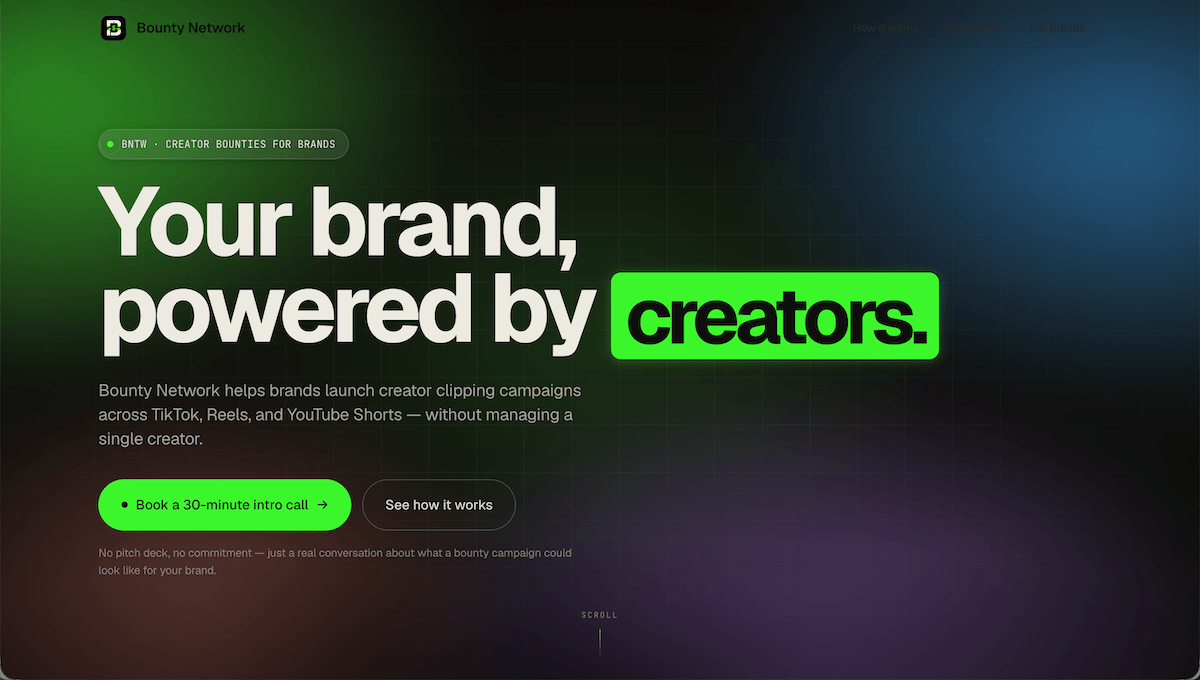
Bounty Network takes a distinctly lightweight, bounty-board approach: brands post a brief, creators apply and self-select into the campaign, and payouts are tied to output and performance rather than a retainer. It's also the most transparent about platform strategy of any agency here, framing TikTok as the discovery layer, Instagram Reels as the mid-funnel/intent layer (with Stories link integration), and YouTube Shorts as the search-driven, long-tail layer that keeps working months after posting. With 10,000+ creators in its pool and a single dashboard across campaigns, it pitches itself on simplicity: no procurement process, no media plan, a brief launched in under an hour. Past work includes a political party (DIKO, Cyprus), the creator platform Fanvue, and TRT Consulting.
Best for: brands or campaigns (including political ones) that want a low-commitment, no-pitch-deck way to test creator-clipping distribution, and appreciate the platform-by-platform strategy breakdown.
9. Clip.tech: best clipping community for web3, gaming, and fandom brands
Clip.tech brands itself as "the #1 clipping community on the internet," and its distribution model reflects that: it's built around a Discord-first community of independent "Clippers" rather than a managed agency network, with secondary distribution through X/Twitter and Instagram. Brands can either recruit directly from the community or launch a campaign through the platform. It's the most community-native, least "agency" feeling option on this list.
Best for: projects with an existing or desired community presence (web3, gaming, or fandom-driven brands) that want distribution to run through an organic, Discord-centered creator base rather than a top-down managed campaign.
10. CLPR Media: best boutique clipping agency for DTC brands and musicians
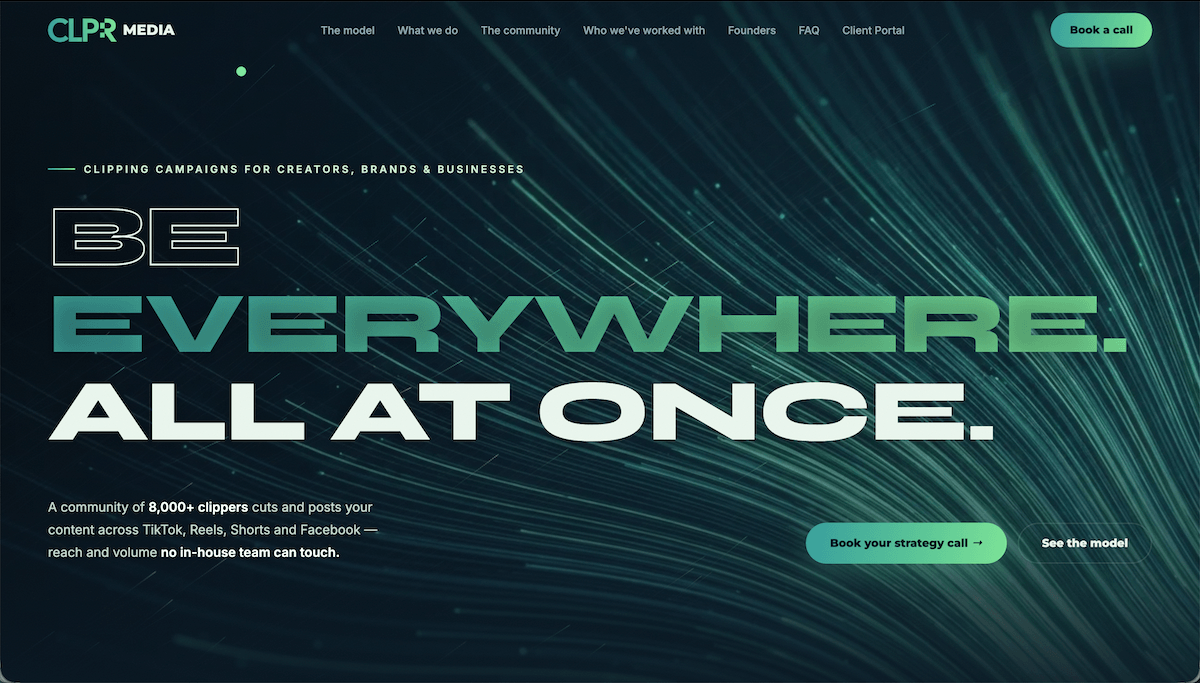
CLPR Media is a boutique operation led by two named co-founders (Kevin Clavell on viral content strategy, Raul Vega on post-production) running an 8,000+ clipper community across TikTok, Instagram Reels, YouTube Shorts, and Facebook Reels. Every clipping campaign runs on all four platforms simultaneously, with the pitch being "distributed reach, not just posting": getting content in front of audiences the client doesn't already own, not just more videos on the client's own accounts. Turnaround is quick: the clipper community typically starts posting within the first week, with full campaign volume by week two. Client work spans creators (Chris Koerner, 35M+ views), DTC brands (Based Bodyworks), musicians (Albino), and even a political podcast (Voces del Cambio).
Best for: DTC brands, musicians, and podcasters who want a smaller, founder-led agency with visible leadership rather than a fully automated platform.
How to choose a clipping agency
A few patterns emerge once you line these up side by side:
- If you want documented, big-name case studies: Clipping Culture and The Clip Ship both lean heavily on named clients and reported view counts.
- If price and CPM math matter most: Clip Central makes the clearest cost-per-view argument against paid ads; Clip Farm and Zula.chat both offer pure pay-per-view models with low commitment.
- If you're a podcaster specifically: Clipping Agency's dedicated podcast product and CLPR Media's boutique model are worth a look before the generalists.
- If platform breadth matters: cliphaus and CLPR Media both push content across four-plus platforms simultaneously.
- If you want the lowest-commitment way to test the waters: Bounty Network's no-pitch-deck, hour-to-launch model is built for that.
- If your source footage is the constraint, not the distribution: no agency on this list can outrun a slow edit pipeline. Ask any shortlisted agency how source clips get produced and who pays for that work, because on a per-view model the answer directly affects your cost per view.
Two questions are worth asking every agency before you sign: what counts as a verified view, and who produces the clips themselves. Agencies differ enormously on both, and both determine what you're actually buying.
Clipping agency or clipping marketplace: which do you actually need?
The agencies above sit on a spectrum, and it's worth being clear about which end you're buying from.
A managed clipping agency writes the brief, sources footage, vets clippers, reviews every submission, and reports back. You pay a management layer on top of the clipper payouts, and in exchange you're buying judgment: which moments travel, which clippers deliver, which submissions to reject.
An open clipping marketplace like Whop Content Rewards, which Clip Farm is built on, removes that layer entirely. You set a rate, fund a budget, and anyone can join. It's the cheapest way to buy views and the most operationally demanding, because the vetting and review work lands on you. We cover exactly how that model works, what campaigns pay, and where it goes wrong in our Whop Content Rewards guide.
Most teams should start self-serve to learn what a viable rate and clip length look like in their niche, then move to a managed agency once the budget is large enough that the management fee costs less than the time it replaces.
Where OpusClip fits in
Whichever agency you work with, the bottleneck is almost always the same: turning hours of long-form footage into dozens or hundreds of clips fast enough to keep a clipper network fed. That's the part of the stack OpusClip is built for: AI-powered clip selection, auto-captioning, reframing, and virality scoring that let agencies (and the clippers in their networks) go from raw footage to a batch of publish-ready shorts in minutes instead of days. If you're running or working with a clipping operation in 2026, the agency handles strategy and distribution, and the right tooling is what lets you actually keep up with the volume.
If you want to see what that looks like on your own footage, you can turn a YouTube video into ranked, ready-to-post clips before you brief a single agency.
Frequently asked questions
What is a clipping agency?
A clipping agency manages a network of short-form editors who cut a brand's long-form content into native TikTok, Reels, and Shorts posts, then distribute those clips across the clippers' own accounts. Most price against verified views rather than a monthly retainer, which makes the model closer to a performance media buy than a traditional agency engagement.
How much does a clipping agency cost?
It ranges from effectively nothing upfront to five figures per campaign. Pay-per-view platforms like Clip Farm and Zula.chat charge no upfront fee and pay only for approved views, while fully managed agencies such as Clipping Culture start at $15,000+ per campaign. CPM-based agencies like Clip Central publish cost-per-view figures of $0.001–$0.004, against $0.005–$0.05 for paid social.
How do clipping agencies work?
The brand supplies long-form source footage and a brief covering tone, hashtags, links, and clip length. The agency distributes that brief to its clipper network, clippers produce and post clips to their own accounts, and the agency reviews submissions against the guidelines before views count toward payout. Payment is typically per 1,000 verified views, capped per clip so budget spreads across more clippers.
What is the difference between a clipping agency and a clipping marketplace?
An agency adds a management layer: it vets clippers, quality-controls submissions, and handles reporting for a fee. A marketplace like Whop Content Rewards is open to anyone, costs less because there's no management fee, and leaves the sourcing, vetting, and review work with you.
Are there clipping agencies for podcasts?
Yes. Clipping Agency runs a dedicated podcast product that turns each episode into 10–30 clips, and CLPR Media works with podcasters through its boutique, founder-led model. Both are worth checking before a generalist agency, because podcast clipping depends heavily on finding conversational moments that stand alone without context.
Do clipping campaigns need #ad disclosure?
It depends on the arrangement, and you should get legal advice on your specific campaign. Agencies including Clip Central note that because no paid media spend sits behind the clips, content runs as organic rather than sponsored and doesn't carry disclosure language by default, though brands can opt into it. Clippers being paid for posts is a material connection, so treat disclosure as a decision to make deliberately rather than a default to inherit.