No items found.
9 Best Auto Caption Generators for Videos in 2026

For most short-form creators, OpusClip is the best auto caption generator when the source is a long recording: captions are generated as part of processing, styled with animated templates and editable word by word, so a podcast, webinar or interview comes back as captioned clips instead of a transcript to format. CapCut and Clipchamp suit free captions on one finished video, Submagic suits caption-first short videos, VEED and Kapwing suit browser editing, Canva suits teams already designing there, Adobe Premiere suits professional timelines, and YouTube's built-in captions suit videos that live only on YouTube. We ranked 9 tools by how little work stands between an upload and usable captions (one-step generation, editable output, styling, price and free-tier limits), not by a transcription accuracy test. For the accuracy angle, see our auto-caption accuracy guide, and for full editors where captions are one feature, see the best video editors with caption features.
Key takeaways
- Best for automatic animated captions on clips cut from long videos: OpusClip. Captions are generated while the video is processed, then edited by word, with brand vocabulary for names and terms.
- Best for free captions on one finished video: CapCut and Clipchamp. Both describe a short generate-and-edit flow and call the feature free.
- Best for caption-first short videos: Submagic. Its caption page lists 35+ animation templates and a text-based editor.
- Best for browser editing with captions: VEED and Kapwing. Both offer editable text and animated subtitle styles.
- Best inside a design suite, a professional timeline or YouTube itself: Canva, Adobe Premiere and YouTube Studio.
- Check the free tier and the review step: watermarks, length caps and locked caption styles differ more than headline prices, and every tool here still expects a human read-through.
At a glance
- OpusClip: best for automatic animated captions on clips cut from long videos; Starter $15 a month, Pro $29 a month ($14.50 a month billed annually); free plan yes (watermark, no editing).
- CapCut: best for free captions on one video inside an all-round editor; Pro $19.99 a month; free plan yes (free templates and basic editing tools).
- Submagic: best for caption-first short videos; Starter $12 per member a month billed yearly ($19 billed monthly); the pricing page lists no free plan.
- VEED: best for browser captioning with karaoke-style and highlight animations; Creator $12 per user a month billed yearly; free to start.
- Kapwing: best for an editable transcript and 100+ subtitle presets; Pro $16 a month on the annual toggle ($24 monthly); free plan yes (watermark, 4-minute exports).
- Clipchamp: best for free automatic captions on Windows and the web; free plan yes; premium features come with Microsoft 365 Personal or Family.
- Canva: best for captions inside a design suite; Pro US$144 a year; free plan yes.
- Adobe Premiere: best for captions on a professional timeline; from US$22.99 a month (annual plan, billed monthly); 7-day free trial.
- YouTube Studio: best for built-in captions on videos published to YouTube; the help article lists no fee.
1. OpusClip: Best for automatic animated captions on clips cut from long videos
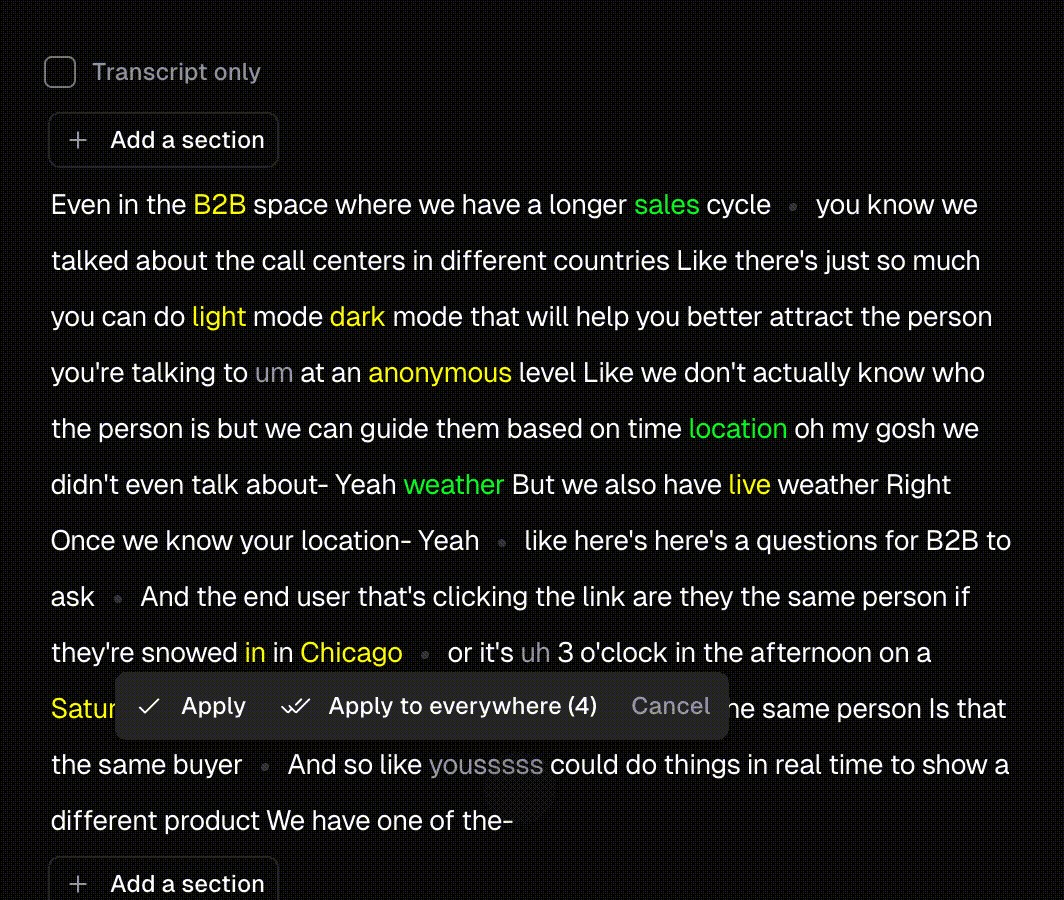
OpusClip's caption editor. Source: OpusClip website
OpusClip generates captions automatically while it processes a video: a pasted link or an uploaded file goes in, and clips come back with captions already on, with no separate captioning step. The OpusClip captions page says captions are added automatically and can be edited freely. When a video should stay whole, the help center describes a Don't Clip option in the AI Copilot that generates a caption-only project from the full video, and an uploaded SRT file can replace OpusClip's own transcript.
Editing is the second half of the job. According to the captions and emojis help article, a selected word or sentence can be edited, missing captions can be added, timestamps can be adjusted, and captions can be dragged to a new position, while the Captions tab changes font style, size, color, stroke, shadow and case. Names and product terms are covered by brand vocabulary: correcting a word and choosing Apply to all fixes every instance in the clip, and adding it to brand vocabulary makes new clips transcribe it correctly. The help center says over 25 languages are supported, with several marked beta, where emoji or highlighted keywords may be less accurate, and that Pro plan users can download a transcript (.txt) and subtitles (.srt).
Pricing: OpusClip's pricing page lists Free at $0 (AI captions with an emoji and keyword highlighter, clips carry a watermark, no editing), Starter at $15 a month (monthly billing only; it adds the editor, filler-word and silence removal, and watermark removal) and Pro at $29 a month, or $14.50 a month billed annually ($174 a year), which adds custom fonts among other features. Business is custom.
Considerations: Because the Free plan lists no editing, fixing a misheard word needs a paid plan. The help center says there is currently no bulk caption edit, so each clip is edited individually, that right-to-left languages such as Hebrew and Arabic are not supported, and that translating captions before clipping currently targets English only. OpusClip is a clipping and captioning tool, not a full timeline editor.
- Choose it if long recordings such as podcasts, webinars and interviews need to become captioned short clips, with animated styles, keyword highlights and brand vocabulary applied automatically, or a full video needs a caption-only project.
- Skip it if the job is a quick, free, watermark-free caption on one finished video, captions in right-to-left languages, or frame-level timeline editing.
2. CapCut: Best for free captions on a single video inside an all-round editor
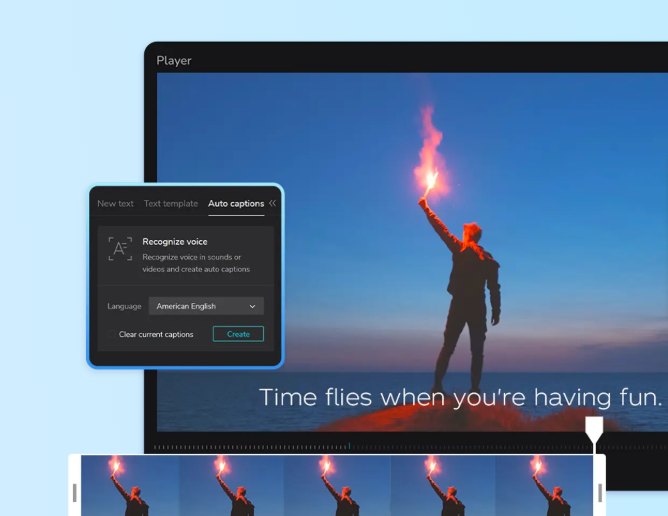
CapCut's auto caption generator page. Source: CapCut website
CapCut's auto caption page describes a short flow: add a video, open the Text tab, choose Auto captions and select Generate. The tool recognizes the spoken language and produces synchronized captions, which can then be corrected by adding or deleting lines. After generation, the page lists text style, format, font, color, effects and motion as adjustable, and says captions can be translated into a target language. The page calls the feature free and notes that no credit card is required to start.
CapCut is a general editor, so captions sit next to trimming, effects, music and templates in the same project, online and on desktop. The page also says teammates can be invited to review captions through shared project access. It describes captioning a video that is already in the editor; it does not describe finding highlights inside a long recording.
Pricing: CapCut's pricing page lists Free at $0 (free templates and basic editing tools), Pro at $19.99 a month ($179.99 a year) with premium templates and 1,200 monthly AI credits, Ultra at $79 a month, and Teams at $12.49 a month per seat with a brand kit. The page notes that displayed pricing is for reference only and that final pricing appears after sign-in.
Considerations: The pricing page does not say whether any caption templates or effects are premium, so check inside the editor before building a workflow around one style. The caption page itself advises reviewing names, specialist terms and timing before publishing translated captions.
- Choose it if the goal is free captions on one finished video, inside an editor that also trims and adds music.
- Skip it if the job is cutting many clips out of long recordings automatically.
3. Submagic: Best for caption-first short videos with a large animated preset library
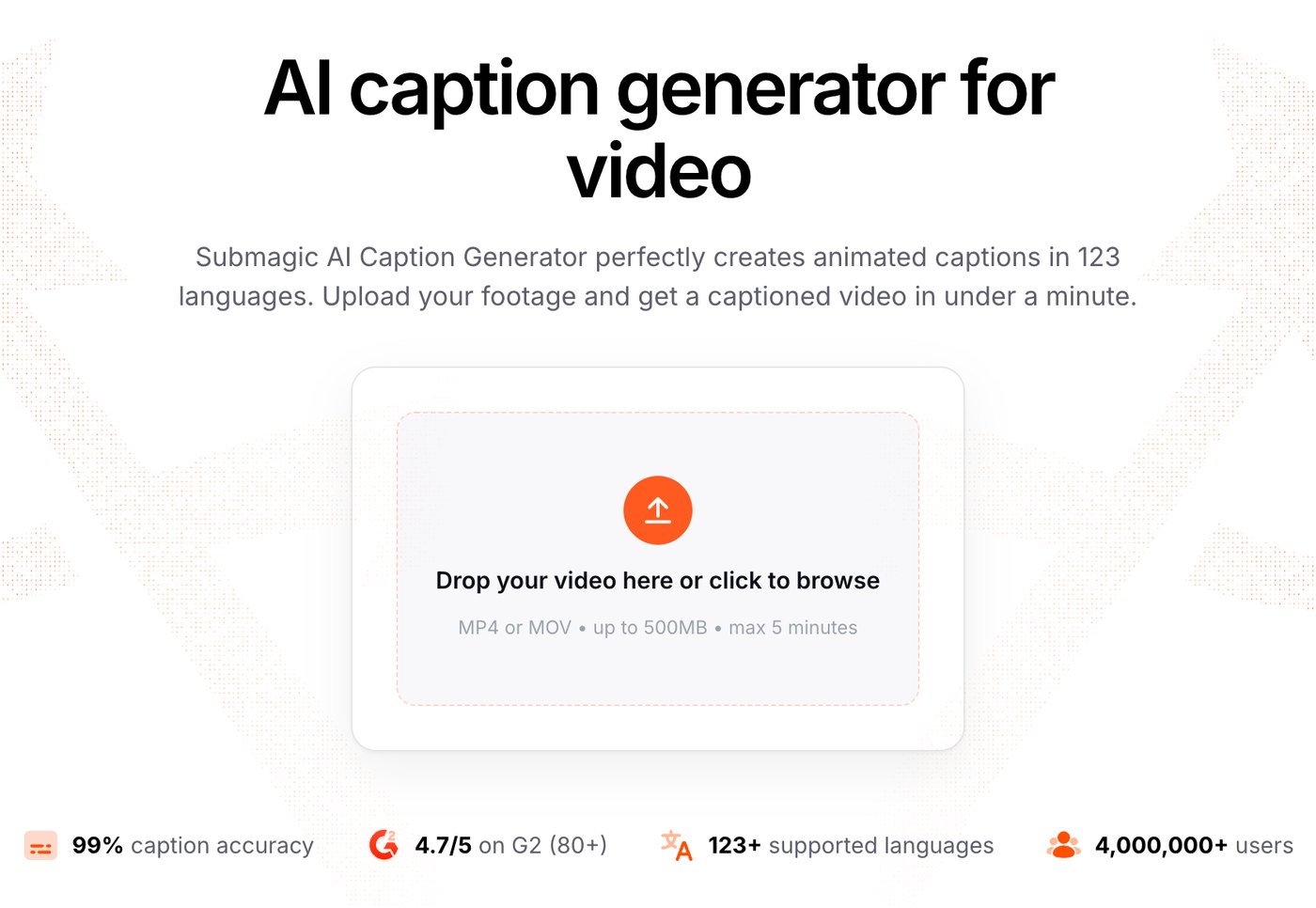
Submagic's AI caption generator page. Source: Submagic website
Submagic's AI caption page says an uploaded video comes back captioned in under a minute, in 123 languages with 99% caption accuracy; those timing and accuracy figures are the vendor's own and we did not measure them. The page describes 35+ animation templates that highlight, bounce and fade word by word, branded captions that reuse uploaded fonts, colors and animation, and a text-based editor where deleting a sentence from the transcript cuts the video. The upload box on that page lists MP4 or MOV files up to 500MB and 5 minutes.
Beyond captions, the Submagic site lists silence and bad-take removal, B-roll, auto-zoom, publishing and a video editing API, and its caption page FAQ describes Magic Clips for long-form videos as an add-on. That makes it a caption-led editor with a clipping layer, not only a subtitle tool.
Pricing: Submagic's pricing page lists Starter at $12 per member a month billed yearly ($19 billed monthly) with 45 credits (about 15 videos), no watermark, AI auto captions and 1080p export; Pro at $23 billed yearly ($39 monthly) with 120 credits and a Brand Kit; and Business at $41 billed yearly ($69 monthly) with 300 credits, 4K export and a custom words dictionary.
Considerations: Starter limits each video to 2 minutes (5 on Pro, 30 on Business) and counts usage in credits. Caption templates are listed as Standard on Starter and Premium on Pro and Business. The pricing page lists no free plan, while the caption page FAQ says a free tier processes 3 videos a month with a watermark, so confirm the free option at sign-up.
- Choose it if captions are the main event and the goal is a polished, animated look on short vertical videos.
- Skip it if videos run longer than a few minutes on a small plan, or a documented free plan is required.
4. VEED: Best for browser captioning with karaoke-style and highlight animations
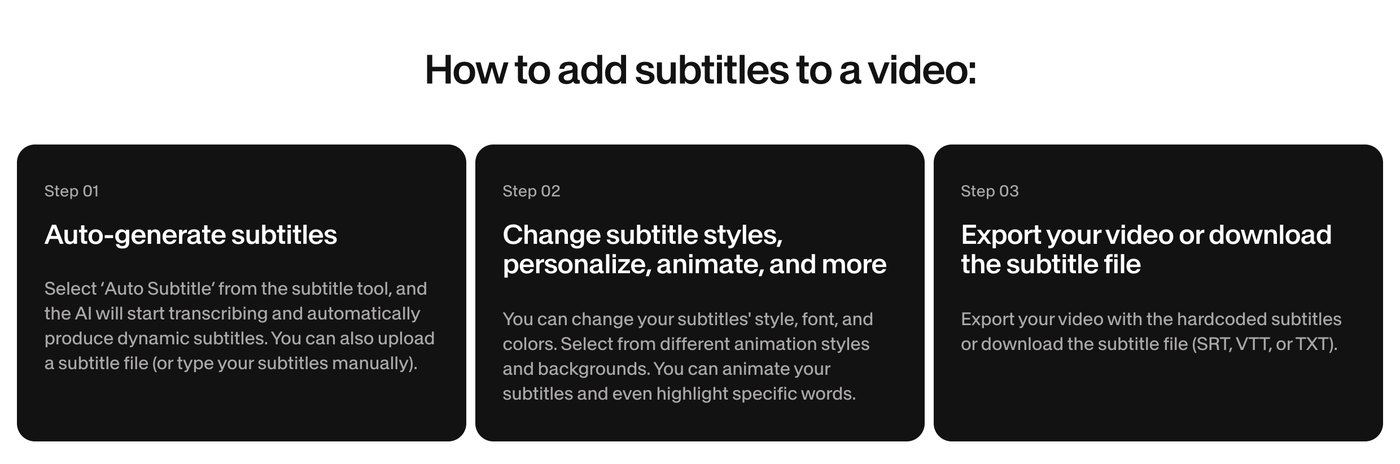
VEED's auto subtitle generator page. Source: VEED website
VEED's auto subtitle page describes selecting Auto Subtitle, choosing a language, and letting the AI transcribe and produce dynamic subtitles; the page says this takes minutes and reaches up to 99.9% accuracy (the vendor's figures, not ours). Animation options include a box highlight, karaoke-style highlights and dynamic subtitles that move with the audio, and specific words can be highlighted. Text is corrected by clicking a line and typing, and the FAQ says audio-only files such as MP3 and WAV work the same way as video.
The same page says subtitles can be burned into the video or downloaded as SRT, VTT or TXT, that a logo can be saved to a Brand Kit and a video saved as a template, and that translation can be added during generation. VEED also lists a subtitle API.
Pricing: VEED's pricing page lists Creator at $12 per user a month billed yearly (no watermark, unlimited auto subtitles), and Pro at $22 (multiple Brand Kits, translation to 50+ languages). The subtitle page says the tool is free to start, that a paid plan is needed for longer videos and subtitle file downloads, and separately cites a Creator price of $20 a month.
Considerations: The pricing FAQ says paid plans include unlimited subtitle generation subject to a fair use limit of 50 hours a month, and that more advanced subtitle styles unlock on higher tiers.
- Choose it if the work happens in the browser and the goal is animated, brand-matched subtitles, including from audio-only files.
- Skip it if the free tier has to cover longer videos or subtitle file downloads, or every subtitle style is needed without upgrading.
5. Kapwing: Best for an editable transcript and 100+ subtitle presets in the browser
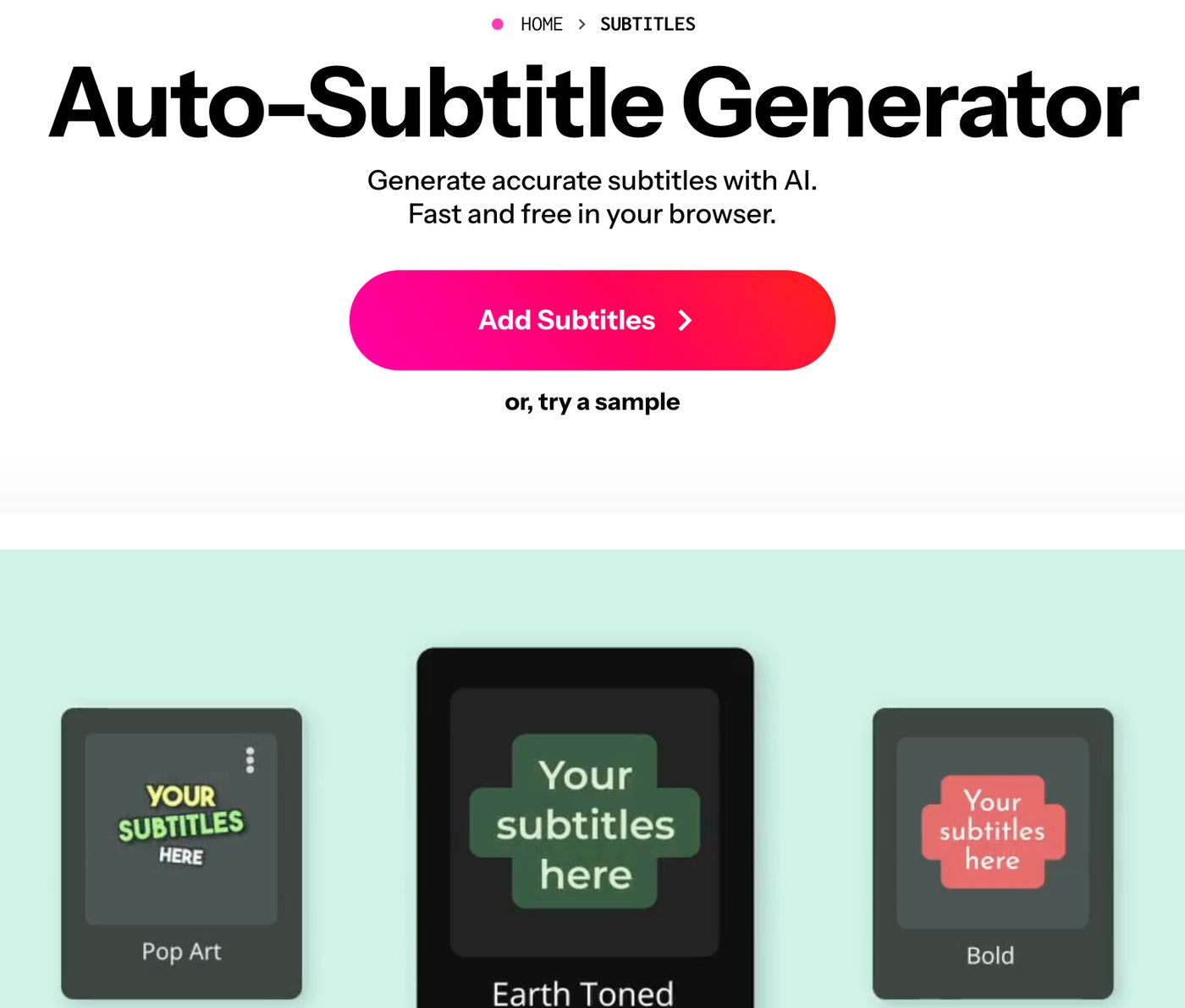
Kapwing's auto-subtitle generator page. Source: Kapwing website
Kapwing's subtitle page says an uploaded file or a YouTube link gets word-by-word subtitles and a fully editable transcript, so terms and timing can be corrected. It cites 99% accurate subtitles generated in seconds and says even long uploads are processed in under 2 minutes; these are vendor claims we did not time. Styles start from over 100 presets, can differ by speaker, and can use uploaded fonts, with a Brand Kit storing colors and fonts for a team. Exports can be hardcoded into the video or downloaded as SRT, VTT or TXT, and subtitles can be translated into 100+ languages.
Kapwing is a general browser editor, so subtitles sit beside trimming, resizing and transcript-based trimming. Its navigation also lists Repurpose Studio for turning a video into social-ready clips.
Pricing: Kapwing's pricing page lists Free at $0 (10 credits, exports with a watermark, exports up to 4 minutes, 720p, and auto-subtitling up to 10 minutes) and Pro at $16 a month on the annual toggle ($24 on the monthly toggle) with 1,000 credits a month, no watermark, 4K, Brand Kit, custom fonts and auto-subtitling up to 1,000 minutes a month.
Considerations: On the Free plan, exports carry a Kapwing watermark and stop at 4 minutes, and Brand Kit and custom fonts are listed on Pro. Auto-subtitling is metered in minutes on every plan.
- Choose it if an editable transcript, 100+ presets and custom fonts in a browser editor are the priority.
- Skip it if watermark-free free exports are needed, or the job is automatic clipping of long videos.
6. Clipchamp: Best for free automatic captions on Windows and the web
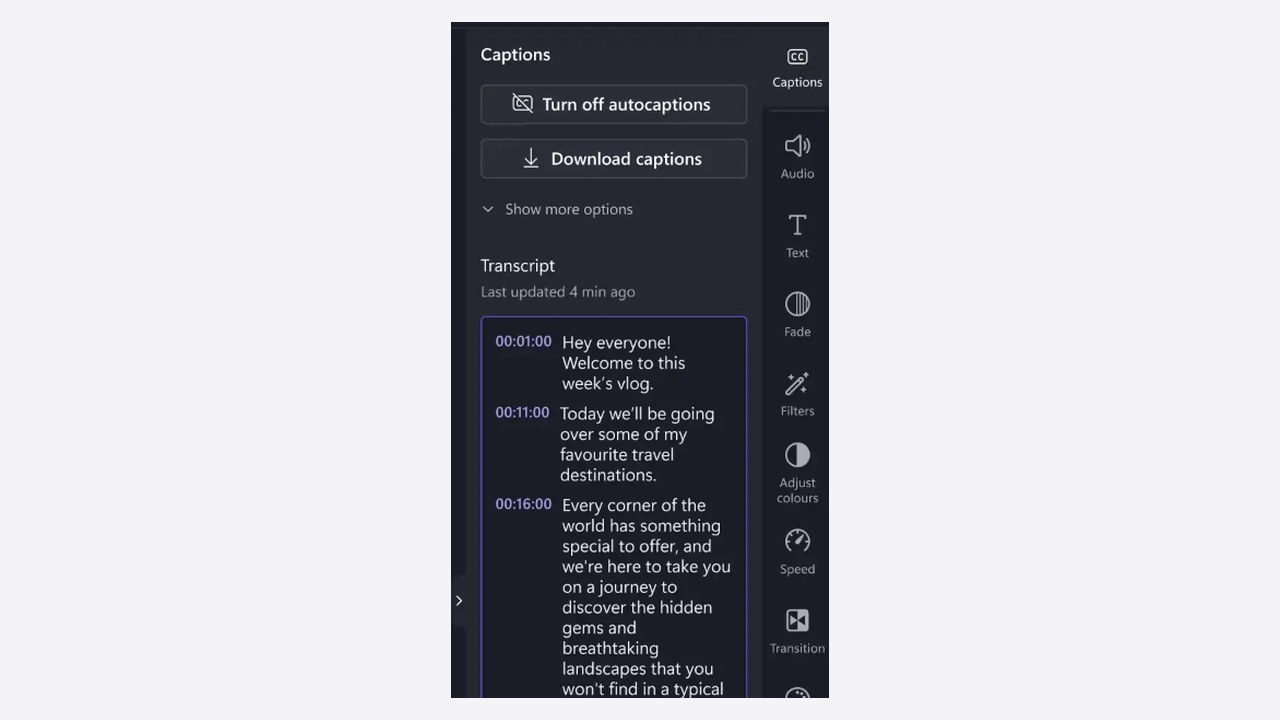
Clipchamp's subtitle generator page, showing the captions panel. Source: Clipchamp website
Clipchamp, Microsoft's video editor, has an AI subtitle generator: upload or record a video, choose the subtitle language, adjust font, colors, size and alignment, then download the video and an .SRT transcript. Its subtitle page FAQ says the autocaptions feature is free for all Clipchamp users and that there are no limits on generating subtitles for a video. The page also lists a one-click filter for offensive language and different colors for speakers, and says the transcript can be edited.
The subtitle page title says subtitles are free in over 100 languages while the home page cites over 80, so check the language list in the editor. The FAQ says speech recognition detects one language at a time and that transcripts download only in .SRT format. Clipchamp runs in the browser and as a Windows app, and its pricing page says free accounts get watermark-free exports up to 1080p.
Pricing: Clipchamp's pricing page lists a Free plan (sign in with a personal Microsoft account; AI video and audio editing tools and watermark-free exports up to 1080p included) and Premium through Microsoft 365 Personal and Family, which adds 4K export, premium stock assets and a brand kit for a single brand. The page does not list Microsoft 365 prices.
Considerations: The subtitle page describes font, color, size, alignment and text-background styling, but not animated word-by-word styles, and downloads are .SRT only. It describes captioning a video that is already in the editor, not finding clips in a long recording.
- Choose it if free automatic captions on a finished video are the goal, with no length limit stated on the page, on Windows or in the browser.
- Skip it if animated karaoke-style captions, VTT downloads or clipping long recordings are needed.
7. Canva: Best for captions inside a design suite

Canva's auto caption generator page. Source: Canva website
Canva's auto caption page describes uploading a video, opening the Text section, choosing Captions under Dynamic Text, selecting the video and clicking Generate captions, then editing the captions and downloading the video as an MP4. The page calls it a free auto caption generator that detects speech, says the spoken language can be detected and captions translated with over 100 options, and says caption font style, size and color can be customized to match branding.
Canva is a design suite, so captions share a project with its video editor, templates and brand tools. The page positions captions alongside cutting scenes, adding audio and applying effects, and mentions Magic Design for Video as a Pro feature.
Pricing: Canva's pricing page lists Free at $0 (1 Brand Kit with a maximum of 3 colors) and Pro at US$144 a year for one person (5 Brand Kits), with Business at US$250 a year per person; the plans are shown at yearly prices. The page does not break out captions by plan.
Considerations: The pricing page does not say whether auto captions have limits on the Free plan, so check in the editor. The caption page describes a generate, edit and download flow; it does not describe animated word-by-word styles or finding clips in long recordings.
- Choose it if videos already live in Canva projects, or captions should sit next to designs that use a Canva brand kit.
- Skip it if the main job is turning long recordings into clips, or animated karaoke-style captions.
8. Adobe Premiere: Best for captions on a professional timeline
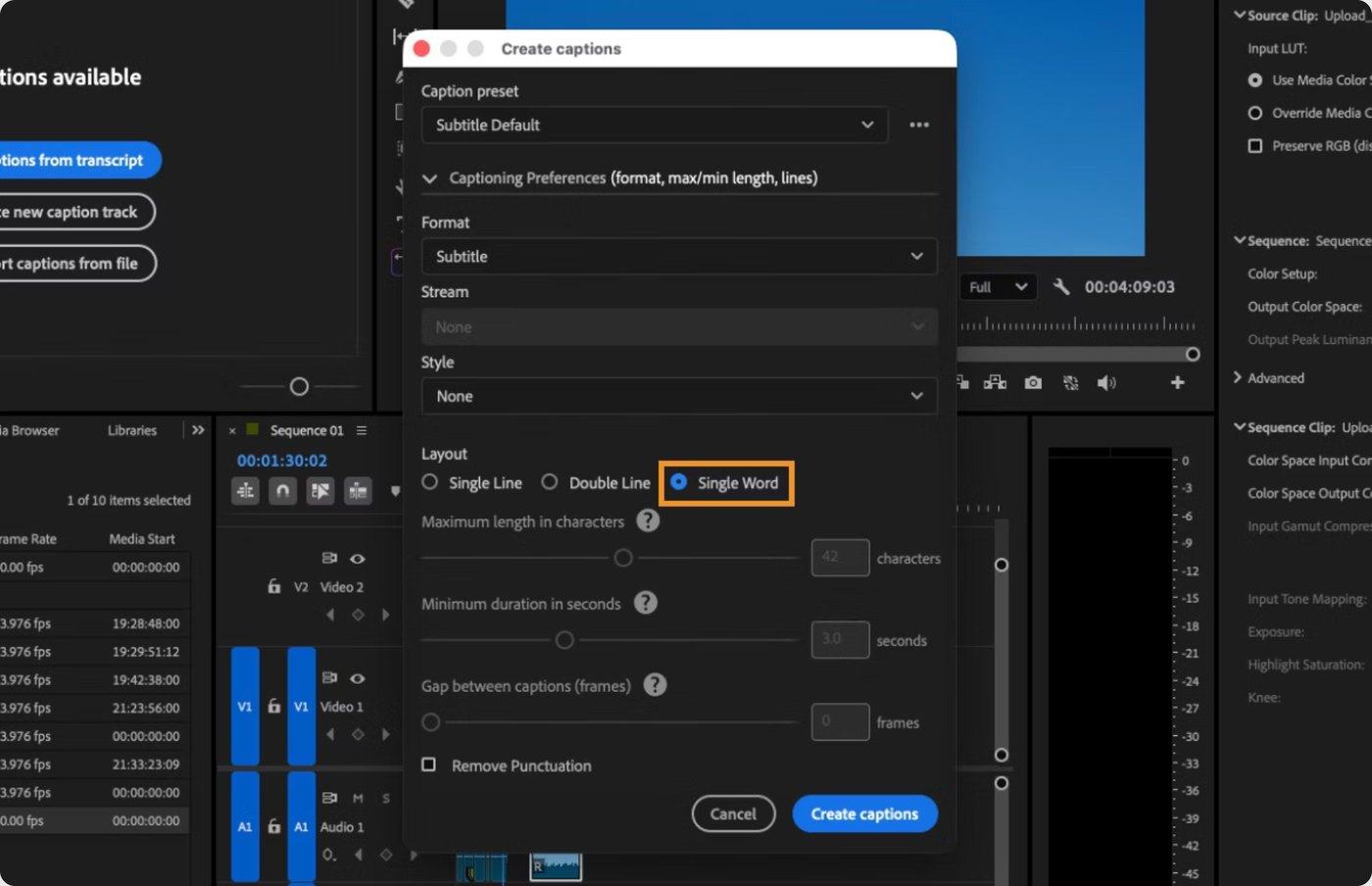
Adobe's Premiere help article on single word captions. Source: Adobe Help Center
Adobe's help center describes captions in Premiere (the app Adobe formerly called Premiere Pro) as a transcript-first workflow. Media is imported with Automatic Transcription selected so a transcript is created on import; then Captions, Create captions from transcript opens a dialog for caption preset, format, style, caption length, duration, gaps and lines. A Single Word layout shows one word at a time, and Speech to Text settings include language, speaker labeling and audio analysis.
Captions can be translated into other languages: Adobe's product page cites 18 languages, and the help article says translations use Google Translate and Microsoft Translator through a cloud service and appear as a new caption track. Premiere also lists Text-Based Editing and Enhance Speech, so captioning sits inside a full editor with color, audio and effects tools.
Pricing: Adobe's Premiere page lists the single-app plan from US$22.99 a month (annual plan, billed monthly; the FAQ says first year only, new subscribers only) with a 7-day free trial, and Creative Cloud Pro at US$69.99 a month regularly. Adobe says Premiere is sold only as a membership, not a perpetual license.
Considerations: Premiere is a timeline editor, so the path from import to styled captions has more steps than a one-upload web tool, and Speech to Text language packs may need to be downloaded for the video's language. Captions are styled in the Properties panel, and a style can be applied to every caption on a track.
- Choose it if captions are part of a professional edit that needs control over caption format, timing, styles and translated tracks.
- Skip it if a one-upload web tool is enough, or a free tool is required.
9. YouTube Studio: Best for built-in automatic captions on videos published to YouTube
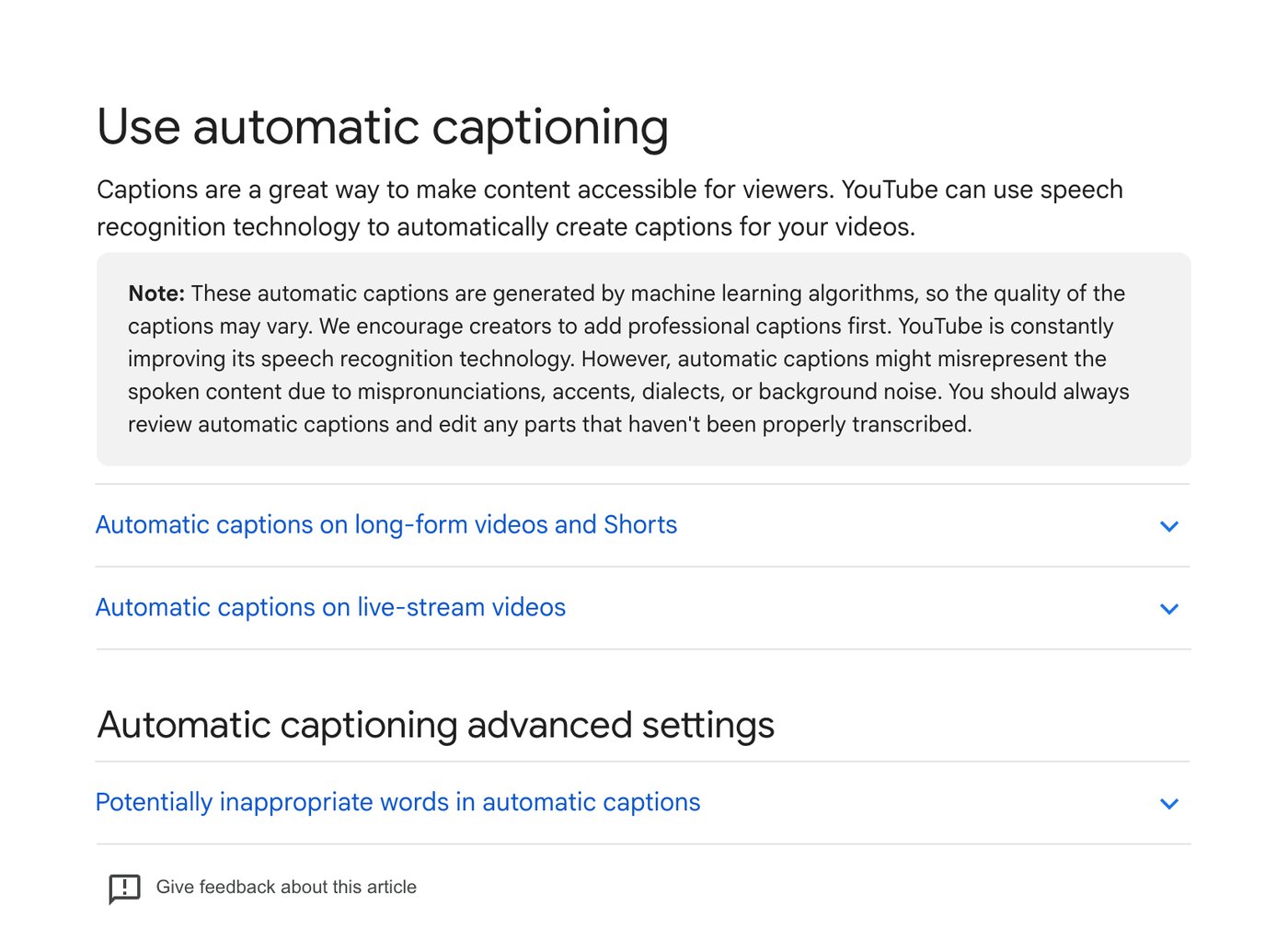
YouTube's help article on automatic captioning. Source: YouTube Help
YouTube's help center says YouTube can use speech recognition to create captions automatically for uploaded videos, on long-form videos and Shorts, in a list of 67 languages. If automatic captions are available, they are published on the video automatically, though they may not be ready at upload because processing time depends on the audio. For English, automatic captions support expressive captions that show the intensity of speech in capitals and sounds such as sighs. Automatic captions on live streams are English only.
Review happens in YouTube Studio: choose Subtitles, open the video, select More beside the automatic captions, and edit or remove any part that was not transcribed correctly. The help article says quality may vary, that mispronunciations, accents, dialects and background noise can cause errors, and that creators should always review automatic captions. Its troubleshooting list names videos that are too long, unsupported languages, poor sound quality, a long silence at the start, and overlapping speakers or multiple languages.
Pricing: The help article lists no fee or plan requirement for automatic captions.
Considerations: The article covers captions attached to videos on YouTube; it does not describe styling captions or exporting a captioned video for other platforms, and it says automatic captions can be missing for long videos or unsupported languages.
- Choose it if videos are published to YouTube and a baseline caption track with a review step is enough.
- Skip it if captions must be styled, burned into the video, or used on TikTok and Instagram Reels.
How we compared these tools
We compared 9 tools on how little work stands between an upload and usable captions: whether captions generate automatically in one step, how they are corrected (text, timing, vocabulary), how they can be styled, which formats they export, and then price, free-tier limits and documented caps. Every fact about a vendor comes from that vendor's own pricing, product and help pages, read on November 4, 2026, and we attribute vendor claims (accuracy, languages, speed) to the vendor. We did not run hands-on tests of the competitors in this list, so rankings reflect documented capability and fit for the job, not a measured accuracy or speed comparison. Prices change often, so check each pricing page before buying.
How to choose
Start with what is being captioned, then match the tool to the volume and the destination.
- If the source is a long recording and the output is many short captioned clips, look for clipping and captioning in one step: OpusClip, and Submagic with its Magic Clips add-on.
- If one finished video needs captions for free, look at CapCut, Clipchamp and Canva, and check the free tiers of VEED and Kapwing for caps and watermarks.
- If captions are one feature of an editor already in use, look at CapCut, VEED, Kapwing, Canva, Clipchamp or Adobe Premiere.
- If the videos only live on YouTube, the built-in captions in YouTube Studio are a baseline that still needs a review pass.
- If an animated, word-by-word look matters, look at OpusClip, Submagic, VEED, Kapwing and Premiere's Single Word layout; for style ideas see caption presets that boost retention.
- If names and product terms keep coming out wrong, look for a vocabulary feature or an easy text editor: OpusClip's brand vocabulary, Submagic's custom words dictionary on Business, and the editable transcripts in Kapwing and VEED.
- If the need is a standalone subtitle file or translation, a dedicated tool may fit better; see the multi-language subtitle generators list.
Red flags to watch for
- Watermarks on free exports. OpusClip's Free plan and Kapwing's Free plan list watermarks, and Submagic's caption page says its free tier has one.
- Short length caps. Kapwing Free stops exports at 4 minutes, Submagic Starter caps each video at 2 minutes, and Submagic's upload box lists 5 minutes.
- Caption styles locked to higher tiers. Submagic lists Standard templates on Starter and Premium ones on higher plans, and VEED says more advanced subtitle styles unlock on higher tiers.
- Speed and accuracy claims without a method. Figures such as under a minute, 99% or 99.9% are vendor claims; run a real video before choosing.
- No easy fix for names. Auto captions miss proper nouns and jargon; confirm captions can be corrected, re-timed and moved, and whether a vocabulary list exists.
- Narrow export formats. Clipchamp's subtitle page lists .SRT only, while VEED and Kapwing list SRT, VTT and TXT.
- Unreviewed output. YouTube's help article and CapCut's caption page both tell creators to review automatic captions before publishing.
Frequently asked questions
What are the best auto captions for videos?
For long recordings that should become short captioned clips, OpusClip is our first pick because captions are generated automatically, styled with animated templates and editable by word in the same tool that cuts the clips. For free captions on one finished video, CapCut, Clipchamp and Canva each describe a short generate-and-edit flow on their own pages, and YouTube Studio adds captions to videos published on YouTube. Which is best depends on the source video and where it will be posted.
What are the best tools for easy video captions?
The easiest flows are the one-upload ones. CapCut describes Text, Auto captions, Generate. VEED describes selecting Auto Subtitle and choosing a language. Kapwing, Canva and Clipchamp each describe uploading a video and generating captions in the browser. In OpusClip, a link or file goes in and clips come back with captions on, and corrections are made in the transcript, with Apply to all for repeated words.
What is the best video captioning in editing apps?
Among editing apps, CapCut, Clipchamp, VEED, Kapwing and Canva all list automatic captions as part of a general editor, and Adobe Premiere offers transcript-based captions with the most control over format and timing. Choose by where the edit already happens and how much styling is needed. See the best video editors with caption features for a deeper comparison of editors.
How accurate are auto captions?
We did not run an accuracy test, so we cannot rank the engines. Vendors publish their own figures: Submagic's caption page cites 99%, VEED's subtitle page says up to 99.9%, and Kapwing's says 99%. YouTube's help article says quality may vary and that accents, dialects, mispronunciations and background noise can cause errors. Review every caption set, and see our auto-caption accuracy guide for how to check a tool on real audio.
Can I get auto captions for free?
Yes, with limits. Clipchamp's subtitle page says autocaptions are free for all users, CapCut's page calls its auto captions free, and Canva's page calls its generator free. Kapwing's Free plan includes auto-subtitling up to 10 minutes but exports with a watermark and stops at 4 minutes, VEED's tool is free to start but needs a paid plan for longer videos and subtitle downloads, and OpusClip's Free plan puts a watermark on clips and lists no editing.
Can auto-generated captions be edited?
Yes in every tool here. OpusClip lets a selected word or sentence be edited and applied everywhere in the clip, VEED lets a line be clicked and retyped, Kapwing offers a fully editable transcript, CapCut lets generated captions be corrected, YouTube Studio lets automatic captions be edited or removed, and Adobe Premiere generates captions from a transcript that can be searched and replaced. Editing in OpusClip needs a paid plan, because the Free plan lists no editing.
Do auto captions work in languages other than English?
Usually, but language counts differ and are the vendors' own figures: OpusClip's help center says over 25 languages (some in beta), YouTube's help article lists 67 languages for automatic captions, Submagic cites 123, and Kapwing and Canva cite translation into 100+ languages. Translation is a separate job from generating captions; see the multi-language subtitle generators list.
Should captions be burned into the video or exported as a file?
Both are common. A burned-in caption is part of the video image, so it shows on every platform, while a subtitle file such as SRT is a separate track a platform can switch on or off. VEED and Kapwing describe both options, Clipchamp lists an .SRT download, and the OpusClip help center says Pro plan users can download subtitles as .srt. Check which one the plan exports.