Auto-Generate Shorts from a Podcast with the OpusClip API

May 13, 2026
Auto-Generate Shorts from a Podcast with the OpusClip API

A typical hour-long podcast contains 10-20 self-contained moments that could each earn 50K+ views on TikTok, Reels, or YouTube Shorts. Almost none of them get cut out. Most podcast teams have neither the editor bandwidth nor the workflow to consistently extract those moments — so a year's worth of episodes sits as a dead archive while the social team scrambles for content from scratch.

A podcast-to-clips API is the right primitive for this problem. You point it at an episode, it identifies the highest-performing moments, and returns short vertical clips ready for distribution. This guide is a developer-focused look at how those APIs work, what to expect when integrating, and how the OpusClip API will fit in when it goes generally available.

The OpusClip API is currently in early accessrequest access at opus.pro/api. Code examples will publish here once the v1 spec is finalized.

Key takeaways

• Podcast-to-clips APIs combine three steps: transcription with speaker labels, moment-scoring against engagement signals, and reframing to 9:16 with burned-in captions.

• The defining quality difference between APIs is moment selection — most can transcribe and reframe, few pick the same moments a skilled editor would.

• Speaker diarization is non-negotiable for multi-host content. Clips that include only one speaker need to know who's talking.

• A typical hour-long episode returns 10-20 candidate clips. The 70th percentile score is usually a strong publish-worthy cut.

• The OpusClip API will support podcast input as URL, MP3, MP4, or RSS feed, with output ready for TikTok, Reels, and YouTube Shorts.

Why podcast repurposing is the highest-leverage growth lever for shows

The math on podcast distribution is brutal:

Apple Podcasts grew 5% YoY in 2024 (Edison Research) — the platform is saturated.

TikTok video posts from podcast clips grew 40%+ YoY (Buzzsprout, Backstage research).

Joe Rogan, Lex Fridman, Diary of a CEO — every top-10 show now runs a parallel clip operation that produces more weekly views than the main episode.

The cost difference is 10-30x. A producer cutting clips manually takes 2-4 hours per episode; an API run takes 5 minutes plus light review.

Shows that aren't repurposing are competing one-handed. A podcast-to-clips pipeline is now table stakes, not a nice-to-have.

What a podcast-to-clips API actually does

Three sequential stages, ideally exposed as one API call:

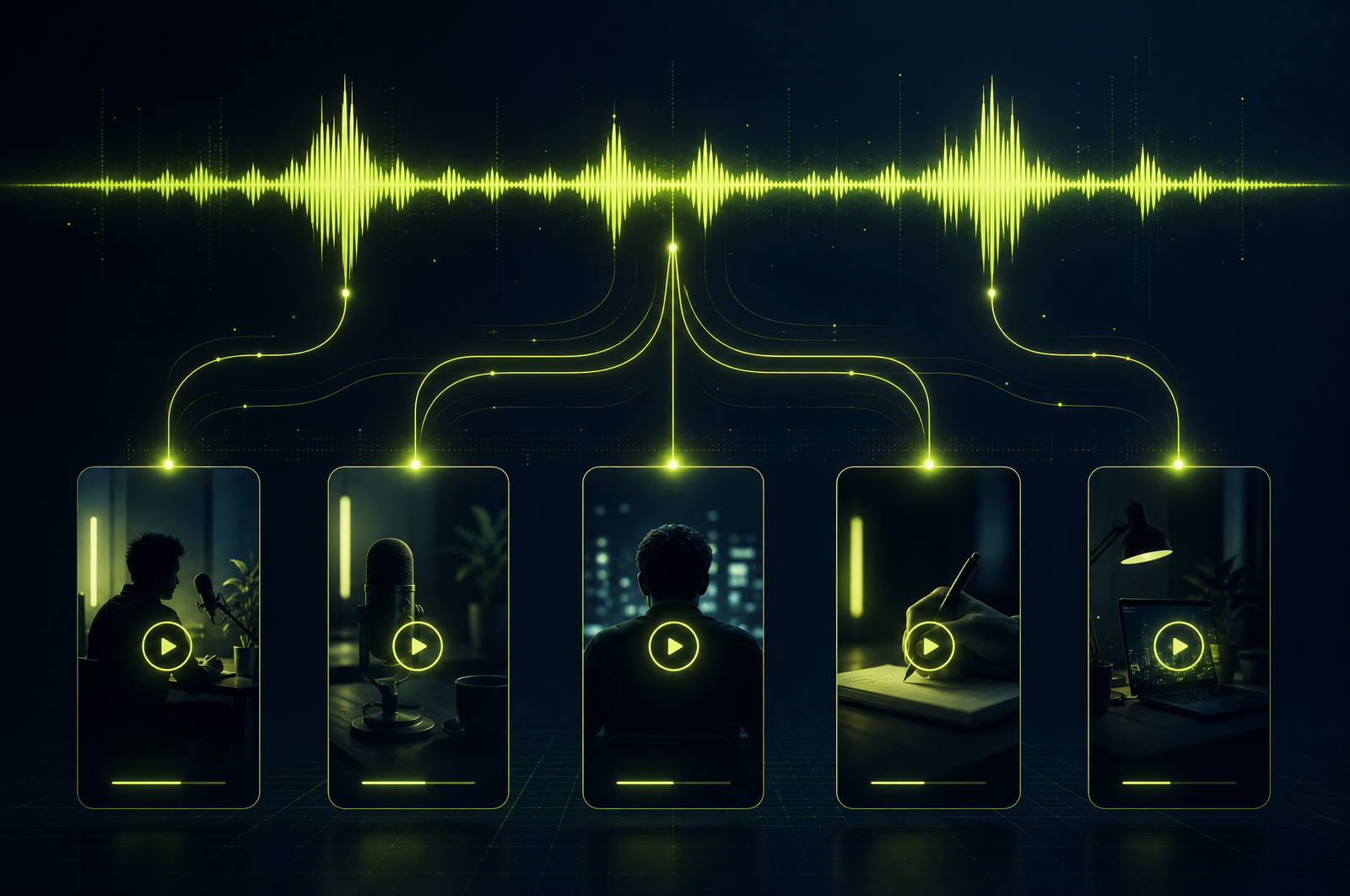
1. Transcription with speaker labels. Speech-to-text on the audio, with diarization to label which speaker said what. Word-level timestamps so the cuts and captions can be aligned precisely.

2. Moment scoring. Each potential clip window (typically 25-60 seconds) is scored on signals like emotional intensity, narrative completeness, hook strength, audio dynamics, and reference to topics that perform well on social.

3. Clip rendering. The selected windows are reframed to 9:16 vertical, captions burned in, and a hook frame chosen for the thumbnail. Output is ready-to-post MP4.

A good API exposes knobs at each stage — speaker focus, scoring thresholds, caption styling, hook style — so you can tune output to your show's voice.

What to consider when integrating

Moment selection quality. Run any candidate API on five episodes you know well and rate the selections against what you'd have picked manually. This is the only test that matters. Cheap APIs return technically reframed but boring clips.

Speaker diarization quality. For multi-host shows, diarization accuracy directly affects which clips are usable. Look for APIs that publish accuracy benchmarks (not just claim "supports multiple speakers").

Caption styling. Default captions look generic. Top-performing podcast clips have word-by-word reveal, highlight emphasis on key words, and platform-appropriate font sizing. Check what the API exposes.

Episode length limits. Some APIs cap at 30 or 60 minutes. For long-form podcasts (Joe Rogan, Lex Fridman), confirm multi-hour support before committing.

Pricing model. Most APIs charge per minute of source. Confirm whether output minutes count separately, and whether multiple aspect-ratio outputs cost extra.

Async pipelines. Even short episodes take several minutes to process. Plan for async — submit, poll or webhook, retrieve.

Common use cases by team type

Top-10 podcasts. Daily clip operation feeding 5-10 platform accounts (TikTok, Reels, Shorts, plus syndicated audiogram channels).

Mid-tier shows. Weekly batch of 5-8 clips per episode pushed to a content team review queue, then published on a stagger.

Network operations. Bulk processing across a portfolio of 20-200 shows, with per-show stylistic controls (font, color, logo).

Audio creators expanding to video. A first attempt at TikTok or Reels presence without filming new content.

B2B podcasts driving lead gen. Repurposing customer interviews and founder conversations into LinkedIn-native vertical video.

Common pitfalls

Submitting raw audio without cleanup. Long intros, sponsor reads, and unedited tangents pollute clip selection. Either trim before submitting or use a cleanup API to strip those segments first.

Auto-publishing without review. Even the best APIs miss context (in-joke, sponsor mention, off-script moment). Build a review queue. Publish from the queue.

Ignoring speaker focus. A clip of co-host A nodding while host B makes a joke isn't a clip. Filter to clips where the active speaker is dominant.

Captions that hide platform UI. TikTok and Reels both have UI chrome at the bottom of the frame. Default-positioned captions get covered. Move them up to the lower-middle third.

Treating virality score as truth. Scores are predictions, not certainties. Some 60-scored clips outperform 85-scored ones because of timing, accompanying caption, or platform luck. Track post-publish performance to learn what your audience actually rewards.

How the OpusClip podcast-to-clips API will work

The OpusClip API is currently in early access. The podcast-to-clips workflow is built around:

• Source input as URL, uploaded file, or RSS feed (for ongoing automation tied to episode publish events)

• Per-show config for speaker focus, caption styling, hook style, and clip count

• Output as ready-to-publish vertical MP4 with optional sidecar transcript and SRT

• Webhook delivery so you can wire the pipeline into your CMS without polling

Full code examples, parameter reference, and SDK quickstarts will publish here when the v1 spec is finalized. To get notified or apply for early access, visit opus.pro/api.

FAQ

How long should podcast-to-shorts clips be?

30-60 seconds works best across TikTok, Reels, and YouTube Shorts. Going under 25 seconds typically loses context; going over 90 seconds significantly hurts completion rate. Most modern APIs default to 35-60 seconds.

How accurate is automated speaker diarization on podcasts?

Production APIs report 92-96% segment-level accuracy on clean two-speaker podcasts. Accuracy drops 5-10 points with overlapping speech, music underbed, or 4+ speakers. Always sample before bulk-processing.

How much does podcast-to-clips processing typically cost?

APIs charge by source minute, typically in the $0.10-0.30 per minute range. For a one-hour episode that's $6-18 per episode regardless of how many clips you generate from it.

Should I auto-publish or use a review queue?

Use a review queue. Even the best APIs miss context — sponsor mentions, off-script moments, technical issues. A 60-second human review per clip saves you brand-safety incidents and lets you bias future selections based on what actually performs.

Will the OpusClip API support RSS feeds for ongoing automation?

Yes. The podcast workflow is designed to accept an RSS feed URL and process new episodes as they publish, delivering clips via webhook to your CMS. Full details will publish to the developer docs at GA.

Next steps

For other repurposing pipelines, see Build a Webinar-to-Shorts Pipeline, Convert Zoom Recordings to Social Clips, and Generate YouTube Shorts from Long Videos. For multi-language podcasts, see Multi-Language Captions Tutorial.
Request access to the OpusClip API at opus.pro/api.

On this page

Use our Free Forever Plan

Ready to build with the OpusClip API?

Create and post one short video every day for free, and grow faster.

Auto-Generate Shorts from a Podcast with the OpusClip API

A typical hour-long podcast contains 10-20 self-contained moments that could each earn 50K+ views on TikTok, Reels, or YouTube Shorts. Almost none of them get cut out. Most podcast teams have neither the editor bandwidth nor the workflow to consistently extract those moments — so a year's worth of episodes sits as a dead archive while the social team scrambles for content from scratch.

A podcast-to-clips API is the right primitive for this problem. You point it at an episode, it identifies the highest-performing moments, and returns short vertical clips ready for distribution. This guide is a developer-focused look at how those APIs work, what to expect when integrating, and how the OpusClip API will fit in when it goes generally available.

The OpusClip API is currently in early accessrequest access at opus.pro/api. Code examples will publish here once the v1 spec is finalized.

Key takeaways

• Podcast-to-clips APIs combine three steps: transcription with speaker labels, moment-scoring against engagement signals, and reframing to 9:16 with burned-in captions.

• The defining quality difference between APIs is moment selection — most can transcribe and reframe, few pick the same moments a skilled editor would.

• Speaker diarization is non-negotiable for multi-host content. Clips that include only one speaker need to know who's talking.

• A typical hour-long episode returns 10-20 candidate clips. The 70th percentile score is usually a strong publish-worthy cut.

• The OpusClip API will support podcast input as URL, MP3, MP4, or RSS feed, with output ready for TikTok, Reels, and YouTube Shorts.

Why podcast repurposing is the highest-leverage growth lever for shows

The math on podcast distribution is brutal:

Apple Podcasts grew 5% YoY in 2024 (Edison Research) — the platform is saturated.

TikTok video posts from podcast clips grew 40%+ YoY (Buzzsprout, Backstage research).

Joe Rogan, Lex Fridman, Diary of a CEO — every top-10 show now runs a parallel clip operation that produces more weekly views than the main episode.

The cost difference is 10-30x. A producer cutting clips manually takes 2-4 hours per episode; an API run takes 5 minutes plus light review.

Shows that aren't repurposing are competing one-handed. A podcast-to-clips pipeline is now table stakes, not a nice-to-have.

What a podcast-to-clips API actually does

Three sequential stages, ideally exposed as one API call:

1. Transcription with speaker labels. Speech-to-text on the audio, with diarization to label which speaker said what. Word-level timestamps so the cuts and captions can be aligned precisely.

2. Moment scoring. Each potential clip window (typically 25-60 seconds) is scored on signals like emotional intensity, narrative completeness, hook strength, audio dynamics, and reference to topics that perform well on social.

3. Clip rendering. The selected windows are reframed to 9:16 vertical, captions burned in, and a hook frame chosen for the thumbnail. Output is ready-to-post MP4.

A good API exposes knobs at each stage — speaker focus, scoring thresholds, caption styling, hook style — so you can tune output to your show's voice.

What to consider when integrating

Moment selection quality. Run any candidate API on five episodes you know well and rate the selections against what you'd have picked manually. This is the only test that matters. Cheap APIs return technically reframed but boring clips.

Speaker diarization quality. For multi-host shows, diarization accuracy directly affects which clips are usable. Look for APIs that publish accuracy benchmarks (not just claim "supports multiple speakers").

Caption styling. Default captions look generic. Top-performing podcast clips have word-by-word reveal, highlight emphasis on key words, and platform-appropriate font sizing. Check what the API exposes.

Episode length limits. Some APIs cap at 30 or 60 minutes. For long-form podcasts (Joe Rogan, Lex Fridman), confirm multi-hour support before committing.

Pricing model. Most APIs charge per minute of source. Confirm whether output minutes count separately, and whether multiple aspect-ratio outputs cost extra.

Async pipelines. Even short episodes take several minutes to process. Plan for async — submit, poll or webhook, retrieve.

Common use cases by team type

Top-10 podcasts. Daily clip operation feeding 5-10 platform accounts (TikTok, Reels, Shorts, plus syndicated audiogram channels).

Mid-tier shows. Weekly batch of 5-8 clips per episode pushed to a content team review queue, then published on a stagger.

Network operations. Bulk processing across a portfolio of 20-200 shows, with per-show stylistic controls (font, color, logo).

Audio creators expanding to video. A first attempt at TikTok or Reels presence without filming new content.

B2B podcasts driving lead gen. Repurposing customer interviews and founder conversations into LinkedIn-native vertical video.

Common pitfalls

Submitting raw audio without cleanup. Long intros, sponsor reads, and unedited tangents pollute clip selection. Either trim before submitting or use a cleanup API to strip those segments first.

Auto-publishing without review. Even the best APIs miss context (in-joke, sponsor mention, off-script moment). Build a review queue. Publish from the queue.

Ignoring speaker focus. A clip of co-host A nodding while host B makes a joke isn't a clip. Filter to clips where the active speaker is dominant.

Captions that hide platform UI. TikTok and Reels both have UI chrome at the bottom of the frame. Default-positioned captions get covered. Move them up to the lower-middle third.

Treating virality score as truth. Scores are predictions, not certainties. Some 60-scored clips outperform 85-scored ones because of timing, accompanying caption, or platform luck. Track post-publish performance to learn what your audience actually rewards.

How the OpusClip podcast-to-clips API will work

The OpusClip API is currently in early access. The podcast-to-clips workflow is built around:

• Source input as URL, uploaded file, or RSS feed (for ongoing automation tied to episode publish events)

• Per-show config for speaker focus, caption styling, hook style, and clip count

• Output as ready-to-publish vertical MP4 with optional sidecar transcript and SRT

• Webhook delivery so you can wire the pipeline into your CMS without polling

Full code examples, parameter reference, and SDK quickstarts will publish here when the v1 spec is finalized. To get notified or apply for early access, visit opus.pro/api.

FAQ

How long should podcast-to-shorts clips be?

30-60 seconds works best across TikTok, Reels, and YouTube Shorts. Going under 25 seconds typically loses context; going over 90 seconds significantly hurts completion rate. Most modern APIs default to 35-60 seconds.

How accurate is automated speaker diarization on podcasts?

Production APIs report 92-96% segment-level accuracy on clean two-speaker podcasts. Accuracy drops 5-10 points with overlapping speech, music underbed, or 4+ speakers. Always sample before bulk-processing.

How much does podcast-to-clips processing typically cost?

APIs charge by source minute, typically in the $0.10-0.30 per minute range. For a one-hour episode that's $6-18 per episode regardless of how many clips you generate from it.

Should I auto-publish or use a review queue?

Use a review queue. Even the best APIs miss context — sponsor mentions, off-script moments, technical issues. A 60-second human review per clip saves you brand-safety incidents and lets you bias future selections based on what actually performs.

Will the OpusClip API support RSS feeds for ongoing automation?

Yes. The podcast workflow is designed to accept an RSS feed URL and process new episodes as they publish, delivering clips via webhook to your CMS. Full details will publish to the developer docs at GA.

Next steps

For other repurposing pipelines, see Build a Webinar-to-Shorts Pipeline, Convert Zoom Recordings to Social Clips, and Generate YouTube Shorts from Long Videos. For multi-language podcasts, see Multi-Language Captions Tutorial.

Request access to the OpusClip API at opus.pro/api.

Creator name

Creator type

Team size

Channels

linkYouTubefacebookXTikTok

Pain point

Time to see positive ROI

About the creator

Don't miss these

How Audacy Drove 1B+ Views by Taking a Tech-Forward Approach to Radio with OpusClip
No items found.

How Audacy Drove 1B+ Views by Taking a Tech-Forward Approach to Radio with OpusClip

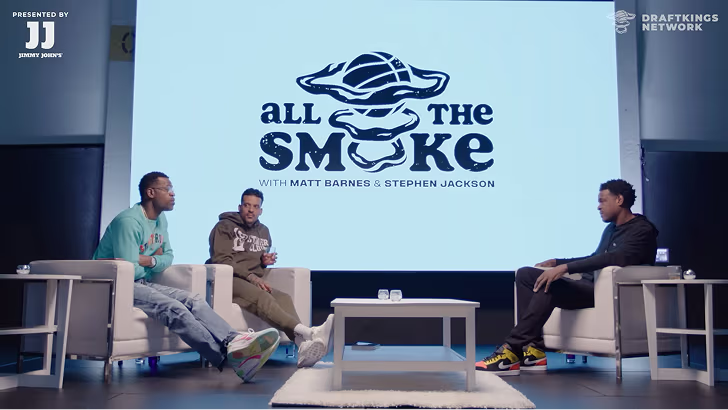
How All the Smoke makes hit compilations faster with OpusSearch

How All the Smoke makes hit compilations faster with OpusSearch

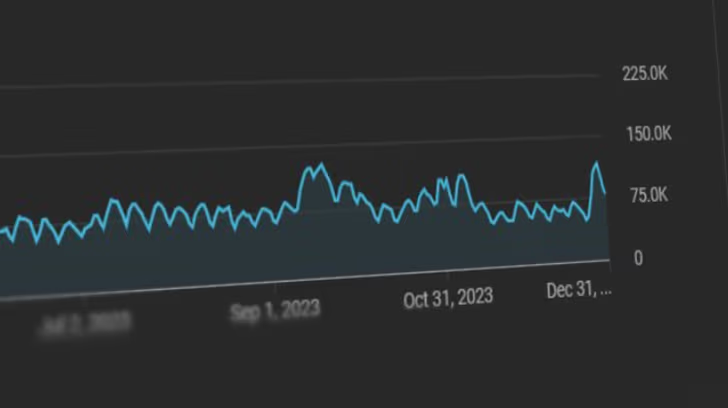
Growing a new channel to 1.5M views in 90 days without creating new videos

Growing a new channel to 1.5M views in 90 days without creating new videos

Auto-Generate Shorts from a Podcast with the OpusClip API

Auto-Generate Shorts from a Podcast with the OpusClip API
No items found.
No items found.

Boost your social media growth with OpusClip

Create and post one short video every day for your social media and grow faster.

Auto-Generate Shorts from a Podcast with the OpusClip API

Auto-Generate Shorts from a Podcast with the OpusClip API

A typical hour-long podcast contains 10-20 self-contained moments that could each earn 50K+ views on TikTok, Reels, or YouTube Shorts. Almost none of them get cut out. Most podcast teams have neither the editor bandwidth nor the workflow to consistently extract those moments — so a year's worth of episodes sits as a dead archive while the social team scrambles for content from scratch.

A podcast-to-clips API is the right primitive for this problem. You point it at an episode, it identifies the highest-performing moments, and returns short vertical clips ready for distribution. This guide is a developer-focused look at how those APIs work, what to expect when integrating, and how the OpusClip API will fit in when it goes generally available.

The OpusClip API is currently in early accessrequest access at opus.pro/api. Code examples will publish here once the v1 spec is finalized.

Key takeaways

• Podcast-to-clips APIs combine three steps: transcription with speaker labels, moment-scoring against engagement signals, and reframing to 9:16 with burned-in captions.

• The defining quality difference between APIs is moment selection — most can transcribe and reframe, few pick the same moments a skilled editor would.

• Speaker diarization is non-negotiable for multi-host content. Clips that include only one speaker need to know who's talking.

• A typical hour-long episode returns 10-20 candidate clips. The 70th percentile score is usually a strong publish-worthy cut.

• The OpusClip API will support podcast input as URL, MP3, MP4, or RSS feed, with output ready for TikTok, Reels, and YouTube Shorts.

Why podcast repurposing is the highest-leverage growth lever for shows

The math on podcast distribution is brutal:

Apple Podcasts grew 5% YoY in 2024 (Edison Research) — the platform is saturated.

TikTok video posts from podcast clips grew 40%+ YoY (Buzzsprout, Backstage research).

Joe Rogan, Lex Fridman, Diary of a CEO — every top-10 show now runs a parallel clip operation that produces more weekly views than the main episode.

The cost difference is 10-30x. A producer cutting clips manually takes 2-4 hours per episode; an API run takes 5 minutes plus light review.

Shows that aren't repurposing are competing one-handed. A podcast-to-clips pipeline is now table stakes, not a nice-to-have.

What a podcast-to-clips API actually does

Three sequential stages, ideally exposed as one API call:

1. Transcription with speaker labels. Speech-to-text on the audio, with diarization to label which speaker said what. Word-level timestamps so the cuts and captions can be aligned precisely.

2. Moment scoring. Each potential clip window (typically 25-60 seconds) is scored on signals like emotional intensity, narrative completeness, hook strength, audio dynamics, and reference to topics that perform well on social.

3. Clip rendering. The selected windows are reframed to 9:16 vertical, captions burned in, and a hook frame chosen for the thumbnail. Output is ready-to-post MP4.

A good API exposes knobs at each stage — speaker focus, scoring thresholds, caption styling, hook style — so you can tune output to your show's voice.

What to consider when integrating

Moment selection quality. Run any candidate API on five episodes you know well and rate the selections against what you'd have picked manually. This is the only test that matters. Cheap APIs return technically reframed but boring clips.

Speaker diarization quality. For multi-host shows, diarization accuracy directly affects which clips are usable. Look for APIs that publish accuracy benchmarks (not just claim "supports multiple speakers").

Caption styling. Default captions look generic. Top-performing podcast clips have word-by-word reveal, highlight emphasis on key words, and platform-appropriate font sizing. Check what the API exposes.

Episode length limits. Some APIs cap at 30 or 60 minutes. For long-form podcasts (Joe Rogan, Lex Fridman), confirm multi-hour support before committing.

Pricing model. Most APIs charge per minute of source. Confirm whether output minutes count separately, and whether multiple aspect-ratio outputs cost extra.

Async pipelines. Even short episodes take several minutes to process. Plan for async — submit, poll or webhook, retrieve.

Common use cases by team type

Top-10 podcasts. Daily clip operation feeding 5-10 platform accounts (TikTok, Reels, Shorts, plus syndicated audiogram channels).

Mid-tier shows. Weekly batch of 5-8 clips per episode pushed to a content team review queue, then published on a stagger.

Network operations. Bulk processing across a portfolio of 20-200 shows, with per-show stylistic controls (font, color, logo).

Audio creators expanding to video. A first attempt at TikTok or Reels presence without filming new content.

B2B podcasts driving lead gen. Repurposing customer interviews and founder conversations into LinkedIn-native vertical video.

Common pitfalls

Submitting raw audio without cleanup. Long intros, sponsor reads, and unedited tangents pollute clip selection. Either trim before submitting or use a cleanup API to strip those segments first.

Auto-publishing without review. Even the best APIs miss context (in-joke, sponsor mention, off-script moment). Build a review queue. Publish from the queue.

Ignoring speaker focus. A clip of co-host A nodding while host B makes a joke isn't a clip. Filter to clips where the active speaker is dominant.

Captions that hide platform UI. TikTok and Reels both have UI chrome at the bottom of the frame. Default-positioned captions get covered. Move them up to the lower-middle third.

Treating virality score as truth. Scores are predictions, not certainties. Some 60-scored clips outperform 85-scored ones because of timing, accompanying caption, or platform luck. Track post-publish performance to learn what your audience actually rewards.

How the OpusClip podcast-to-clips API will work

The OpusClip API is currently in early access. The podcast-to-clips workflow is built around:

• Source input as URL, uploaded file, or RSS feed (for ongoing automation tied to episode publish events)

• Per-show config for speaker focus, caption styling, hook style, and clip count

• Output as ready-to-publish vertical MP4 with optional sidecar transcript and SRT

• Webhook delivery so you can wire the pipeline into your CMS without polling

Full code examples, parameter reference, and SDK quickstarts will publish here when the v1 spec is finalized. To get notified or apply for early access, visit opus.pro/api.

FAQ

How long should podcast-to-shorts clips be?

30-60 seconds works best across TikTok, Reels, and YouTube Shorts. Going under 25 seconds typically loses context; going over 90 seconds significantly hurts completion rate. Most modern APIs default to 35-60 seconds.

How accurate is automated speaker diarization on podcasts?

Production APIs report 92-96% segment-level accuracy on clean two-speaker podcasts. Accuracy drops 5-10 points with overlapping speech, music underbed, or 4+ speakers. Always sample before bulk-processing.

How much does podcast-to-clips processing typically cost?

APIs charge by source minute, typically in the $0.10-0.30 per minute range. For a one-hour episode that's $6-18 per episode regardless of how many clips you generate from it.

Should I auto-publish or use a review queue?

Use a review queue. Even the best APIs miss context — sponsor mentions, off-script moments, technical issues. A 60-second human review per clip saves you brand-safety incidents and lets you bias future selections based on what actually performs.

Will the OpusClip API support RSS feeds for ongoing automation?

Yes. The podcast workflow is designed to accept an RSS feed URL and process new episodes as they publish, delivering clips via webhook to your CMS. Full details will publish to the developer docs at GA.

Next steps

For other repurposing pipelines, see Build a Webinar-to-Shorts Pipeline, Convert Zoom Recordings to Social Clips, and Generate YouTube Shorts from Long Videos. For multi-language podcasts, see Multi-Language Captions Tutorial.

Request access to the OpusClip API at opus.pro/api.

Ready to start streaming differently?

Opus is completely FREE for one year for all private beta users. You can get access to all our premium features during this period. We also offer free support for production, studio design, and content repurposing to help you grow.
Join the beta
Limited spots remaining

Try OPUS today

Try Opus Studio

Make your live stream your Magnum Opus