YouTube Brings AI to Smart TVs: What This Means for Video Creators in 2026

February 19, 2026
YouTube Brings AI to Smart TVs: What This Means for Video Creators in 2026

YouTube Brings AI to Smart TVs: What This Means for Video Creators in 2026

YouTube is testing a conversational AI assistant on smart TVs, and this shift could fundamentally change how audiences discover and engage with your content. The platform's latest experiment allows viewers to ask questions about videos they're watching on the big screen, creating an interactive layer between your content and your audience.

For video creators, this isn't just another feature update. It signals YouTube's commitment to AI-enhanced viewing experiences that reward well-structured, information-rich content. Understanding what YouTube AI on smart TVs means for your strategy now will help you stay ahead as these features roll out more broadly throughout 2026.

What YouTube's TV AI Assistant Actually Does

According to TechCrunch's reporting, YouTube is bringing its conversational AI tool to the television viewing experience. Viewers can ask the assistant questions related to the video they're currently watching, getting contextual answers without leaving the content.

This represents a significant evolution from passive viewing to interactive engagement. Here's what we know about the functionality:

  • Contextual Q&A: Viewers can ask questions about topics mentioned in the video
  • Real-time assistance: The AI provides answers while the video continues playing
  • Big screen optimization: The interface is designed specifically for TV remote navigation
  • Content understanding: The AI analyzes video content to provide relevant responses

This feature builds on YouTube's existing AI experiments, including the conversational AI that launched on mobile devices. Bringing it to smart TVs acknowledges that a significant portion of YouTube viewing happens on the largest screen in the home.

Why This Matters for Content Strategy

The introduction of AI assistants that can parse and respond to questions about your videos creates new considerations for how you structure and present information.

Content Clarity Becomes Critical

When an AI assistant can answer viewer questions about your video, the clarity of your content directly impacts how well those answers serve your audience. Videos with clear explanations, well-defined segments, and logical information flow will likely perform better in this new environment.

Consider these structural elements:

  • Clear topic introductions at the start of each section
  • Explicit definitions when introducing concepts
  • Logical progression from basic to advanced information
  • Verbal signposting that helps both viewers and AI understand transitions

Metadata and Descriptions Gain Importance

AI assistants rely on multiple signals to understand video content. Your titles, descriptions, chapters, and tags all contribute to how accurately the AI can respond to viewer queries.

Strong metadata practices include:

  • Detailed video descriptions that outline key topics covered
  • Accurate chapter markers with descriptive titles
  • Tags that reflect the actual content rather than just trending terms
  • Titles that clearly communicate the video's value proposition

Long-Form Content Gets a Boost

Interactive AI features may particularly benefit longer videos. When viewers can ask questions and get immediate answers, they're more likely to stay engaged with comprehensive content rather than bouncing to find specific information elsewhere.

This creates an opportunity for creators who produce in-depth tutorials, educational content, and detailed explainers.

How to Optimize Your Videos for AI-Enhanced Viewing

Preparing your content for YouTube's AI features doesn't require a complete strategy overhaul. Instead, focus on enhancements that improve both human and AI comprehension.

Step 1: Audit Your Content Structure

Review your recent videos and assess how clearly information is organized. Can a viewer (or an AI) easily identify the main topics covered? Are transitions between sections clear?

Step 2: Implement Comprehensive Chapters

YouTube chapters aren't just navigation aids anymore. They help AI systems understand the structure and content of your videos. Create chapters for every distinct topic or section, using descriptive titles that accurately reflect the content.

Step 3: Enhance Your Descriptions

Write descriptions that serve as content summaries. Include key points covered, questions answered, and resources mentioned. This gives AI systems more context for understanding and responding to viewer queries.

Step 4: Speak Clearly and Define Terms

When recording, be explicit about what you're covering. Introduce topics clearly, define technical terms, and summarize key points. This helps both human viewers and AI systems follow your content.

Step 5: Create Supporting Short-Form Content

While long-form content may benefit from AI features, short-form clips remain essential for discovery and audience building. Tools like OpusClip can help you identify the most engaging moments from your long-form videos and transform them into optimized short clips for YouTube Shorts, TikTok, and Instagram Reels.

Step 6: Add Accurate Captions

AI systems often rely on transcripts and captions to understand video content. Ensure your videos have accurate captions, either through YouTube's auto-generation (reviewed for errors) or custom uploads. OpusClip's AI-powered captioning can help ensure accuracy while adding visual engagement to your clips.

The Repurposing Opportunity

YouTube's investment in AI-enhanced viewing creates a compelling case for content repurposing. Here's why:

Long-form content becomes more valuable: If AI features help viewers engage with longer videos, creating comprehensive content pays off more than ever.

Short-form drives discovery: YouTube Shorts and other platforms remain crucial for reaching new audiences who can then discover your long-form library.

Consistency matters: Regular posting across formats keeps you visible in an increasingly competitive landscape.

This is where strategic repurposing becomes essential. Rather than creating entirely separate content for each format, you can maximize your long-form investments by extracting high-performing clips.

OpusClip analyzes your long-form videos to identify the most compelling moments, automatically generating short clips with captions, reframing for vertical formats, and maintaining your brand consistency. This approach lets you feed both the long-form AI-enhanced experience and the short-form discovery engine without doubling your production workload.

Content TypeAI-Enhanced TV BenefitRepurposing Strategy
TutorialsViewers can ask step-by-step questionsClip individual steps as Shorts
InterviewsAI can surface specific quotes and insightsExtract key soundbites for social
ReviewsViewers can ask about specific featuresCreate feature-focused clips
EducationalInteractive learning experienceBreak into topic-specific segments
VlogsContext about locations, products mentionedHighlight memorable moments

Common Mistakes to Avoid

As you adapt to AI-enhanced viewing, watch out for these pitfalls:

  • Keyword stuffing descriptions: Write for humans first. AI systems are sophisticated enough to understand natural language, and stuffed descriptions hurt viewer trust.
  • Ignoring chapters: Skipping chapter markers means missing an easy optimization that helps both viewers and AI understand your content.
  • Inconsistent terminology: Using different terms for the same concept confuses both human viewers and AI systems trying to parse your content.
  • Neglecting short-form: Even as long-form gains AI advantages, short-form remains essential for discovery. Don't abandon your Shorts strategy.
  • Over-optimizing for AI: Remember that humans are still your primary audience. Content that feels robotic or overly structured for machines will lose viewer engagement.
  • Forgetting accessibility: Accurate captions help AI understand your content while also serving viewers who need them. It's a win-win you shouldn't skip.

What This Signals About YouTube's Direction

YouTube's TV AI experiment is part of a broader pattern. The platform has been steadily integrating AI features, from Dream Screen backgrounds for Shorts to AI-generated video summaries. Each addition points toward a future where AI mediates more of the viewing experience.

For creators, this means:

  • Quality signals matter more: AI systems can assess content quality in ways that go beyond simple metrics
  • Structured content wins: Well-organized videos are easier for AI to parse and recommend
  • Multi-format presence is essential: You need to show up in both AI-enhanced long-form and discovery-focused short-form
  • Authenticity remains valuable: AI can help viewers find content, but human connection keeps them engaged

Key Takeaways

  • YouTube is testing conversational AI on smart TVs, allowing viewers to ask questions about videos they're watching
  • This feature rewards well-structured, clearly organized content with accurate metadata
  • Long-form content may benefit as AI helps viewers engage with comprehensive videos
  • Short-form content remains essential for discovery and audience building
  • Repurposing long-form videos into short clips lets you serve both formats efficiently
  • OpusClip can help you extract engaging clips from long-form content with AI-powered captioning and reframing
  • Focus on clarity, chapters, and accurate descriptions to optimize for AI-enhanced viewing
  • Don't over-optimize for AI at the expense of human viewer experience

Frequently Asked Questions

How does YouTube's AI assistant on smart TVs affect video discoverability?

YouTube's TV AI assistant primarily enhances the viewing experience rather than initial discovery. However, videos that perform well with the AI assistant (keeping viewers engaged longer, answering their questions effectively) may see improved algorithmic recommendations. To benefit, focus on clear content structure, accurate chapters, and comprehensive descriptions. Using OpusClip to create short-form clips from your long-form content helps with discovery on YouTube Shorts, driving viewers to your full videos where AI features can enhance their experience.

Should I change my content format because of YouTube's AI TV features?

You don't need to overhaul your content format, but refinements can help. Focus on clearer topic introductions, explicit definitions of terms, and logical information flow. These changes improve both human comprehension and AI parsing. If you create long-form content, consider using OpusClip to identify and extract the most engaging segments for short-form distribution. This dual approach lets you benefit from AI-enhanced long-form viewing while maintaining discovery through Shorts.

Will YouTube's AI features make short-form content less important?

Short-form content remains crucial even as AI enhances long-form viewing. Shorts drive discovery, attract new subscribers, and keep your channel active in the algorithm. The smart strategy is creating comprehensive long-form content optimized for AI features while repurposing key moments into Shorts. OpusClip's AI can analyze your long-form videos to identify viral-worthy clips, automatically adding captions and reframing for vertical formats, so you can maintain a strong presence in both formats without doubling your workload.

How can I tell if my videos are well-structured for AI parsing?

Test your content structure by asking: Can someone understand the main topics from your chapter titles alone? Does your description accurately summarize key points covered? Are technical terms defined when introduced? If you answered no to any of these, there's room for improvement. OpusClip can also help you identify which segments of your videos resonate most with viewers, giving you insights into what content works best and should be emphasized in future videos.

What role do captions play in YouTube's AI-enhanced viewing?

Captions provide AI systems with text-based understanding of your video content, making them essential for AI features. Accurate captions help the AI assistant respond correctly to viewer questions. YouTube's auto-captions have improved but still contain errors, especially with technical terms or accents. Review and correct auto-generated captions, or use tools like OpusClip that provide AI-powered captioning with higher accuracy. Good captions also improve accessibility and viewer retention, making them valuable beyond just AI optimization.

How should I balance optimizing for AI versus creating authentic content?

Authenticity should always come first. AI optimization and authentic content aren't mutually exclusive. Clear explanations, logical structure, and accurate metadata help both AI systems and human viewers. The key is making improvements that serve your audience while also being AI-friendly. Avoid robotic delivery or unnatural keyword insertion. Use OpusClip to identify which authentic moments from your videos perform best, then create more content in that style. The goal is content that resonates with humans and happens to be well-structured for AI.

What to Do Next

YouTube's AI features on smart TVs represent the platform's continued investment in AI-enhanced experiences. Creators who prepare now by improving content structure, metadata, and multi-format presence will be positioned to benefit as these features expand.

Start by auditing your recent videos for clarity and structure, then establish a consistent repurposing workflow. If you want to efficiently transform your long-form content into optimized short clips with AI-powered captions and reframing, try OpusClip at opus.pro to streamline your multi-format strategy.
On this page

Use our Free Forever Plan

Create and post one short video every day for free, and grow faster.

YouTube Brings AI to Smart TVs: What This Means for Video Creators in 2026

YouTube Brings AI to Smart TVs: What This Means for Video Creators in 2026

YouTube is testing a conversational AI assistant on smart TVs, and this shift could fundamentally change how audiences discover and engage with your content. The platform's latest experiment allows viewers to ask questions about videos they're watching on the big screen, creating an interactive layer between your content and your audience.

For video creators, this isn't just another feature update. It signals YouTube's commitment to AI-enhanced viewing experiences that reward well-structured, information-rich content. Understanding what YouTube AI on smart TVs means for your strategy now will help you stay ahead as these features roll out more broadly throughout 2026.

What YouTube's TV AI Assistant Actually Does

According to TechCrunch's reporting, YouTube is bringing its conversational AI tool to the television viewing experience. Viewers can ask the assistant questions related to the video they're currently watching, getting contextual answers without leaving the content.

This represents a significant evolution from passive viewing to interactive engagement. Here's what we know about the functionality:

  • Contextual Q&A: Viewers can ask questions about topics mentioned in the video
  • Real-time assistance: The AI provides answers while the video continues playing
  • Big screen optimization: The interface is designed specifically for TV remote navigation
  • Content understanding: The AI analyzes video content to provide relevant responses

This feature builds on YouTube's existing AI experiments, including the conversational AI that launched on mobile devices. Bringing it to smart TVs acknowledges that a significant portion of YouTube viewing happens on the largest screen in the home.

Why This Matters for Content Strategy

The introduction of AI assistants that can parse and respond to questions about your videos creates new considerations for how you structure and present information.

Content Clarity Becomes Critical

When an AI assistant can answer viewer questions about your video, the clarity of your content directly impacts how well those answers serve your audience. Videos with clear explanations, well-defined segments, and logical information flow will likely perform better in this new environment.

Consider these structural elements:

  • Clear topic introductions at the start of each section
  • Explicit definitions when introducing concepts
  • Logical progression from basic to advanced information
  • Verbal signposting that helps both viewers and AI understand transitions

Metadata and Descriptions Gain Importance

AI assistants rely on multiple signals to understand video content. Your titles, descriptions, chapters, and tags all contribute to how accurately the AI can respond to viewer queries.

Strong metadata practices include:

  • Detailed video descriptions that outline key topics covered
  • Accurate chapter markers with descriptive titles
  • Tags that reflect the actual content rather than just trending terms
  • Titles that clearly communicate the video's value proposition

Long-Form Content Gets a Boost

Interactive AI features may particularly benefit longer videos. When viewers can ask questions and get immediate answers, they're more likely to stay engaged with comprehensive content rather than bouncing to find specific information elsewhere.

This creates an opportunity for creators who produce in-depth tutorials, educational content, and detailed explainers.

How to Optimize Your Videos for AI-Enhanced Viewing

Preparing your content for YouTube's AI features doesn't require a complete strategy overhaul. Instead, focus on enhancements that improve both human and AI comprehension.

Step 1: Audit Your Content Structure

Review your recent videos and assess how clearly information is organized. Can a viewer (or an AI) easily identify the main topics covered? Are transitions between sections clear?

Step 2: Implement Comprehensive Chapters

YouTube chapters aren't just navigation aids anymore. They help AI systems understand the structure and content of your videos. Create chapters for every distinct topic or section, using descriptive titles that accurately reflect the content.

Step 3: Enhance Your Descriptions

Write descriptions that serve as content summaries. Include key points covered, questions answered, and resources mentioned. This gives AI systems more context for understanding and responding to viewer queries.

Step 4: Speak Clearly and Define Terms

When recording, be explicit about what you're covering. Introduce topics clearly, define technical terms, and summarize key points. This helps both human viewers and AI systems follow your content.

Step 5: Create Supporting Short-Form Content

While long-form content may benefit from AI features, short-form clips remain essential for discovery and audience building. Tools like OpusClip can help you identify the most engaging moments from your long-form videos and transform them into optimized short clips for YouTube Shorts, TikTok, and Instagram Reels.

Step 6: Add Accurate Captions

AI systems often rely on transcripts and captions to understand video content. Ensure your videos have accurate captions, either through YouTube's auto-generation (reviewed for errors) or custom uploads. OpusClip's AI-powered captioning can help ensure accuracy while adding visual engagement to your clips.

The Repurposing Opportunity

YouTube's investment in AI-enhanced viewing creates a compelling case for content repurposing. Here's why:

Long-form content becomes more valuable: If AI features help viewers engage with longer videos, creating comprehensive content pays off more than ever.

Short-form drives discovery: YouTube Shorts and other platforms remain crucial for reaching new audiences who can then discover your long-form library.

Consistency matters: Regular posting across formats keeps you visible in an increasingly competitive landscape.

This is where strategic repurposing becomes essential. Rather than creating entirely separate content for each format, you can maximize your long-form investments by extracting high-performing clips.

OpusClip analyzes your long-form videos to identify the most compelling moments, automatically generating short clips with captions, reframing for vertical formats, and maintaining your brand consistency. This approach lets you feed both the long-form AI-enhanced experience and the short-form discovery engine without doubling your production workload.

Content TypeAI-Enhanced TV BenefitRepurposing Strategy
TutorialsViewers can ask step-by-step questionsClip individual steps as Shorts
InterviewsAI can surface specific quotes and insightsExtract key soundbites for social
ReviewsViewers can ask about specific featuresCreate feature-focused clips
EducationalInteractive learning experienceBreak into topic-specific segments
VlogsContext about locations, products mentionedHighlight memorable moments

Common Mistakes to Avoid

As you adapt to AI-enhanced viewing, watch out for these pitfalls:

  • Keyword stuffing descriptions: Write for humans first. AI systems are sophisticated enough to understand natural language, and stuffed descriptions hurt viewer trust.
  • Ignoring chapters: Skipping chapter markers means missing an easy optimization that helps both viewers and AI understand your content.
  • Inconsistent terminology: Using different terms for the same concept confuses both human viewers and AI systems trying to parse your content.
  • Neglecting short-form: Even as long-form gains AI advantages, short-form remains essential for discovery. Don't abandon your Shorts strategy.
  • Over-optimizing for AI: Remember that humans are still your primary audience. Content that feels robotic or overly structured for machines will lose viewer engagement.
  • Forgetting accessibility: Accurate captions help AI understand your content while also serving viewers who need them. It's a win-win you shouldn't skip.

What This Signals About YouTube's Direction

YouTube's TV AI experiment is part of a broader pattern. The platform has been steadily integrating AI features, from Dream Screen backgrounds for Shorts to AI-generated video summaries. Each addition points toward a future where AI mediates more of the viewing experience.

For creators, this means:

  • Quality signals matter more: AI systems can assess content quality in ways that go beyond simple metrics
  • Structured content wins: Well-organized videos are easier for AI to parse and recommend
  • Multi-format presence is essential: You need to show up in both AI-enhanced long-form and discovery-focused short-form
  • Authenticity remains valuable: AI can help viewers find content, but human connection keeps them engaged

Key Takeaways

  • YouTube is testing conversational AI on smart TVs, allowing viewers to ask questions about videos they're watching
  • This feature rewards well-structured, clearly organized content with accurate metadata
  • Long-form content may benefit as AI helps viewers engage with comprehensive videos
  • Short-form content remains essential for discovery and audience building
  • Repurposing long-form videos into short clips lets you serve both formats efficiently
  • OpusClip can help you extract engaging clips from long-form content with AI-powered captioning and reframing
  • Focus on clarity, chapters, and accurate descriptions to optimize for AI-enhanced viewing
  • Don't over-optimize for AI at the expense of human viewer experience

Frequently Asked Questions

How does YouTube's AI assistant on smart TVs affect video discoverability?

YouTube's TV AI assistant primarily enhances the viewing experience rather than initial discovery. However, videos that perform well with the AI assistant (keeping viewers engaged longer, answering their questions effectively) may see improved algorithmic recommendations. To benefit, focus on clear content structure, accurate chapters, and comprehensive descriptions. Using OpusClip to create short-form clips from your long-form content helps with discovery on YouTube Shorts, driving viewers to your full videos where AI features can enhance their experience.

Should I change my content format because of YouTube's AI TV features?

You don't need to overhaul your content format, but refinements can help. Focus on clearer topic introductions, explicit definitions of terms, and logical information flow. These changes improve both human comprehension and AI parsing. If you create long-form content, consider using OpusClip to identify and extract the most engaging segments for short-form distribution. This dual approach lets you benefit from AI-enhanced long-form viewing while maintaining discovery through Shorts.

Will YouTube's AI features make short-form content less important?

Short-form content remains crucial even as AI enhances long-form viewing. Shorts drive discovery, attract new subscribers, and keep your channel active in the algorithm. The smart strategy is creating comprehensive long-form content optimized for AI features while repurposing key moments into Shorts. OpusClip's AI can analyze your long-form videos to identify viral-worthy clips, automatically adding captions and reframing for vertical formats, so you can maintain a strong presence in both formats without doubling your workload.

How can I tell if my videos are well-structured for AI parsing?

Test your content structure by asking: Can someone understand the main topics from your chapter titles alone? Does your description accurately summarize key points covered? Are technical terms defined when introduced? If you answered no to any of these, there's room for improvement. OpusClip can also help you identify which segments of your videos resonate most with viewers, giving you insights into what content works best and should be emphasized in future videos.

What role do captions play in YouTube's AI-enhanced viewing?

Captions provide AI systems with text-based understanding of your video content, making them essential for AI features. Accurate captions help the AI assistant respond correctly to viewer questions. YouTube's auto-captions have improved but still contain errors, especially with technical terms or accents. Review and correct auto-generated captions, or use tools like OpusClip that provide AI-powered captioning with higher accuracy. Good captions also improve accessibility and viewer retention, making them valuable beyond just AI optimization.

How should I balance optimizing for AI versus creating authentic content?

Authenticity should always come first. AI optimization and authentic content aren't mutually exclusive. Clear explanations, logical structure, and accurate metadata help both AI systems and human viewers. The key is making improvements that serve your audience while also being AI-friendly. Avoid robotic delivery or unnatural keyword insertion. Use OpusClip to identify which authentic moments from your videos perform best, then create more content in that style. The goal is content that resonates with humans and happens to be well-structured for AI.

What to Do Next

YouTube's AI features on smart TVs represent the platform's continued investment in AI-enhanced experiences. Creators who prepare now by improving content structure, metadata, and multi-format presence will be positioned to benefit as these features expand.

Start by auditing your recent videos for clarity and structure, then establish a consistent repurposing workflow. If you want to efficiently transform your long-form content into optimized short clips with AI-powered captions and reframing, try OpusClip at opus.pro to streamline your multi-format strategy.

Creator name

Creator type

Team size

Channels

linkYouTubefacebookXTikTok

Pain point

Time to see positive ROI

About the creator

Don't miss these

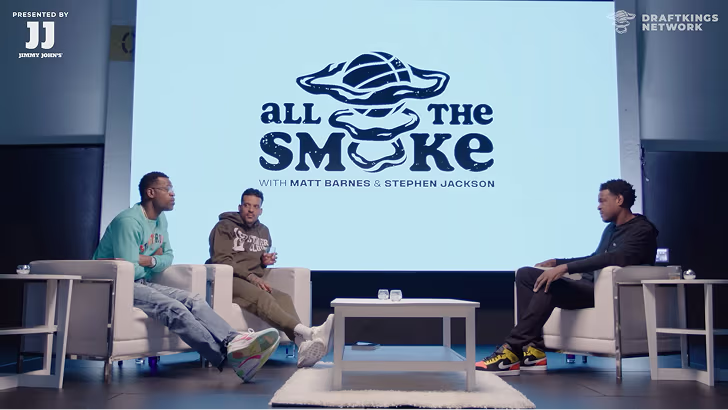
How All the Smoke makes hit compilations faster with OpusSearch

How All the Smoke makes hit compilations faster with OpusSearch

Growing a new channel to 1.5M views in 90 days without creating new videos

Growing a new channel to 1.5M views in 90 days without creating new videos

Turning old videos into new hits: How KFC Radio drives 43% more views with a new YouTube strategy

Turning old videos into new hits: How KFC Radio drives 43% more views with a new YouTube strategy

YouTube Brings AI to Smart TVs: What This Means for Video Creators in 2026

YouTube Brings AI to Smart TVs: What This Means for Video Creators in 2026
No items found.
No items found.

Boost your social media growth with OpusClip

Create and post one short video every day for your social media and grow faster.

YouTube Brings AI to Smart TVs: What This Means for Video Creators in 2026

YouTube Brings AI to Smart TVs: What This Means for Video Creators in 2026

YouTube Brings AI to Smart TVs: What This Means for Video Creators in 2026

YouTube is testing a conversational AI assistant on smart TVs, and this shift could fundamentally change how audiences discover and engage with your content. The platform's latest experiment allows viewers to ask questions about videos they're watching on the big screen, creating an interactive layer between your content and your audience.

For video creators, this isn't just another feature update. It signals YouTube's commitment to AI-enhanced viewing experiences that reward well-structured, information-rich content. Understanding what YouTube AI on smart TVs means for your strategy now will help you stay ahead as these features roll out more broadly throughout 2026.

What YouTube's TV AI Assistant Actually Does

According to TechCrunch's reporting, YouTube is bringing its conversational AI tool to the television viewing experience. Viewers can ask the assistant questions related to the video they're currently watching, getting contextual answers without leaving the content.

This represents a significant evolution from passive viewing to interactive engagement. Here's what we know about the functionality:

  • Contextual Q&A: Viewers can ask questions about topics mentioned in the video
  • Real-time assistance: The AI provides answers while the video continues playing
  • Big screen optimization: The interface is designed specifically for TV remote navigation
  • Content understanding: The AI analyzes video content to provide relevant responses

This feature builds on YouTube's existing AI experiments, including the conversational AI that launched on mobile devices. Bringing it to smart TVs acknowledges that a significant portion of YouTube viewing happens on the largest screen in the home.

Why This Matters for Content Strategy

The introduction of AI assistants that can parse and respond to questions about your videos creates new considerations for how you structure and present information.

Content Clarity Becomes Critical

When an AI assistant can answer viewer questions about your video, the clarity of your content directly impacts how well those answers serve your audience. Videos with clear explanations, well-defined segments, and logical information flow will likely perform better in this new environment.

Consider these structural elements:

  • Clear topic introductions at the start of each section
  • Explicit definitions when introducing concepts
  • Logical progression from basic to advanced information
  • Verbal signposting that helps both viewers and AI understand transitions

Metadata and Descriptions Gain Importance

AI assistants rely on multiple signals to understand video content. Your titles, descriptions, chapters, and tags all contribute to how accurately the AI can respond to viewer queries.

Strong metadata practices include:

  • Detailed video descriptions that outline key topics covered
  • Accurate chapter markers with descriptive titles
  • Tags that reflect the actual content rather than just trending terms
  • Titles that clearly communicate the video's value proposition

Long-Form Content Gets a Boost

Interactive AI features may particularly benefit longer videos. When viewers can ask questions and get immediate answers, they're more likely to stay engaged with comprehensive content rather than bouncing to find specific information elsewhere.

This creates an opportunity for creators who produce in-depth tutorials, educational content, and detailed explainers.

How to Optimize Your Videos for AI-Enhanced Viewing

Preparing your content for YouTube's AI features doesn't require a complete strategy overhaul. Instead, focus on enhancements that improve both human and AI comprehension.

Step 1: Audit Your Content Structure

Review your recent videos and assess how clearly information is organized. Can a viewer (or an AI) easily identify the main topics covered? Are transitions between sections clear?

Step 2: Implement Comprehensive Chapters

YouTube chapters aren't just navigation aids anymore. They help AI systems understand the structure and content of your videos. Create chapters for every distinct topic or section, using descriptive titles that accurately reflect the content.

Step 3: Enhance Your Descriptions

Write descriptions that serve as content summaries. Include key points covered, questions answered, and resources mentioned. This gives AI systems more context for understanding and responding to viewer queries.

Step 4: Speak Clearly and Define Terms

When recording, be explicit about what you're covering. Introduce topics clearly, define technical terms, and summarize key points. This helps both human viewers and AI systems follow your content.

Step 5: Create Supporting Short-Form Content

While long-form content may benefit from AI features, short-form clips remain essential for discovery and audience building. Tools like OpusClip can help you identify the most engaging moments from your long-form videos and transform them into optimized short clips for YouTube Shorts, TikTok, and Instagram Reels.

Step 6: Add Accurate Captions

AI systems often rely on transcripts and captions to understand video content. Ensure your videos have accurate captions, either through YouTube's auto-generation (reviewed for errors) or custom uploads. OpusClip's AI-powered captioning can help ensure accuracy while adding visual engagement to your clips.

The Repurposing Opportunity

YouTube's investment in AI-enhanced viewing creates a compelling case for content repurposing. Here's why:

Long-form content becomes more valuable: If AI features help viewers engage with longer videos, creating comprehensive content pays off more than ever.

Short-form drives discovery: YouTube Shorts and other platforms remain crucial for reaching new audiences who can then discover your long-form library.

Consistency matters: Regular posting across formats keeps you visible in an increasingly competitive landscape.

This is where strategic repurposing becomes essential. Rather than creating entirely separate content for each format, you can maximize your long-form investments by extracting high-performing clips.

OpusClip analyzes your long-form videos to identify the most compelling moments, automatically generating short clips with captions, reframing for vertical formats, and maintaining your brand consistency. This approach lets you feed both the long-form AI-enhanced experience and the short-form discovery engine without doubling your production workload.

Content TypeAI-Enhanced TV BenefitRepurposing Strategy
TutorialsViewers can ask step-by-step questionsClip individual steps as Shorts
InterviewsAI can surface specific quotes and insightsExtract key soundbites for social
ReviewsViewers can ask about specific featuresCreate feature-focused clips
EducationalInteractive learning experienceBreak into topic-specific segments
VlogsContext about locations, products mentionedHighlight memorable moments

Common Mistakes to Avoid

As you adapt to AI-enhanced viewing, watch out for these pitfalls:

  • Keyword stuffing descriptions: Write for humans first. AI systems are sophisticated enough to understand natural language, and stuffed descriptions hurt viewer trust.
  • Ignoring chapters: Skipping chapter markers means missing an easy optimization that helps both viewers and AI understand your content.
  • Inconsistent terminology: Using different terms for the same concept confuses both human viewers and AI systems trying to parse your content.
  • Neglecting short-form: Even as long-form gains AI advantages, short-form remains essential for discovery. Don't abandon your Shorts strategy.
  • Over-optimizing for AI: Remember that humans are still your primary audience. Content that feels robotic or overly structured for machines will lose viewer engagement.
  • Forgetting accessibility: Accurate captions help AI understand your content while also serving viewers who need them. It's a win-win you shouldn't skip.

What This Signals About YouTube's Direction

YouTube's TV AI experiment is part of a broader pattern. The platform has been steadily integrating AI features, from Dream Screen backgrounds for Shorts to AI-generated video summaries. Each addition points toward a future where AI mediates more of the viewing experience.

For creators, this means:

  • Quality signals matter more: AI systems can assess content quality in ways that go beyond simple metrics
  • Structured content wins: Well-organized videos are easier for AI to parse and recommend
  • Multi-format presence is essential: You need to show up in both AI-enhanced long-form and discovery-focused short-form
  • Authenticity remains valuable: AI can help viewers find content, but human connection keeps them engaged

Key Takeaways

  • YouTube is testing conversational AI on smart TVs, allowing viewers to ask questions about videos they're watching
  • This feature rewards well-structured, clearly organized content with accurate metadata
  • Long-form content may benefit as AI helps viewers engage with comprehensive videos
  • Short-form content remains essential for discovery and audience building
  • Repurposing long-form videos into short clips lets you serve both formats efficiently
  • OpusClip can help you extract engaging clips from long-form content with AI-powered captioning and reframing
  • Focus on clarity, chapters, and accurate descriptions to optimize for AI-enhanced viewing
  • Don't over-optimize for AI at the expense of human viewer experience

Frequently Asked Questions

How does YouTube's AI assistant on smart TVs affect video discoverability?

YouTube's TV AI assistant primarily enhances the viewing experience rather than initial discovery. However, videos that perform well with the AI assistant (keeping viewers engaged longer, answering their questions effectively) may see improved algorithmic recommendations. To benefit, focus on clear content structure, accurate chapters, and comprehensive descriptions. Using OpusClip to create short-form clips from your long-form content helps with discovery on YouTube Shorts, driving viewers to your full videos where AI features can enhance their experience.

Should I change my content format because of YouTube's AI TV features?

You don't need to overhaul your content format, but refinements can help. Focus on clearer topic introductions, explicit definitions of terms, and logical information flow. These changes improve both human comprehension and AI parsing. If you create long-form content, consider using OpusClip to identify and extract the most engaging segments for short-form distribution. This dual approach lets you benefit from AI-enhanced long-form viewing while maintaining discovery through Shorts.

Will YouTube's AI features make short-form content less important?

Short-form content remains crucial even as AI enhances long-form viewing. Shorts drive discovery, attract new subscribers, and keep your channel active in the algorithm. The smart strategy is creating comprehensive long-form content optimized for AI features while repurposing key moments into Shorts. OpusClip's AI can analyze your long-form videos to identify viral-worthy clips, automatically adding captions and reframing for vertical formats, so you can maintain a strong presence in both formats without doubling your workload.

How can I tell if my videos are well-structured for AI parsing?

Test your content structure by asking: Can someone understand the main topics from your chapter titles alone? Does your description accurately summarize key points covered? Are technical terms defined when introduced? If you answered no to any of these, there's room for improvement. OpusClip can also help you identify which segments of your videos resonate most with viewers, giving you insights into what content works best and should be emphasized in future videos.

What role do captions play in YouTube's AI-enhanced viewing?

Captions provide AI systems with text-based understanding of your video content, making them essential for AI features. Accurate captions help the AI assistant respond correctly to viewer questions. YouTube's auto-captions have improved but still contain errors, especially with technical terms or accents. Review and correct auto-generated captions, or use tools like OpusClip that provide AI-powered captioning with higher accuracy. Good captions also improve accessibility and viewer retention, making them valuable beyond just AI optimization.

How should I balance optimizing for AI versus creating authentic content?

Authenticity should always come first. AI optimization and authentic content aren't mutually exclusive. Clear explanations, logical structure, and accurate metadata help both AI systems and human viewers. The key is making improvements that serve your audience while also being AI-friendly. Avoid robotic delivery or unnatural keyword insertion. Use OpusClip to identify which authentic moments from your videos perform best, then create more content in that style. The goal is content that resonates with humans and happens to be well-structured for AI.

What to Do Next

YouTube's AI features on smart TVs represent the platform's continued investment in AI-enhanced experiences. Creators who prepare now by improving content structure, metadata, and multi-format presence will be positioned to benefit as these features expand.

Start by auditing your recent videos for clarity and structure, then establish a consistent repurposing workflow. If you want to efficiently transform your long-form content into optimized short clips with AI-powered captions and reframing, try OpusClip at opus.pro to streamline your multi-format strategy.

Ready to start streaming differently?

Opus is completely FREE for one year for all private beta users. You can get access to all our premium features during this period. We also offer free support for production, studio design, and content repurposing to help you grow.
Join the beta
Limited spots remaining

Try OPUS today

Try Opus Studio

Make your live stream your Magnum Opus